

Published in connection with Valencia Half Marathon 2026 | October 25
The first few kilometers of a half marathon can feel surprisingly comfortable. Your legs are fresh, the crowd is moving, and the pace you planned to hold may seem slower than expected. It is tempting to accelerate while running still feels easy. But a comfortable start leaves one important question unanswered: will that same speed remain manageable when most of the race is behind you?
The Valencia Half Marathon Trinidad Alfonso Zurich returned on October 25, 2026, for its 35th edition. The 21.0975-kilometer event is known for fast performances, but its field also includes runners with widely different finishing goals and experience levels. It offers a useful occasion to examine how runners distribute their effort across a race, and why an early increase in speed deserves careful consideration.1
What Race Splits Reveal
Pacing describes how running speed changes across a race. An even pace keeps speed relatively stable. A positive split means completing the second half more slowly than the first, while a negative split means running the second half faster. These terms describe the resulting pattern, not necessarily the strategy a runner intended to follow.2
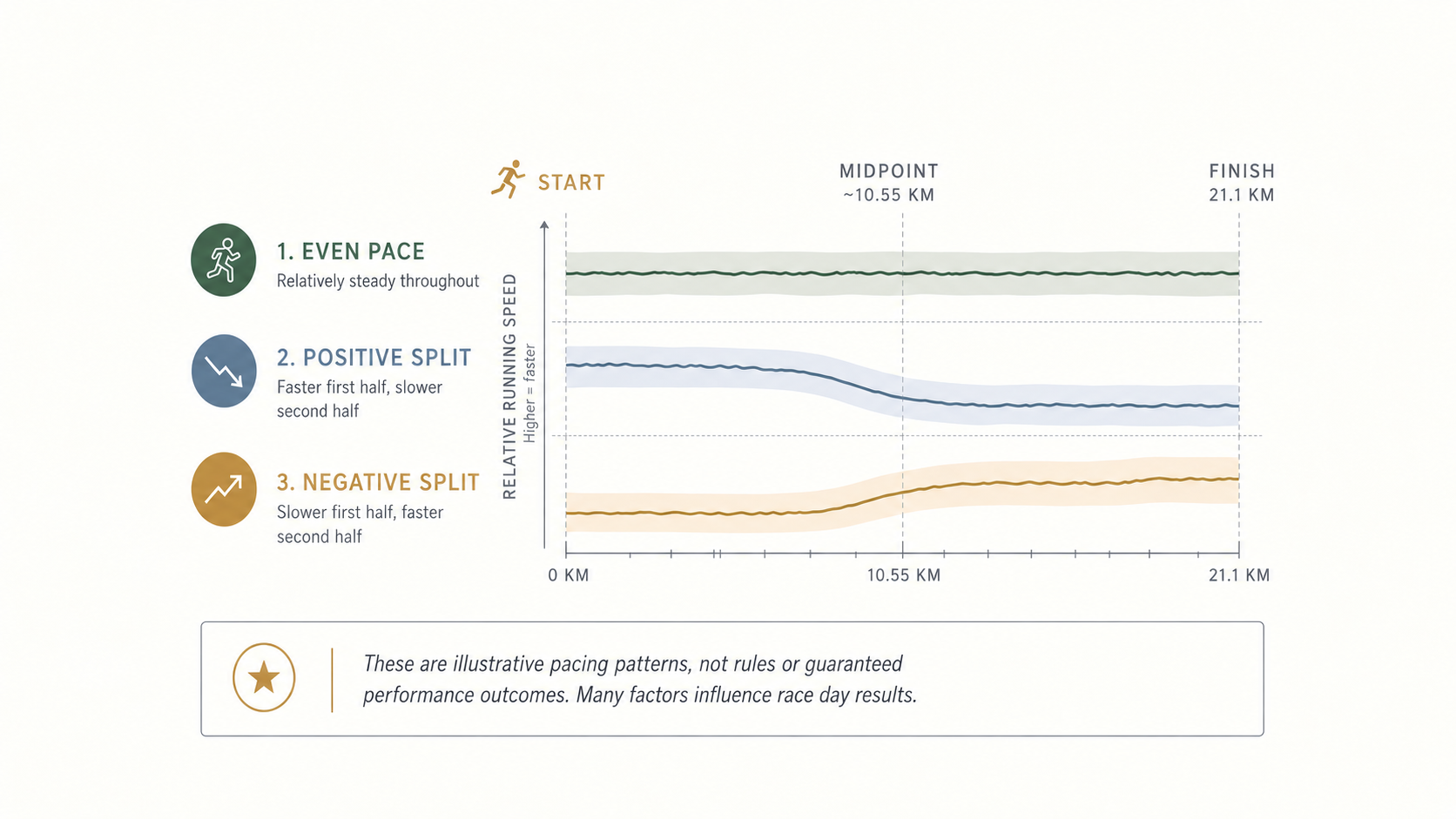
Race results offer a way to examine those patterns across large groups of runners.
A study of the 2017 Vienna races analyzed split times from 11,440 half-marathon finishers and 6,085 marathon finishers. The researchers found that half-marathon participants generally maintained more consistent speeds than marathon participants. In the half marathon, the average absolute change in speed across race segments was 3.60% for men and 3.36% for women. The corresponding values in the marathon were 5.46% and 4.12%. These percentages describe variation observed in those races; they are not recommended limits on how much an individual runner's speed should change.3
A 2026 narrative review published in Medicina synthesized findings from 37 studies of half-marathon and marathon pacing. Overall, the evidence suggested that half-marathon pacing tended to be more even than marathon pacing. Faster runners generally showed less variation in speed, while slower runners more often experienced pronounced slowing as races progressed. The review also identified an important limitation: evidence specifically examining half-marathon pacing is less extensive than the research on marathons. Its findings describe tendencies across studied populations rather than a pacing formula that has been experimentally shown to work best for everyone. A runner's finishing time and pace distribution are related, but a consistent pace may also reflect differences in fitness, preparation, and race experience.2
The Trouble With Trying to Bank Time
Starting faster than planned can seem like a way to build a cushion for the final kilometers. If a runner gains time early, the reasoning goes, there will be something to spare if the pace becomes harder to maintain.
The difficulty is that time gained during the opening kilometers cannot be considered independently of what happens afterward. A 2018 study published in Big Data examined 120,472 race results covering 10K, half-marathon, and marathon events organized by the Boston Athletic Association. The researchers analyzed patterns in runners' split times and their relationships with performance, accounting for characteristics such as race distance, age, and sex. The analysis identified pacing characteristics associated with better finishing performances. However, the researchers examined recorded race results rather than assigning runners to different starting strategies. The findings therefore cannot establish whether deliberately running faster or slower at the beginning would have improved the same runner's finishing time.4
That distinction matters when interpreting a fast start followed by substantial slowing. The opening speed may have been difficult to sustain, but split times alone cannot reveal precisely why a runner slowed. Fitness, preparation, course conditions, accumulated fatigue, and decisions made during the race may all contribute to the final pacing pattern. The evidence gives runners reason to be cautious about deliberately banking time, without proving that every faster-than-planned opening will lead to a worse result.2,4
Why Feeling Comfortable Is Not a Complete Pacing Plan?
How hard running feels can change considerably as a race progresses, even when a runner is trying to maintain a similar speed.
A 2008 study published in Psychophysiology examined perceived exertion during competitive running. Nine participants completed both a seven-mile road race and a half marathon, with researchers recording heart rate, mile splits, and ratings of perceived exertion. Perceived exertion increased during the races. Although the rate of increase differed between the two events when examined against elapsed time, the patterns were more similar when expressed relative to the proportion of race time completed.5
The study was small, and its findings should not be treated as a precise prediction of how effort will develop for every runner. It nevertheless illustrates a limitation of judging a race pace solely by how demanding it feels at one moment. A pace that feels controlled near the start may become increasingly demanding later. Early comfort is useful feedback, but it does not establish whether a faster pace can be maintained across the remaining distance. This is especially relevant when the temptation to accelerate comes from the absence of fatigue rather than from a reasoned assessment of the pace a runner can sustain.2,5
What a Sensible Race Plan Can Look Like
For someone approaching a half marathon with a finishing-time goal, recent training and previous race experience can provide a more useful starting point than the excitement of the opening kilometers.
The 2026 pacing review suggests that runners may benefit from considering controlled early pacing and avoiding an excessively fast start. These are tentative, evidence-informed considerations drawn largely from observed race patterns, not experimentally established rules for an ideal pacing strategy.2
A practical approach is to begin at a pace that appears realistic for the full race distance, then interpret how the effort develops rather than making large adjustments in response to the first few easy kilometers. That does not require holding exactly the same speed at every checkpoint. Course conditions and weather can change both running speed and the effort required to maintain it. Small variations do not necessarily mean the pacing plan has failed.2
It is also worth distinguishing between maintaining control and deliberately aiming for a negative split. More even or slightly negative pacing has generally been associated with favorable performances in long-distance running research. Yet the strength of that evidence differs by race distance and performance level, and an observed association does not demonstrate that a negative split is the best strategy for every half-marathon runner.2
A faster final section may reflect a runner's remaining capacity, race circumstances, or an intentional acceleration. It does not automatically prove that the opening pace was optimal. For recreational runners, the more defensible principle is to use training experience to choose a plausible starting pace, avoid unnecessary early acceleration, and allow the plan to respond to conditions rather than chasing a predetermined split pattern.2
The Decision That Starts Before the Finish Line
The Valencia Half Marathon brings together runners capable of very different finishing times. The pacing patterns of elite competitors can be interesting to observe, but they are not automatically suitable models for someone whose training history, experience, or goals are different.1,2
The first kilometers offer a chance to settle into a planned effort and assess how it feels. They are not enough to establish how comfortably that effort can be sustained for the full 21.1 kilometers. A half marathon rewards more than the ability to run quickly while fresh. For a runner tempted to speed up early, the more useful consideration is whether the faster pace still fits the race they prepared to run. The opening kilometers are only the beginning of that answer.



Join the discussion
No account or email is required. Your display name and comment will be public.