
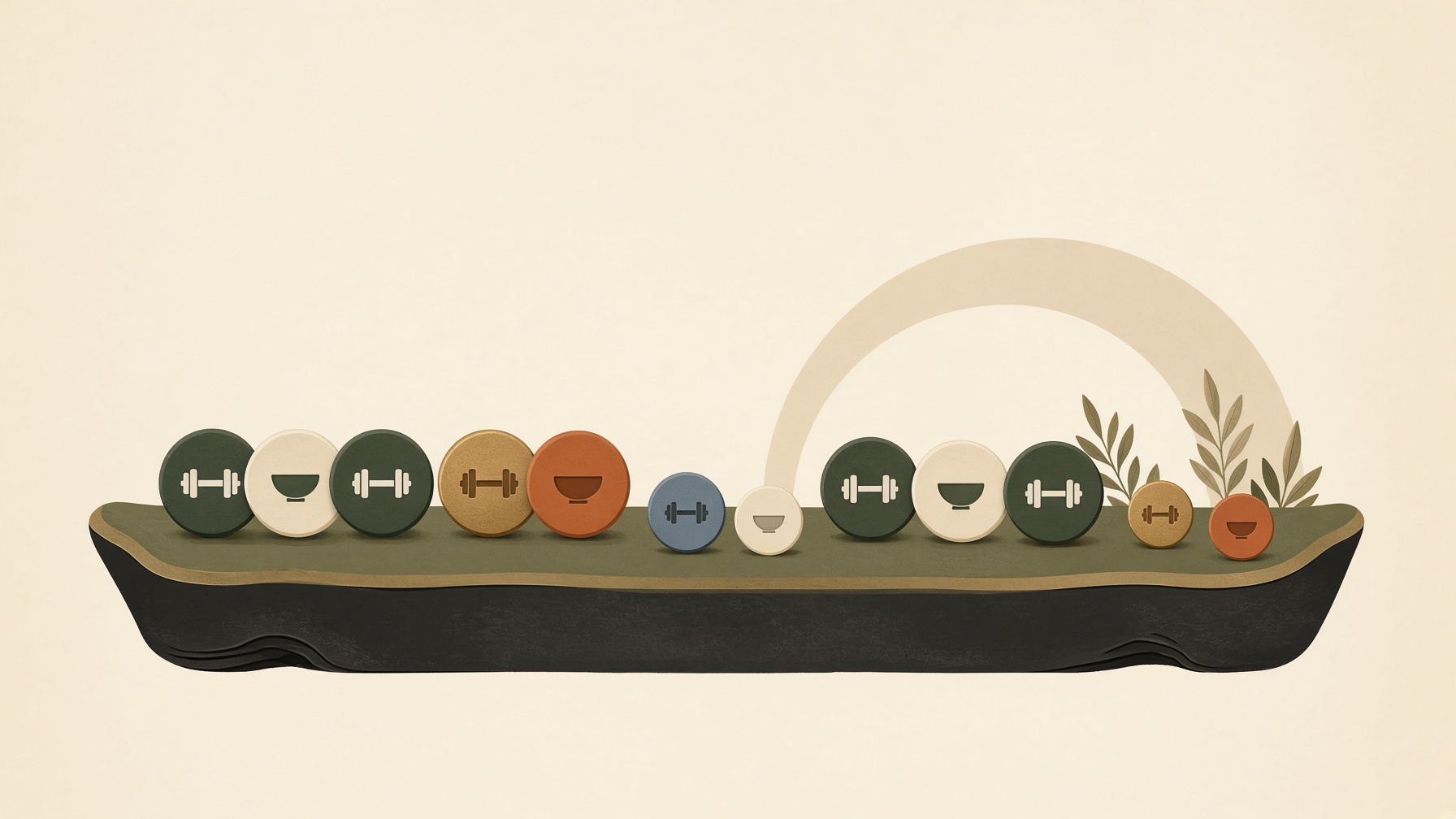
Missed a Few Days? Your Routine Isn’t Necessarily Back to Square One
Lapse and relapse describe different patterns of behavior change, but research offers no fixed number of missed days that separates the two.
Wikis
Environmental and social cues can prompt learned responses when recurring situations become linked to a behavior through repeated experience.
Environmental and social cues are features of a person’s context that can signal, prompt, or trigger a behavior. In habit research, cues are especially important because repeated performance in recurring contexts can create learned associations between a cue and a response, allowing the response to be initiated with less deliberate decision-making .1
Environmental cues can include locations, objects, times, preceding actions, or other recurring features of a situation. Social cues can include the presence or behavior of particular people, social settings, or interactions that reliably accompany an action. What functions as a cue is specific to the learned behavior and person; the same physical or social feature may be irrelevant in another context .1
A cue is not the same as a motive or goal. A person may still value an outcome or hold an intention, while a familiar context helps determine when a well-learned behavior is activated. Stable contexts can also support habit formation: research has found that repeating a behavior under more stable contextual conditions is associated with greater increases in automaticity. Cues are therefore best understood as contextual signals that can acquire control over behavior through learning, rather than as causes that mechanically produce the same response every time .2
From this collection
Lapse and relapse describe different patterns of behavior change, but research offers no fixed number of missed days that separates the two.