
What “Good” and “Bad” Cholesterol Mean
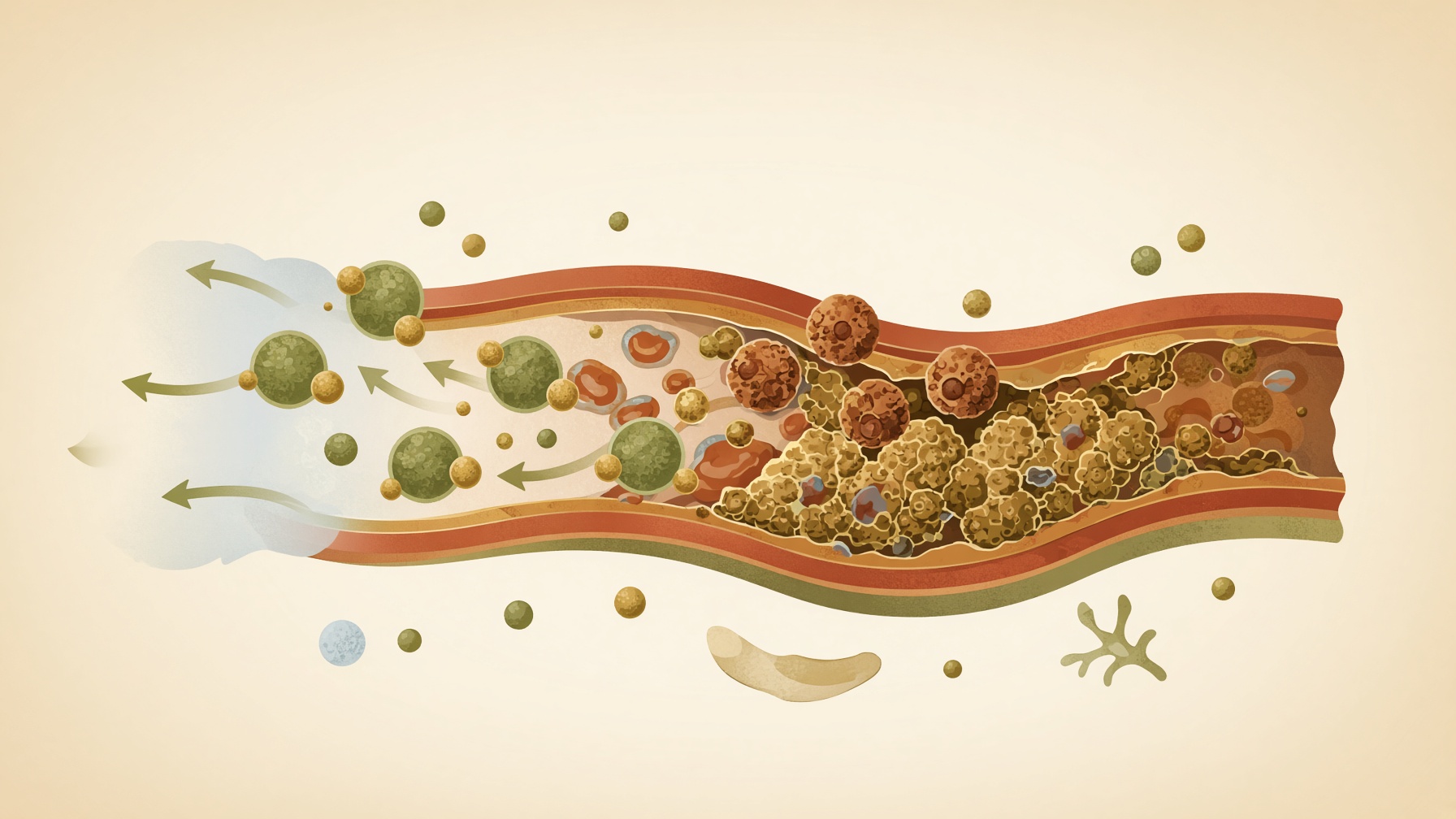
LDL and HDL carry the same cholesterol in different particles, whose behavior matters more for health than the familiar good and bad labels.
Wikis
HDL, or high-density lipoprotein, is a class of lipoprotein particles that transports cholesterol and other lipids through the blood. HDL particles are relatively small and dense compared with triglyceride-rich lipoproteins and contain a mixture of phospholipids, cholesterol, triglycerides, and proteins. Apolipoprotein A-I (apoA-I) is their major structural protein .1,2
HDL particles are continuously formed, remodeled, and cleared rather than existing as one uniform particle type. Lipid-poor apoA-I acquires phospholipids and cholesterol from cells, producing developing HDL particles. Cholesterol carried by HDL can be esterified and moved into the particle's core as HDL matures. HDL can subsequently transfer cholesteryl esters to other lipoproteins or carry cholesterol toward the liver through several pathways .1,2
HDL participates in reverse cholesterol transport, a set of processes through which cholesterol can move from peripheral cells, including macrophages, toward the liver for further processing. An early step involves cholesterol efflux from cells to apoA-I or HDL. HDL particles also carry numerous proteins and lipids with other biological functions, so HDL cannot be understood simply as a container for cholesterol .1,2
HDL is distinct from HDL cholesterol (HDL-C). HDL refers to the lipoprotein particles themselves, whereas HDL-C is the amount of cholesterol contained within HDL particles in a blood sample. Although higher HDL-C has historically been associated with lower cardiovascular risk in observational studies, HDL-C does not directly measure HDL particle number, cholesterol-efflux capacity, or reverse cholesterol transport. Calling HDL-C simply “good cholesterol” therefore obscures the biological complexity of HDL .2
From this collection
LDL and HDL carry the same cholesterol in different particles, whose behavior matters more for health than the familiar good and bad labels.