
What “Good” and “Bad” Cholesterol Mean
LDL and HDL carry the same cholesterol in different particles, whose behavior matters more for health than the familiar good and bad labels.
Wikis
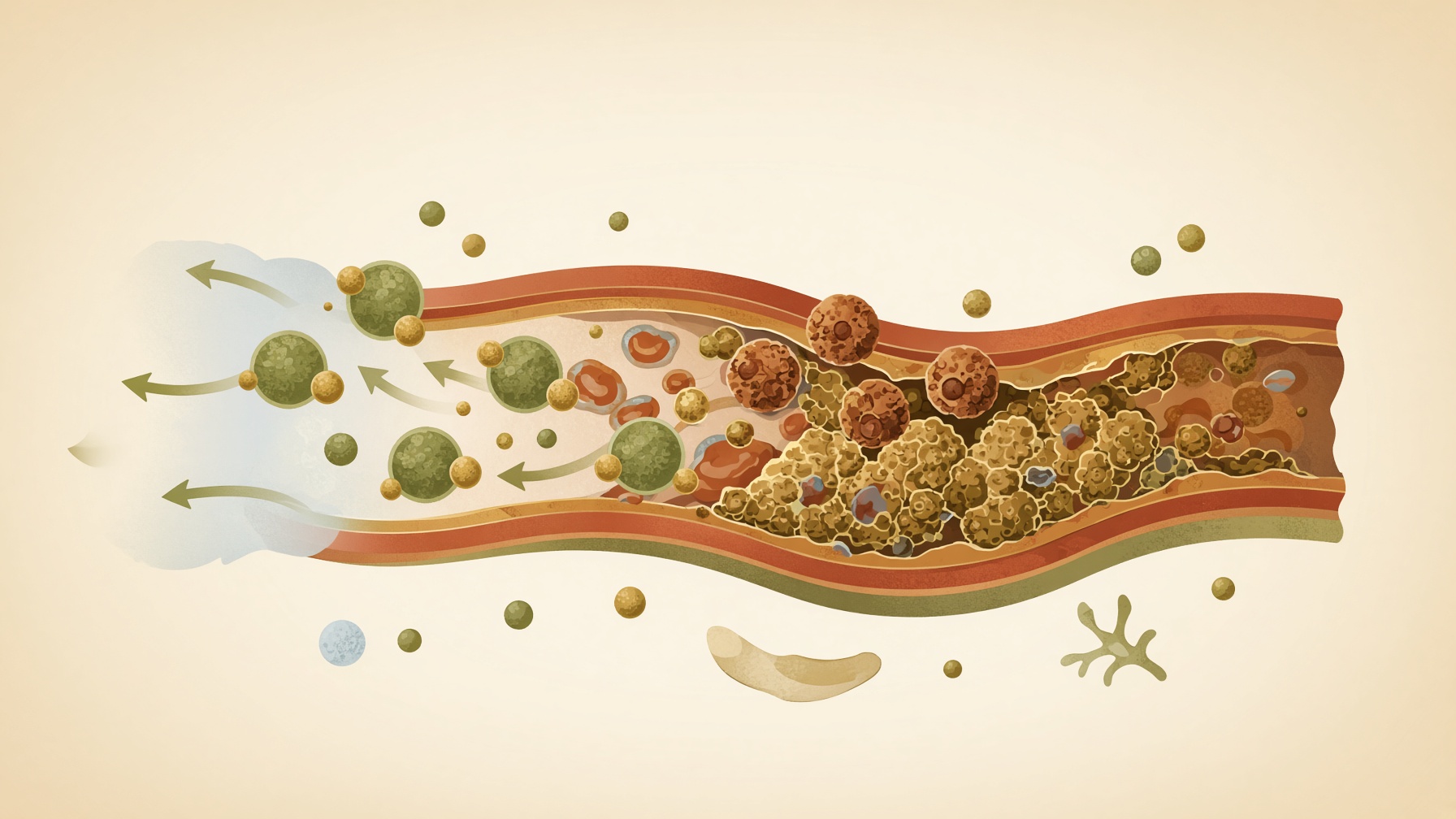
Reverse cholesterol transport (RCT) is the set of processes that moves excess cholesterol from peripheral tissues toward the liver and facilitates its eventual elimination from the body. It is particularly relevant to macrophages, which can accumulate cholesterol after taking up lipoproteins in tissues such as the arterial wall. High-density lipoproteins (HDL) and their major protein, apolipoprotein A-I (apoA-I), play central roles in the classical RCT pathway .1,2
A key early step is cholesterol efflux, in which cells transfer unesterified cholesterol to lipid-poor apoA-I or HDL particles. Membrane transporters including ABCA1 and ABCG1 contribute to this transfer, with ABCA1 acting particularly in cholesterol transfer to lipid-poor apoA-I and ABCG1 promoting transfer to HDL. Within HDL, the enzyme lecithin-cholesterol acyltransferase (LCAT) can convert free cholesterol into cholesteryl esters, which move into the particle's core as HDL is remodeled .1
HDL-associated cholesterol can reach the liver by more than one route. The hepatic receptor SR-BI can facilitate selective uptake of cholesterol from HDL. In humans, cholesteryl ester transfer protein (CETP) can also transfer cholesteryl esters from HDL to apoB-containing lipoproteins, which can subsequently be taken up by the liver. Hepatic cholesterol can then be secreted into bile or converted into bile acids, providing routes toward intestinal and fecal elimination .1
Reverse cholesterol transport is not the same as HDL-C concentration. HDL-C measures how much cholesterol is present within HDL particles at a particular time, whereas RCT describes the movement, or flux, of cholesterol through multiple biological steps. A high HDL-C value therefore does not necessarily indicate more efficient reverse cholesterol transport .1,2
From this collection
LDL and HDL carry the same cholesterol in different particles, whose behavior matters more for health than the familiar good and bad labels.