
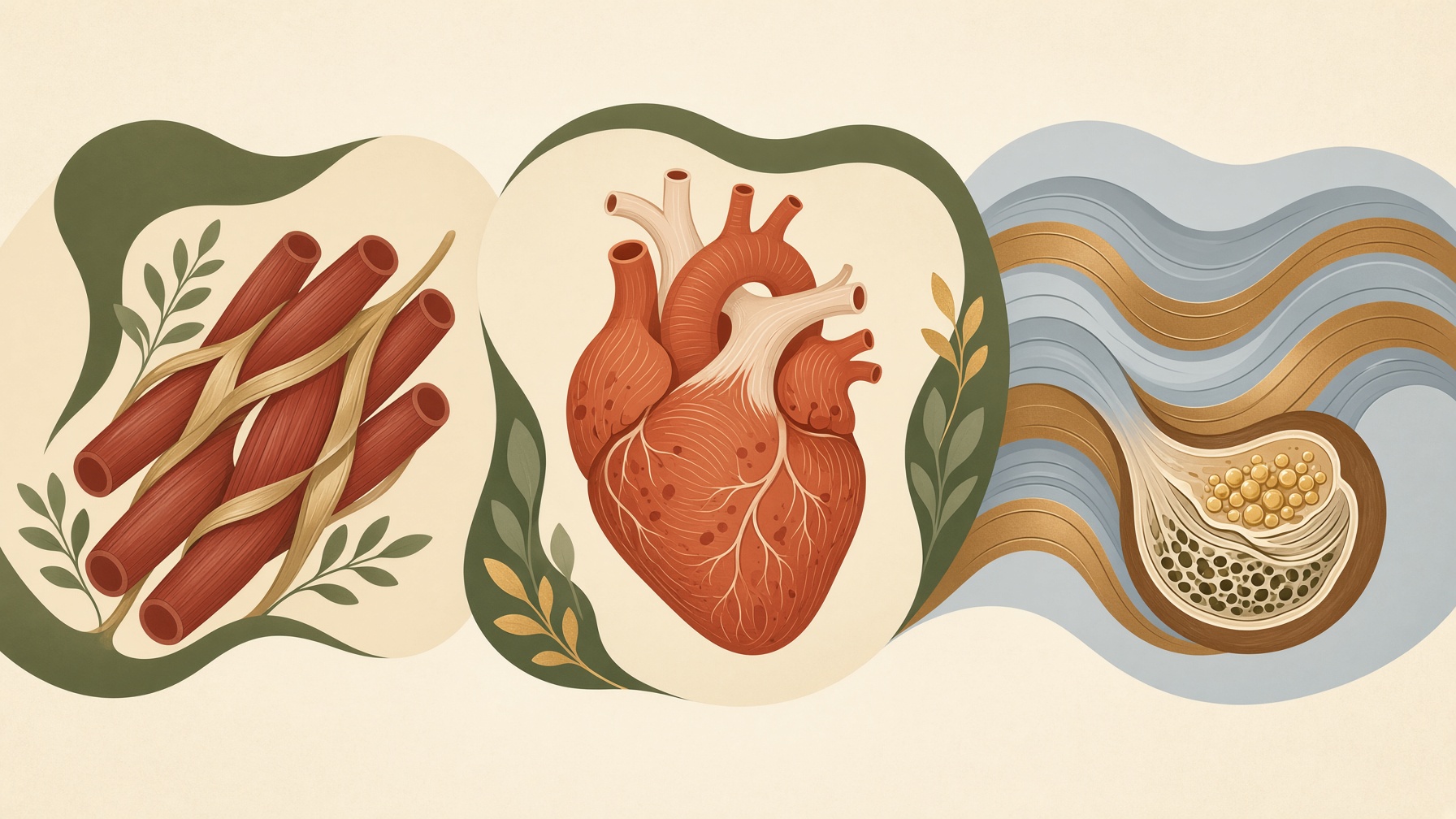
What Makes Skeletal, Cardiac, and Smooth Muscle Different?
Skeletal, cardiac, and smooth muscle share the ability to contract, but differences in cell structure and control suit each to different tasks.
Wikis
Striated muscle is muscle tissue that has a striped appearance under a microscope because its contractile proteins are arranged in highly ordered, repeating units called sarcomeres. In humans, skeletal muscle and cardiac muscle are both striated. Smooth muscle is not, because its actin and myosin filaments are not organized into sarcomeres .1,2
Within striated muscle cells, sarcomeres are arranged end to end within structures called myofibrils. Each sarcomere contains overlapping thin filaments, composed mainly of actin, and thick filaments, composed mainly of myosin. Their regular arrangement produces alternating light and dark bands that create the visible striations. During contraction, interactions between actin and myosin generate force and, when mechanical conditions allow shortening, reduce sarcomere length .1,2
Although skeletal and cardiac muscle share this basic striated organization, they are distinct tissues. Skeletal muscle is composed of long, typically multinucleated muscle fibers and is generally controlled through somatic motor neurons. Cardiac muscle consists of shorter, branching cardiomyocytes joined by intercalated discs, which provide mechanical connections and electrical coupling between neighboring cells .1,2
The term striated muscle therefore describes a structural category rather than a single muscle type. Its defining feature is the organized sarcomere-based arrangement of contractile proteins shared by skeletal and cardiac muscle, despite major differences in their cellular structure, control, and physiological roles .1,2
From this collection
Skeletal, cardiac, and smooth muscle share the ability to contract, but differences in cell structure and control suit each to different tasks.