
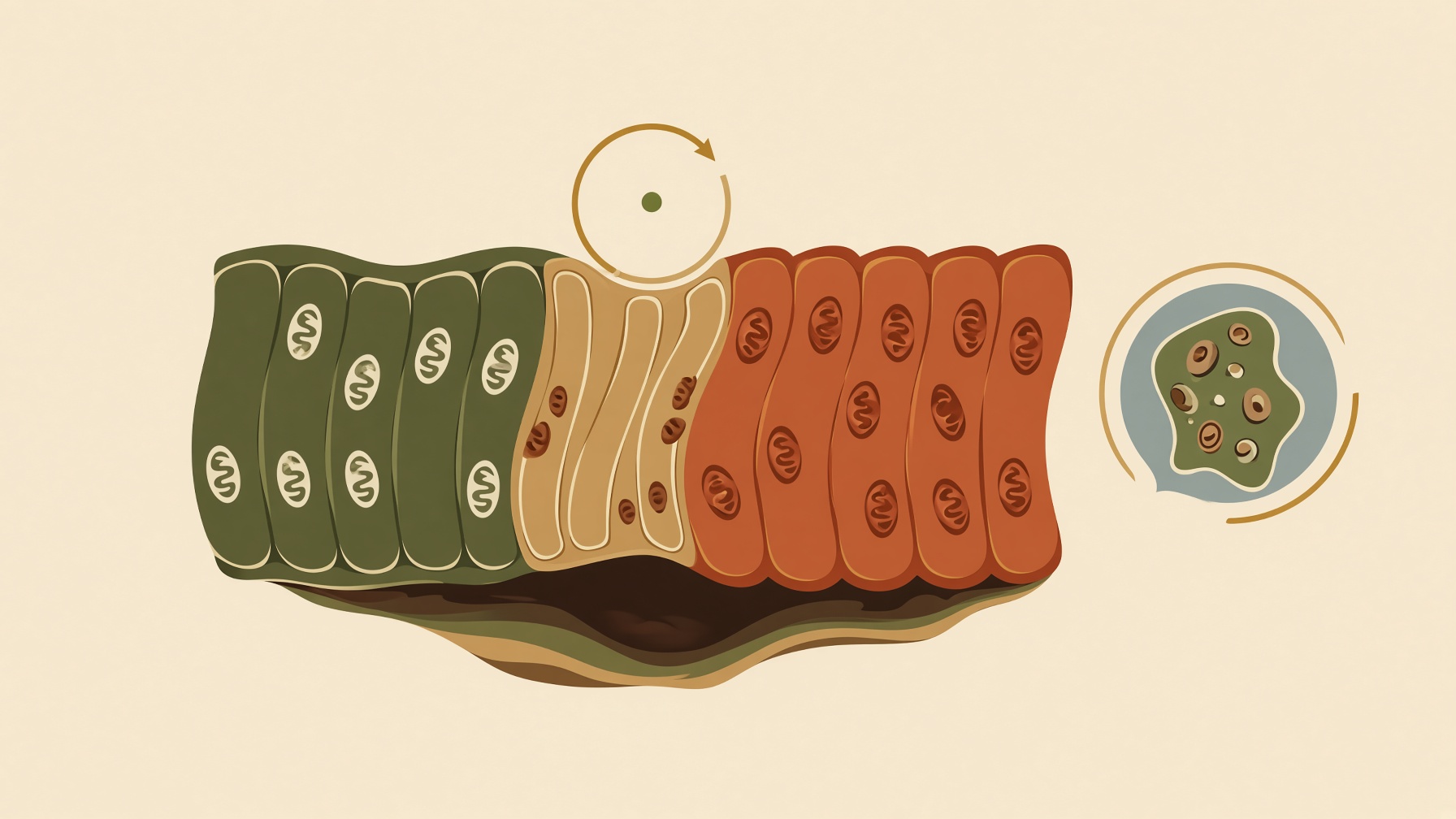
Muscle fibers are often described as though their type tells the whole story. But if a fiber becomes larger, stronger, or better suited to repeated work after training, does that necessarily mean it has become a different type?
In human skeletal muscle, Type I, Type IIa, and Type IIx classifications largely reflect which myosin heavy-chain isoforms a fiber expresses. Some fibers express more than one isoform and are classified as hybrids. This system captures an important part of muscle phenotype, but it does not describe every structural, metabolic, or functional property of the fiber.1,2
That leaves room for substantial adaptation within a fiber-type category. Training can alter characteristics such as fiber size and the expression of proteins involved in metabolism and other cellular functions without every change amounting to a new myosin-based classification. Modern proteomic work also shows meaningful variation among fibers assigned to the same broad type.2,3
Fiber-type transitions can still occur. With traditional resistance training, one of the more consistently observed patterns is a shift away from Type IIx and IIa/IIx hybrid expression toward Type IIa. That pattern does not support the simple idea that strength training continually makes muscle “faster” by converting fibers into Type IIx.2,5
Transitions involving Type I and Type IIa have also been reported, but their direction and magnitude are less predictable. Results vary with the training program, the population being studied, and the method used to identify fiber types. Long-term evidence is also more limited, so training should not be treated as a precise switch for converting a chosen proportion of fibers from one category to another.2,5
Hybrid fibers make the picture more complicated than movement between three separate boxes. A fiber can express both Type IIa and Type IIx myosin, for example, and methods that reduce the muscle to counts of only “pure” types can miss part of that transition. Fiber-type change is therefore better understood as a shift in phenotype than as every fiber simply jumping from one fixed category to another.1,2
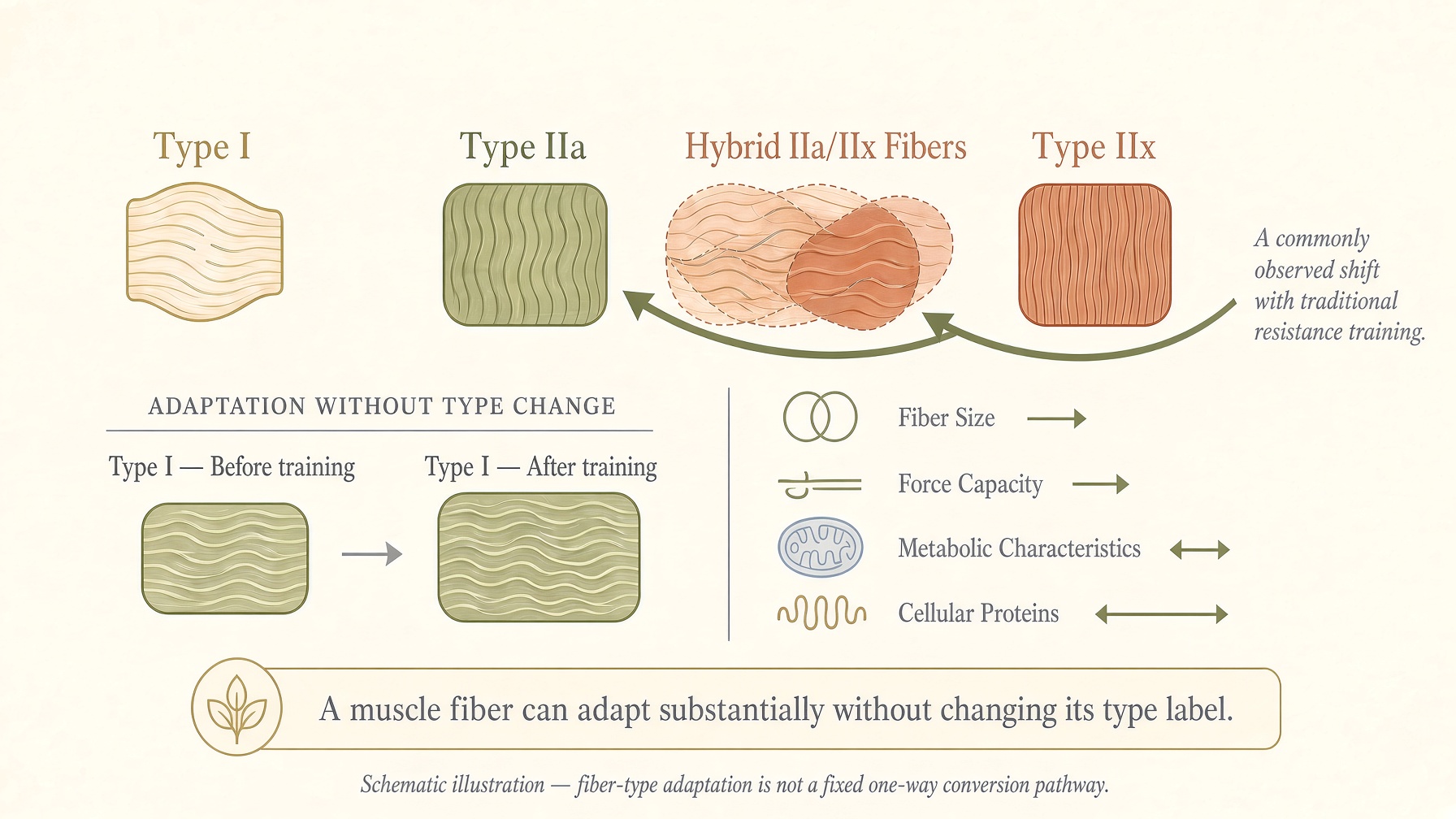
Mechanical performance can change within fibers that are still classified under the same type after training. In a small study of eight men, eight weeks of maximal-effort stretch-shortening-cycle training was followed by greater cross-sectional area, peak force, and maximal shortening velocity in sampled Type I fibers. Because muscle biopsies before and after training sample different individual fibers, the study did not track the exact same fiber through the entire intervention. It nevertheless shows that improved mechanical properties can be observed among fibers that remain classified as Type I after training.4
Starting fiber-type proportions also differ between people for reasons that include inherited and environmental influences. Genetic influence does not make muscle phenotype fixed, while evidence of training-related plasticity does not imply complete control over the final distribution of fiber types.2,6
A fiber-type label is useful, but it is not a complete biography of the fiber. Training can change a great deal about how muscle looks and performs without every adaptation requiring a new label.
Join the discussion
No account or email is required. Your display name and comment will be public.