
How Are the Tiny Filaments Inside Your Muscles Arranged?
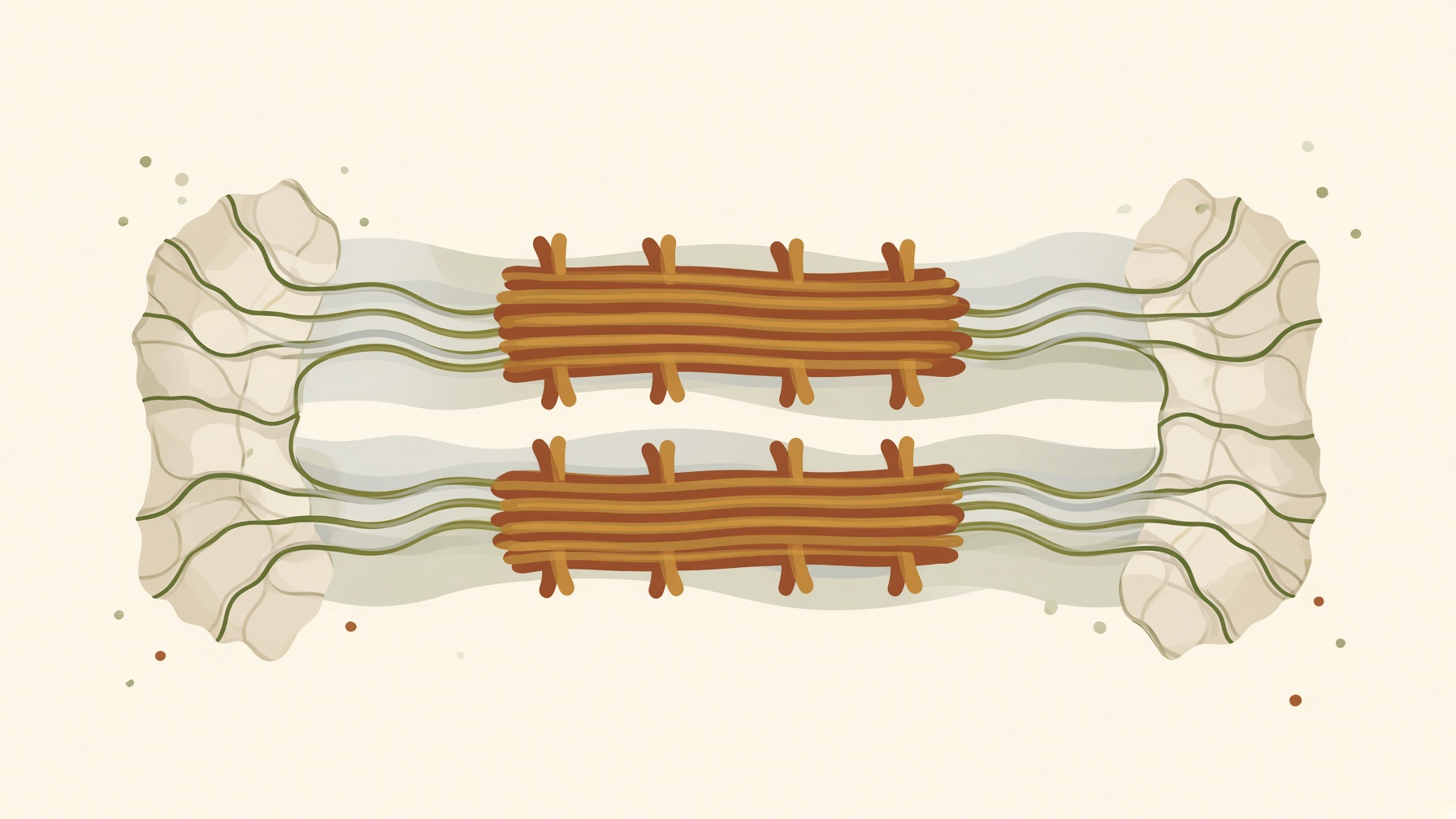
Sarcomeres shorten as thin filaments slide alongside thick filaments, increasing overlap without reducing the length of the filaments themselves.
Wikis
The A band is the region of a sarcomere that spans the full length of the thick, myosin-containing filaments in striated muscle. It lies near the center of each sarcomere and appears darker than the neighboring I bands in typical microscopic images. The name comes from its anisotropic optical properties, which contributed to the characteristic alternating band pattern observed in muscle fibers .1,2
Most of the A band contains thick filaments together with portions of the thin, actin-containing filaments that overlap them. At its center is the H zone, where thick filaments are present without overlapping thin filaments when the degree of filament overlap permits. The M-line lies in the middle of this region and helps organize the thick filaments at the center of the sarcomere .1,2
The A band is defined by the length of the thick filaments rather than simply by the region where actin and myosin overlap. This distinction becomes important during sarcomere shortening. As thin filaments slide farther between the thick filaments, their overlap increases, but the thick filaments themselves do not appreciably shorten. Consequently, the width of the A band remains essentially constant while regions such as the I band and H zone become narrower .1
The A band therefore differs from the I band, which contains portions of thin filaments that do not overlap thick filaments. Together, these regularly arranged regions contribute to the striated appearance of skeletal and cardiac muscle .1,2
From this collection
Sarcomeres shorten as thin filaments slide alongside thick filaments, increasing overlap without reducing the length of the filaments themselves.