
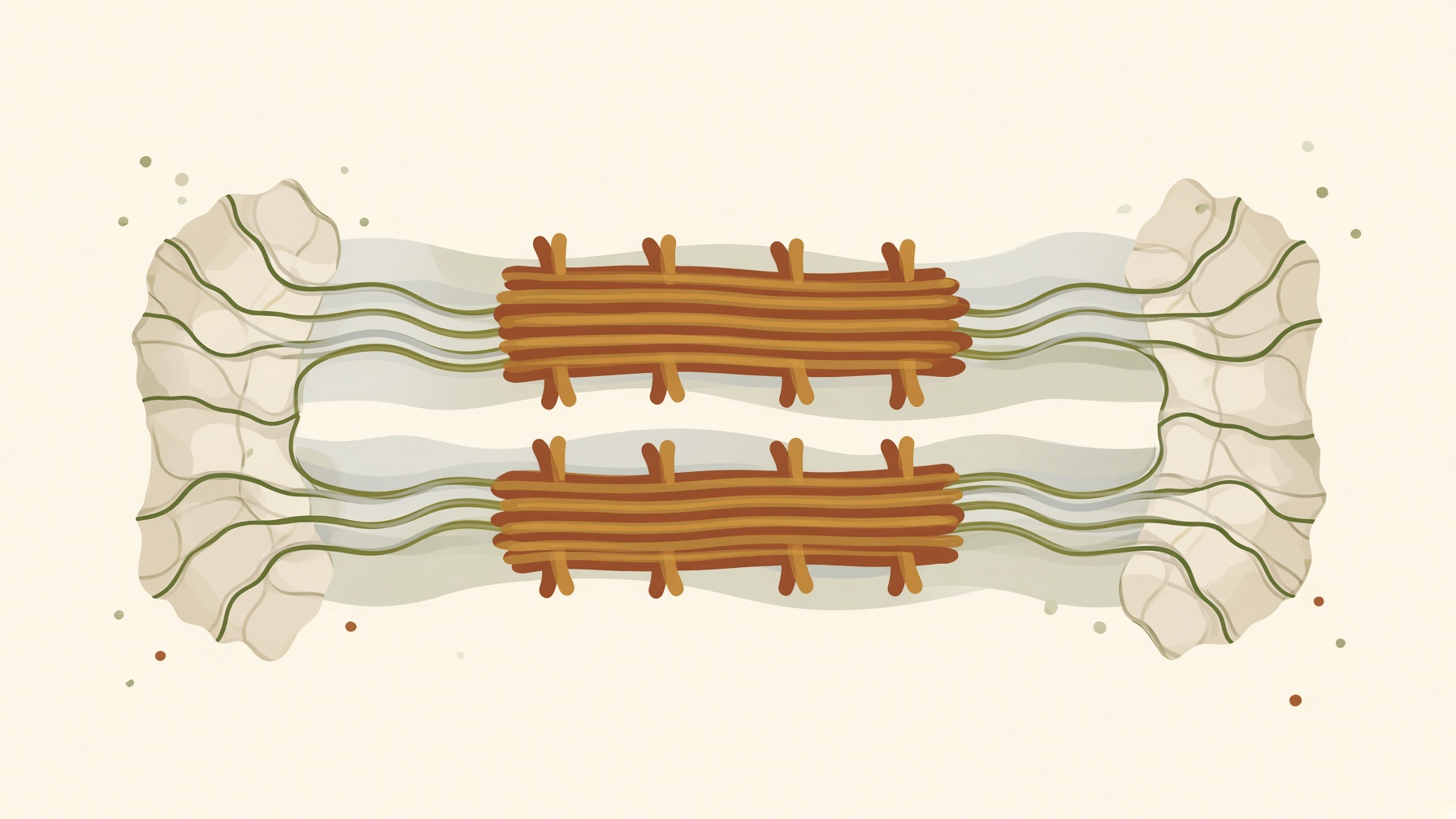
Inside skeletal muscle, the sarcomere follows a surprisingly orderly layout. Thin and thick filaments occupy different positions between two Z-discs, and those positions give rise to the bands, zones, and lines used to describe its structure.
The sarcomere is the fundamental contractile unit of a skeletal-muscle fiber. Each sarcomere is bounded by Z-discs. These boundaries provide the basic frame for understanding the rest of its structure, marking where one sarcomere begins and ends .1
Within those boundaries, the two major filament systems have opposing spatial arrangements. Actin-based thin filaments extend inward from the Z-discs toward the center of the sarcomere. Myosin-based thick filaments, by contrast, are centered within the sarcomere and extend outward toward the Z-discs without reaching them .1
That arrangement creates the main regions used to describe a sarcomere. The A band contains the thick filaments and also includes areas where thick and thin filaments overlap. At the center of the A band is the H zone, which contains thick filaments but no thin filaments. The M-line lies in the center of the H zone and bisects the A band. The I band, meanwhile, contains thin filaments but no thick filaments .1
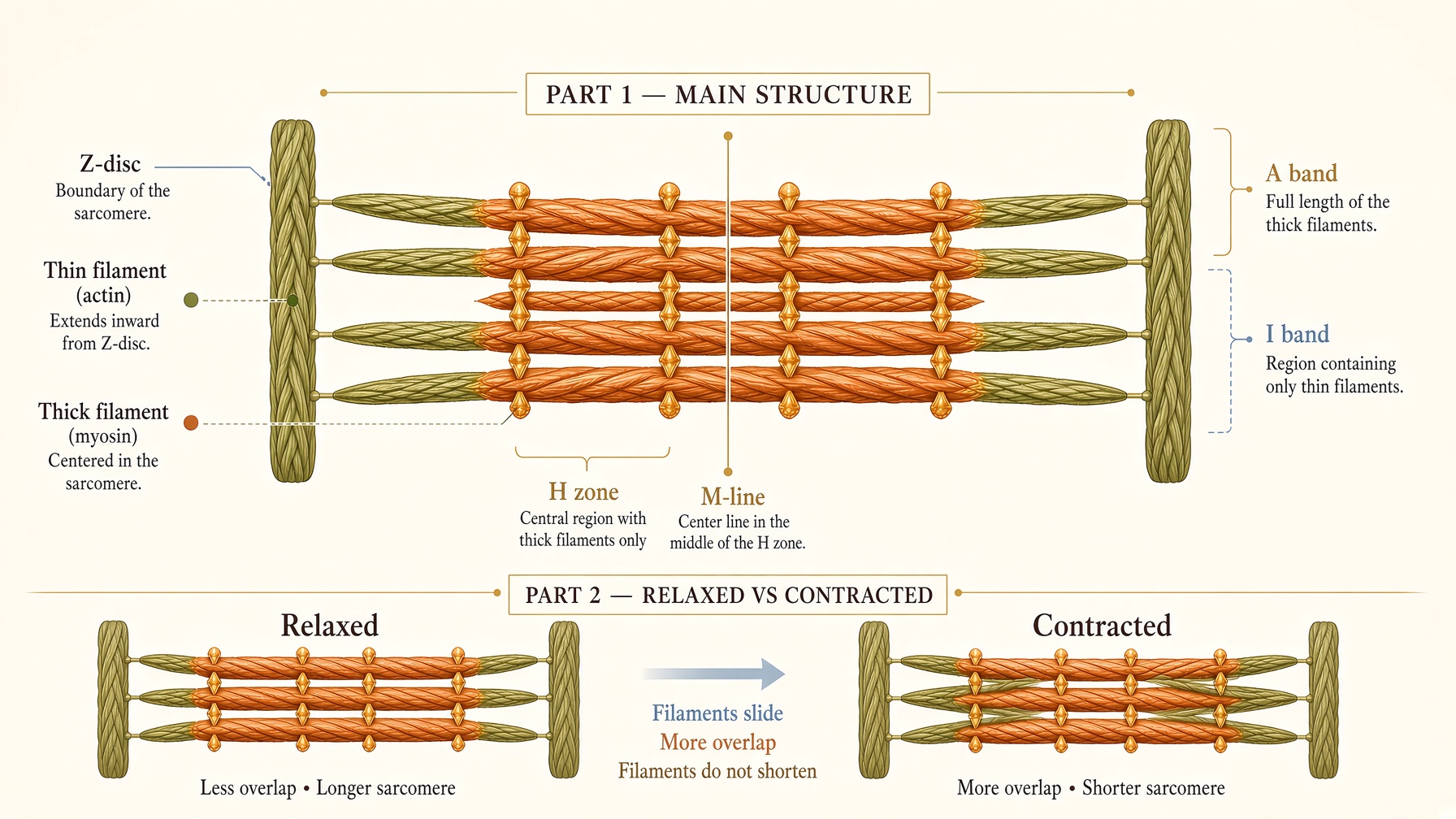
This arrangement also explains what happens during muscle contraction. As a sarcomere shortens, the thin filaments slide farther alongside the thick filaments, increasing the amount of overlap between them. The filaments themselves do not become shorter. Instead, their positions relative to one another change as the sarcomere contracts .1
Once that basic arrangement is clear, the different labels become easier to make sense of. The A band, I band, H zone, and M-line are not simply a collection of anatomical terms to memorize; each describes a particular part of the pattern created by the thin and thick filaments. And that same pattern provides the structural framework for understanding how a sarcomere changes as muscle contracts.
Join the discussion
No account or email is required. Your display name and comment will be public.