
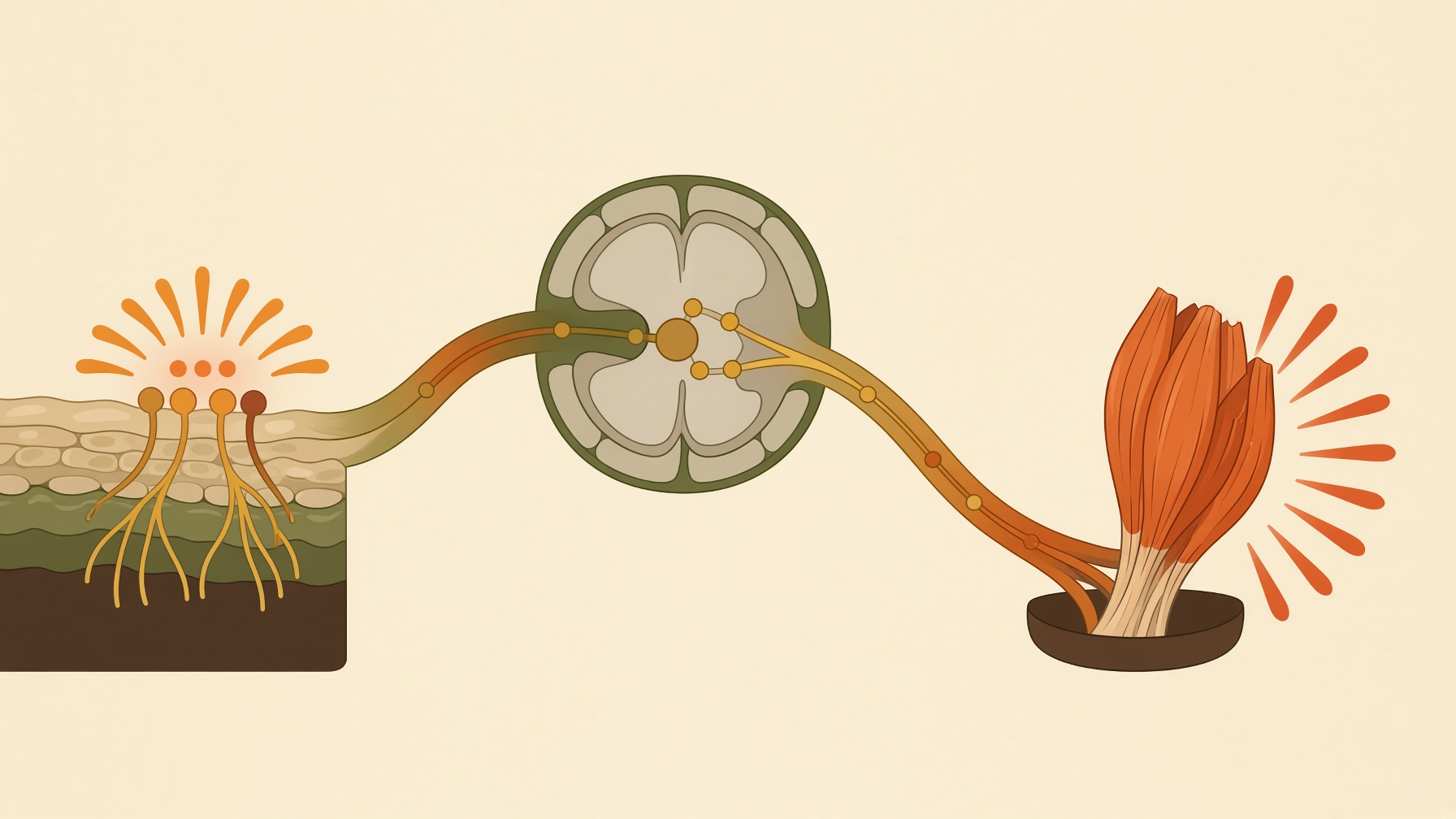
How Your Body Turns a Stimulus Into a Reflex
A reflex arc carries sensory information into the central nervous system and sends motor commands outward to produce an automatic response.
Wikis
An afferent pathway is a neural pathway that carries sensory information toward the central nervous system, meaning the spinal cord and brain. Afferent signals originate when sensory receptors detect changes inside or outside the body, such as touch, temperature, potentially damaging stimuli, muscle stretch, or changes in internal organs. Sensory neurons then transmit signals toward central neural circuits where the information can be processed .1,2
In the somatic sensory system, many primary afferent neurons have cell bodies in the dorsal root ganglia beside the spinal cord. Their peripheral processes receive or transduce sensory information, while their central processes enter the spinal cord through the dorsal roots. From there, sensory information may participate in local spinal circuits or travel through ascending pathways toward higher regions of the central nervous system .1,2
An afferent pathway does not necessarily lead to conscious sensation. Some afferent information contributes directly to reflexes and automatic motor control. For example, Ia afferents from muscle spindles carry information about muscle stretch into the spinal cord, where they can influence motor neurons as part of the stretch reflex .1
The term afferent is defined by the direction of information flow and contrasts with efferent. Afferent pathways carry sensory information toward the central nervous system, whereas efferent pathways carry signals away from central neural circuits toward targets such as muscles and glands .1
From this collection
A reflex arc carries sensory information into the central nervous system and sends motor commands outward to produce an automatic response.