
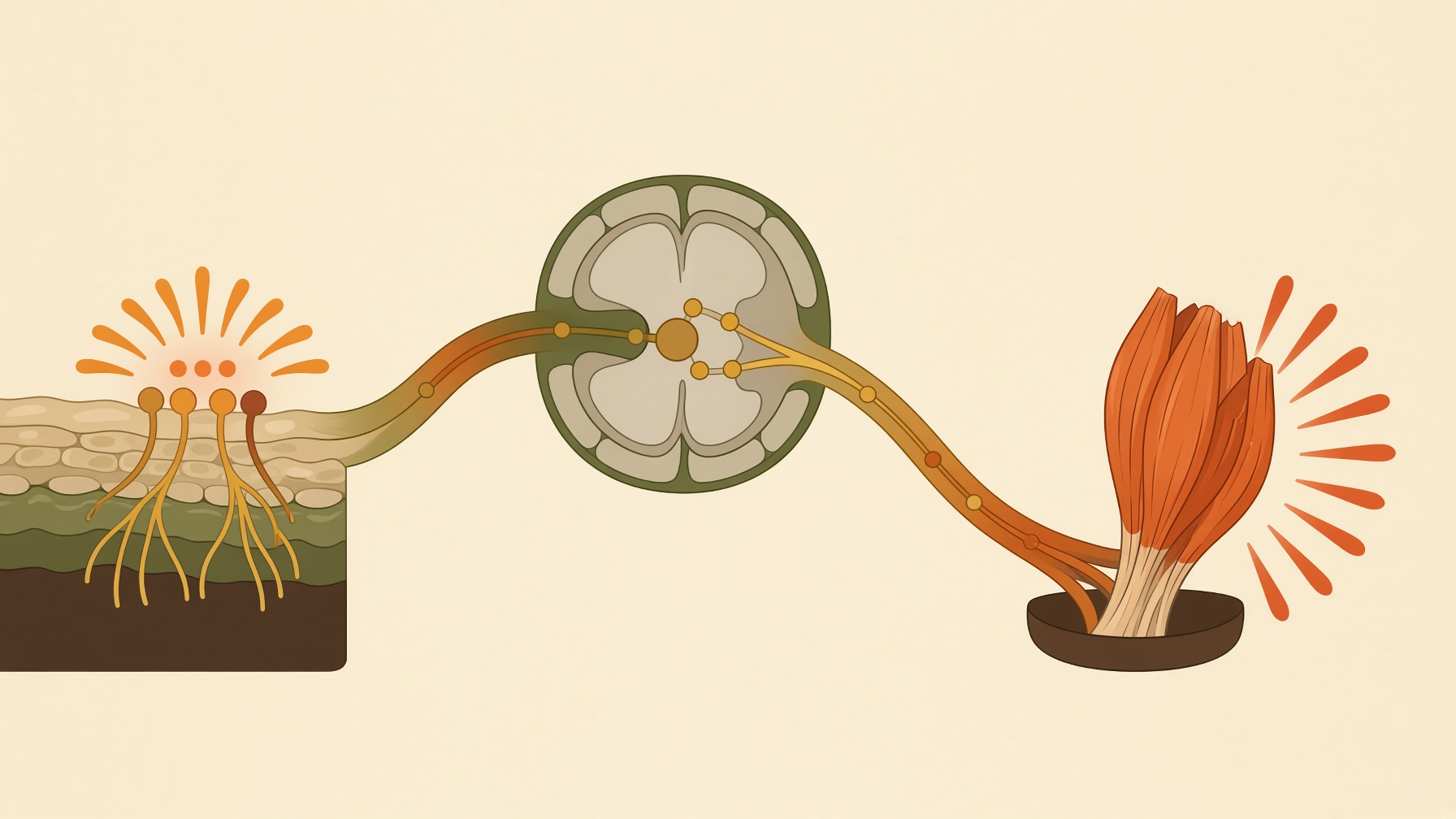
Touch a hot pot on the stove and your hand pulls away almost automatically. That familiar reaction is a reflex, but between the heat at your skin and the movement of your arm, a neural pathway is already at work. Following that pathway shows how the basic parts of a reflex arc carry a stimulus from detection to response.
The neural pathway that mediates a reflex is called a reflex arc. In its basic form, that pathway can be described through six elements: a stimulus, a receptor, an afferent pathway, central integration, an efferent pathway, and an effector. These elements give the reflex arc a clear sequence from the event that starts it to the part of the body that ultimately produces the response. The terms may sound technical at first, but they mainly provide a way to keep track of where information enters the pathway, how it passes through the nervous system, and where the response is produced .1
The sensory side begins when an appropriate sensory receptor detects a stimulus. From there, afferent neurons carry sensory information toward the central nervous system, or CNS. Direction matters here: the afferent part of the pathway is carrying information inward, toward the CNS.
The pathway then has an outgoing side. Efferent neurons carry motor commands away from the CNS to effectors. Once the effector is activated, it produces the reflex response. So, the flow of information through the basic arc has a simple directional structure: sensory information travels toward the CNS, while motor commands travel away from it to the effector that produces the response .1
A hot stove makes the reflex arc easy to picture because the sequence unfolds as one automatic response: a receptor detects the stimulus, sensory information travels toward the central nervous system, and a motor signal travels back out to an effector. The result is the familiar withdrawal of the hand. This is an everyday example of how the nervous system produces a response without conscious effort.
Join the discussion
No account or email is required. Your display name and comment will be public.