
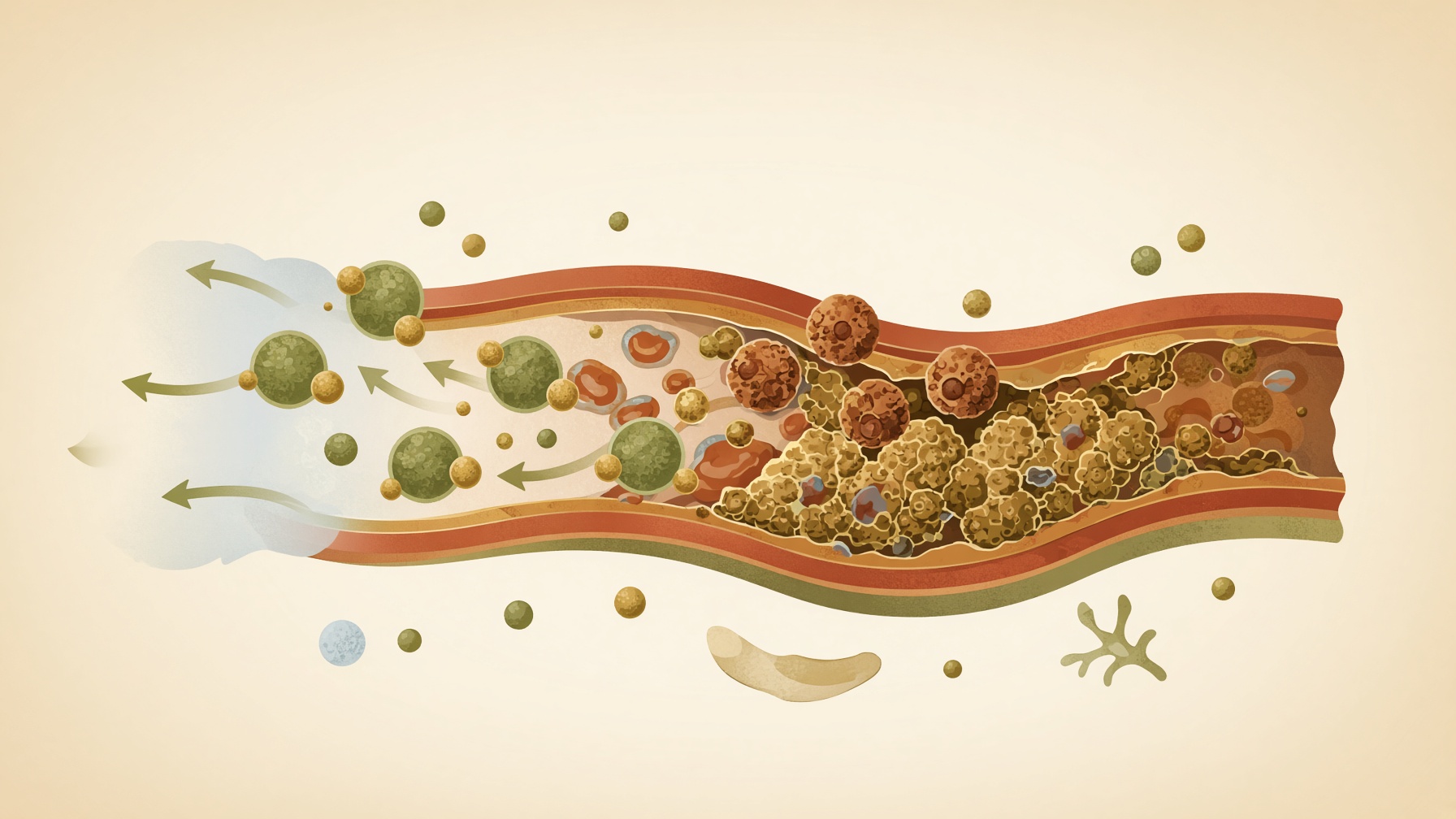
What “Good” and “Bad” Cholesterol Mean
LDL and HDL carry the same cholesterol in different particles, whose behavior matters more for health than the familiar good and bad labels.
Wikis
ApoB, or apolipoprotein B, is a large structural protein found on several classes of lipoprotein particles that transport lipids through the blood. Two main forms occur in humans: apoB-100, produced primarily by the liver, and apoB-48, produced in the intestine. ApoB-100 is present on VLDL, IDL, LDL, and lipoprotein(a), while apoB-48 is the structural protein of chylomicrons and their remnants .1,2
Each VLDL, IDL, LDL, and lipoprotein(a) particle contains one molecule of apoB-100, while each chylomicron and chylomicron remnant contains one molecule of apoB-48. Because each of these particles carries a single apoB molecule, plasma apoB concentration provides a close estimate of the number of circulating apoB-containing particles. In typical blood measurements, most measured apoB is apoB-100, with LDL particles accounting for much of the circulating apoB .1
ApoB-containing particles are important in atherosclerosis because particles such as LDL, VLDL remnants, IDL, chylomicron remnants, and lipoprotein(a) can carry cholesterol into the arterial wall. Their retention within the artery can initiate and sustain processes involved in atherosclerotic plaque formation. A higher plasma apoB concentration therefore generally reflects a greater number of circulating atherogenic lipoprotein particles .1,2
ApoB is distinct from LDL-C. LDL-C measures the amount of cholesterol carried within LDL particles, whereas apoB more closely reflects the number of atherogenic lipoprotein particles. Because individual particles can carry different amounts of cholesterol, LDL-C and apoB can sometimes be discordant. Two people with similar LDL-C concentrations can therefore have different apoB concentrations and different numbers of atherogenic particles .1,2
From this collection
LDL and HDL carry the same cholesterol in different particles, whose behavior matters more for health than the familiar good and bad labels.