
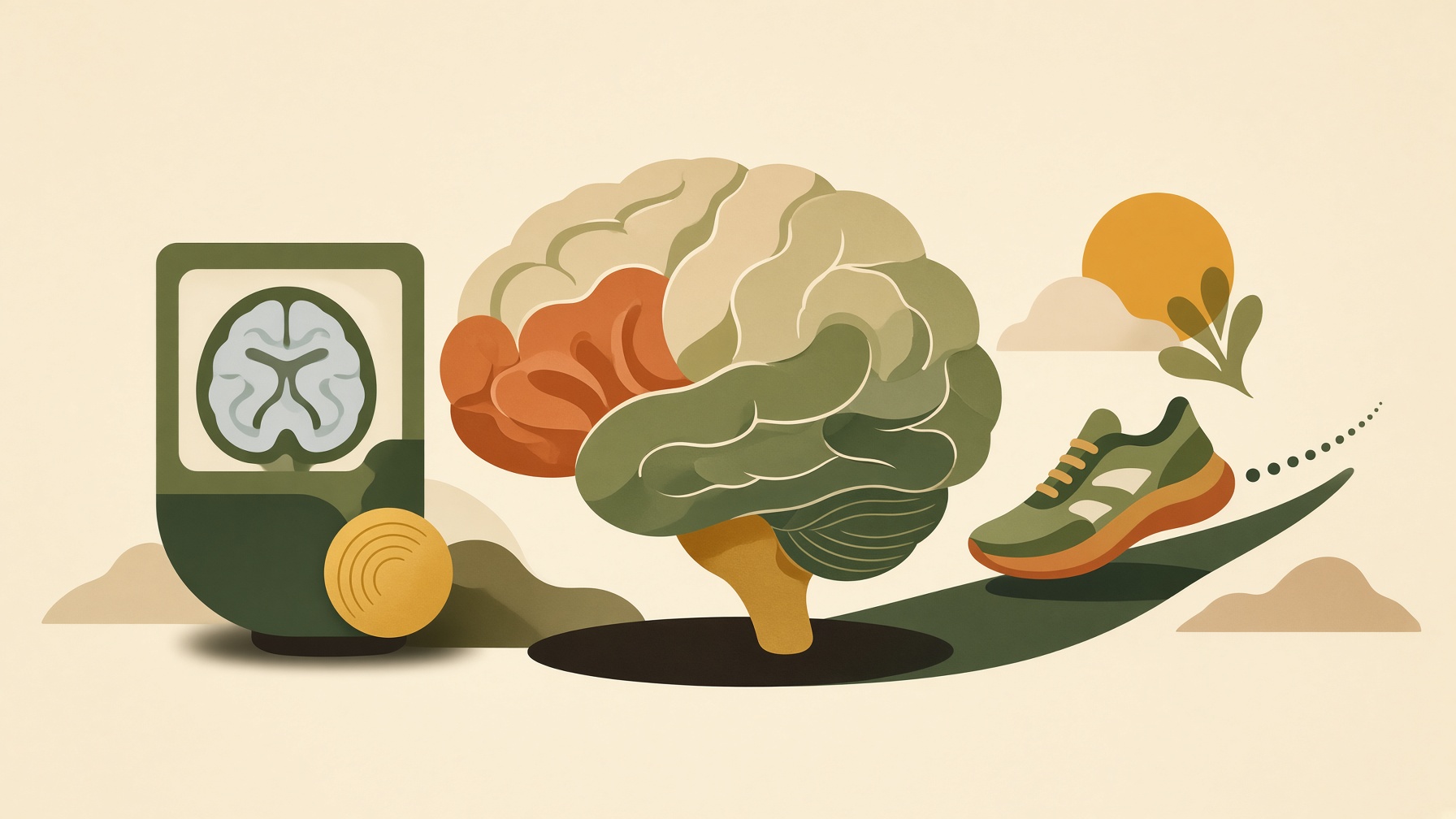
The Brain-Age Score Got Younger on the MRI. Did the Brain, or Just the Reading?
Exercise can shift some MRI-based brain-age estimates, but changes depend on the model and do not demonstrate literal reversal of brain aging.
Wikis
Brain age models estimate age from imaging features, so the difference from calendar age does not directly measure years of biological brain aging.
Brain age is an estimate of a person's age generated from features of brain imaging, most often structural MRI, using a statistical or machine-learning model trained on people of known chronological ages. Brain-predicted age difference, often shortened to brain-PAD or called a brain-age gap, is the predicted brain age minus the person's actual chronological age .1
A positive brain-PAD means that the imaging pattern was assigned an older age than the person's calendar age, while a negative value means it was assigned a younger age. The measure summarizes many age-related imaging features into a single number. It does not mean the brain has literally aged by that exact number of years, and terms such as accelerated brain aging should be used cautiously because prediction bias, image quality, scanner differences, and model design can influence the estimate .1,2
Brain age is therefore best understood as a model-derived biomarker rather than a direct biological clock. Researchers study it because group differences and associations with neurological conditions, cognition, and other aging-related measures may reveal atypical patterns of brain structure. Its performance depends on how the model was trained and validated, so brain-PAD values from different algorithms or datasets are not automatically interchangeable .1,2
From this collection
Exercise can shift some MRI-based brain-age estimates, but changes depend on the model and do not demonstrate literal reversal of brain aging.