
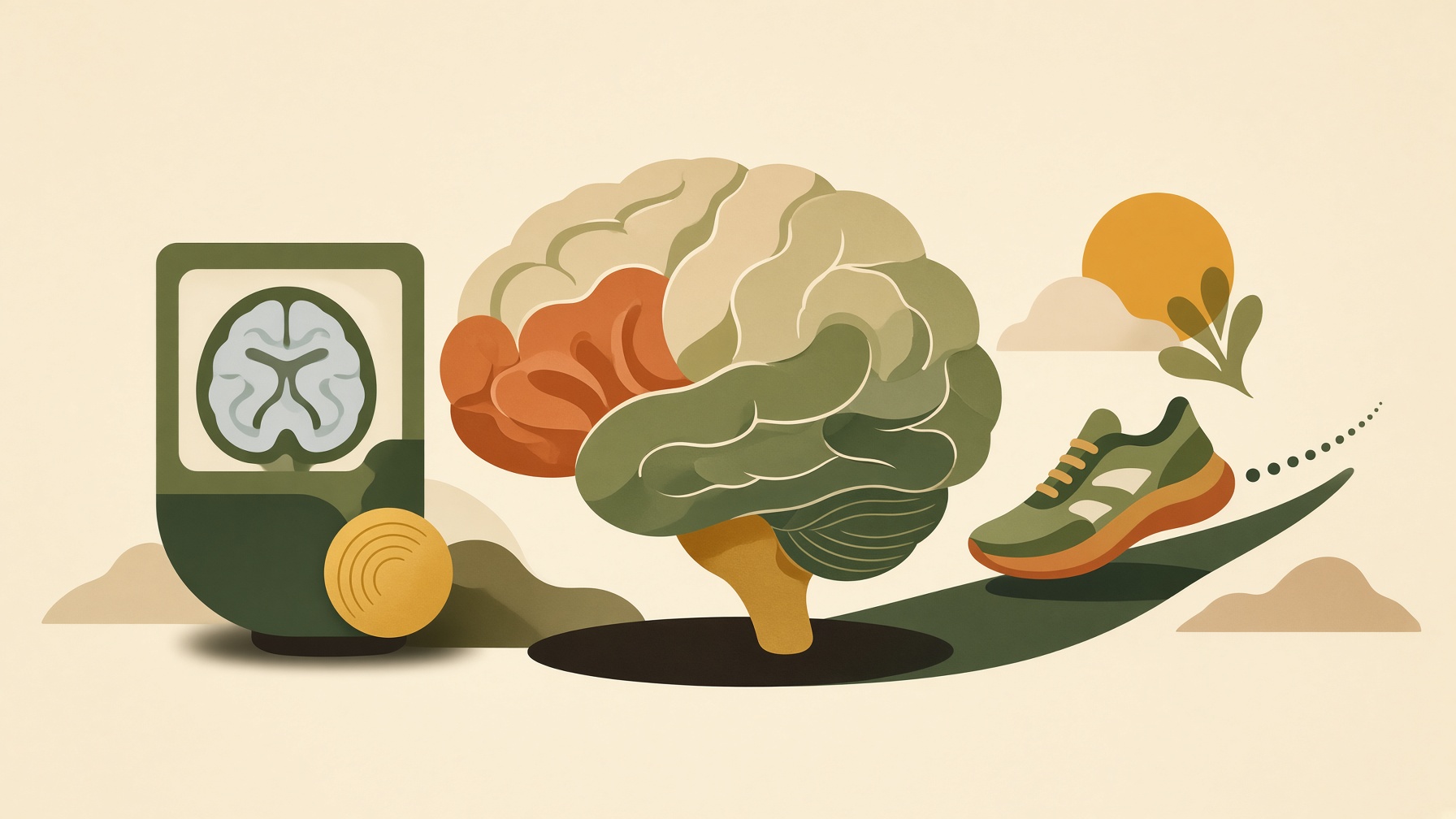
We are used to thinking of age as a number that moves in only one direction. Put the words “brain age” next to exercise, though, and the metaphor becomes tempting: could training somehow turn the clock backward? The phrase makes a striking headline, but the number behind it needs some unpacking before it starts to sound like rejuvenation.
“Brain age” is not a second birthday. Researchers can use MRI data and machine-learning models to estimate the age that a brain’s measured features most closely resemble. The difference between that estimate and chronological age is often called the brain-predicted age difference, or brain-PAD. A lower value means the brain appears younger according to that particular model, not that the tissue has literally reversed a year of biological aging. For a reader interested in exercise, the useful question is therefore narrower: can training shift these MRI-based estimates, and how much meaning should we attach to that shift?1,2
One randomized trial suggests that exercise can move the estimate. Researchers assigned 130 generally healthy, relatively inactive adults aged 26–58 to either a 12-month aerobic exercise program or a control condition. After one year, brain-PAD decreased by 0.60 years in the exercise group and increased by 0.35 years in the control group, producing an adjusted between-group difference of about 0.95 years.1
That result is interesting, but it is still a change in a machine-learning estimate derived from structural MRI. Follow-up imaging was available for only 81 of the 130 randomized participants, with attrition partly related to the COVID-19 pandemic. The trial also did not identify a clear biological pathway behind the shift: cardiorespiratory fitness improved, but changes in fitness, body composition, blood pressure, and blood levels of brain-derived neurotrophic factor did not statistically mediate the effect on brain-PAD. The study therefore detected a change in the imaging marker without showing that exercise literally made the participants’ brains one year younger or establishing what biological process produced the difference.1
A second randomized trial published in 2026 makes the signal more intriguing. In an MRI subsample of 309 adults aged 62–70, participants performed heavy resistance training, moderate-intensity training, or remained in a non-exercise control group. After one year, estimated brain-age gaps based on resting-state functional MRI decreased from baseline by about 1.40 years in the heavy-training group and 1.39 years in the moderate-training group, with lower gaps still evident at two years.3
Those numbers should not be placed directly beside the aerobic trial as if both studies used the same clock. The participants were older, the exercise programs were different, and the models were built from different kinds of MRI information. The aerobic trial used structural MRI, while the resistance-training study used patterns of functional connectivity. A “one-year” change from one model is therefore not necessarily the same biological signal as a “one-year” change from another.1,3
That matters because brain-age tools themselves are still being evaluated. A separate 2026 analysis compared six publicly available structural-MRI brain-age tools and found only moderate agreement between their estimates. Their associations with outcomes such as later memory decline and gray-matter loss were generally small, and the brain-age measures did not consistently outperform simpler measures of gray-matter volume. Brain age remains an active research measure rather than a clinically settled biomarker of biological brain aging.2
The exercise studies therefore support a cautious conclusion: training may shift some MRI-based brain-age estimates, but the size and meaning of those shifts depend on how the estimate is constructed. For now, the value of the research is in showing that these imaging patterns may be responsive to exercise, not in giving an individual a new biological age.1,2,3
The promise of turning back a clock makes an easy headline. A more useful reading starts by asking what kind of clock is being discussed and what its number is meant to tell you.


Join the discussion
No account or email is required. Your display name and comment will be public.