
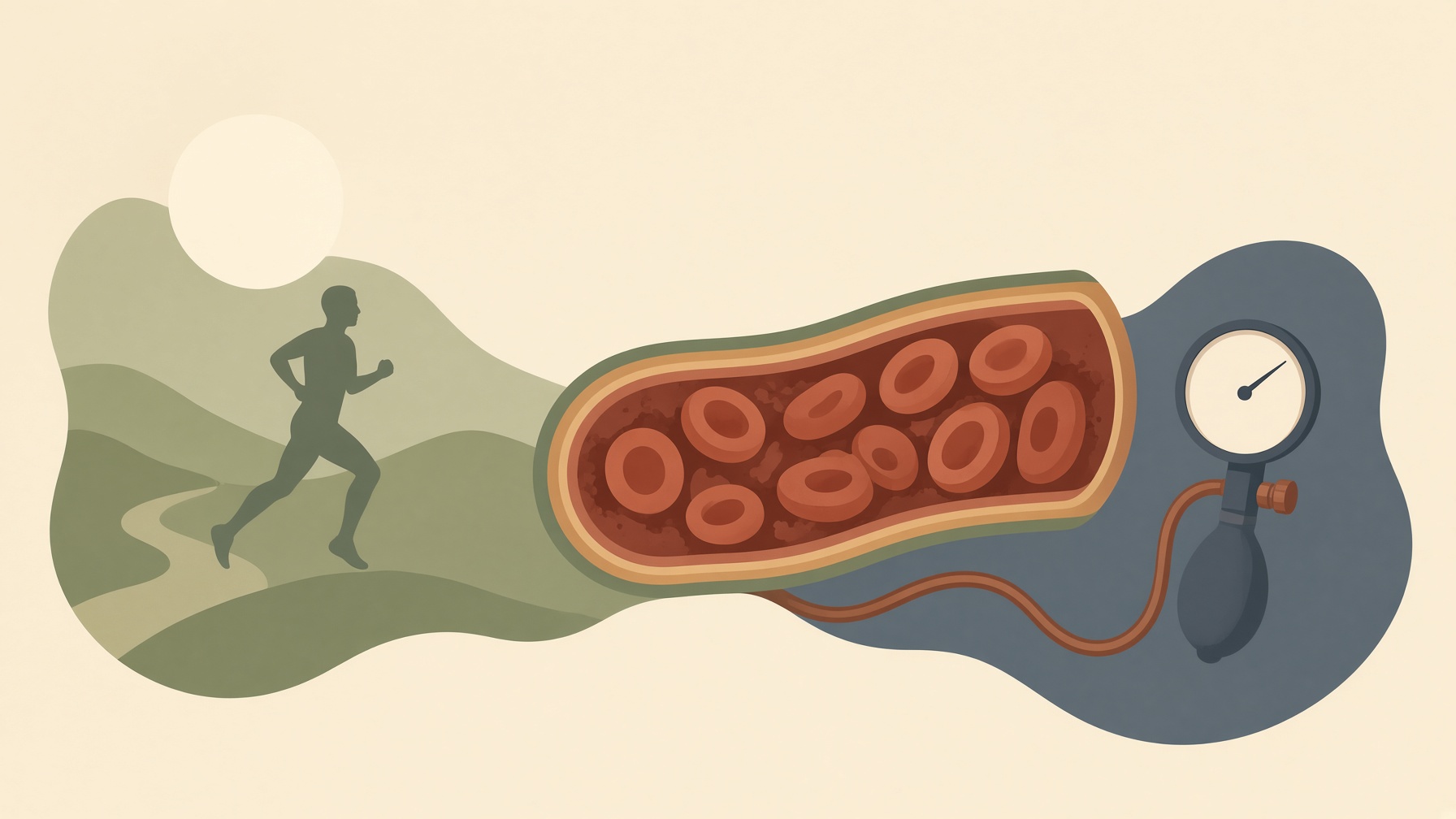
Your Blood-Pressure Reading during Exercise Doesn't Mean the Same Thing as the One at the Clinic. Why?
Blood pressure during exercise reflects physical effort, so a temporary rise does not carry the same meaning as persistent elevation at rest.
Wikis
Cerebral autoregulation helps brain blood vessels limit changes in blood flow when driving pressure shifts, but cannot keep flow perfectly constant.
Cerebral autoregulation is the ability of the brain’s blood vessels to limit changes in blood flow when the pressure driving blood through the brain changes. It helps keep the brain’s blood supply relatively stable despite fluctuations in blood pressure. The relevant driving pressure is called cerebral perfusion pressure .1
An important part of this response involves changing the diameter of arteries and arterioles, the smaller branches that regulate resistance to flow. When perfusion pressure rises, vessel narrowing can increase resistance; when it falls, widening can reduce resistance. Smooth muscle in vessel walls contributes by responding to changes in pressure, although several interacting mechanisms are involved and their precise contributions remain incompletely understood .1
Autoregulation does not keep brain blood flow perfectly constant. Its effectiveness depends partly on how quickly pressure changes, and rapid fluctuations can still cause substantial changes in flow. It also operates within limits, rather than protecting blood flow at every possible pressure .1
This process differs from neurovascular coupling, which adjusts local blood flow to changes in nerve-cell activity. It also differs from the vessels’ response to changing carbon dioxide levels. These processes interact in regulating the brain’s circulation, but they respond to different signals and are not interchangeable measures of autoregulation .1
From this collection
Blood pressure during exercise reflects physical effort, so a temporary rise does not carry the same meaning as persistent elevation at rest.