
Why Your Pelvis Is Built for Stability
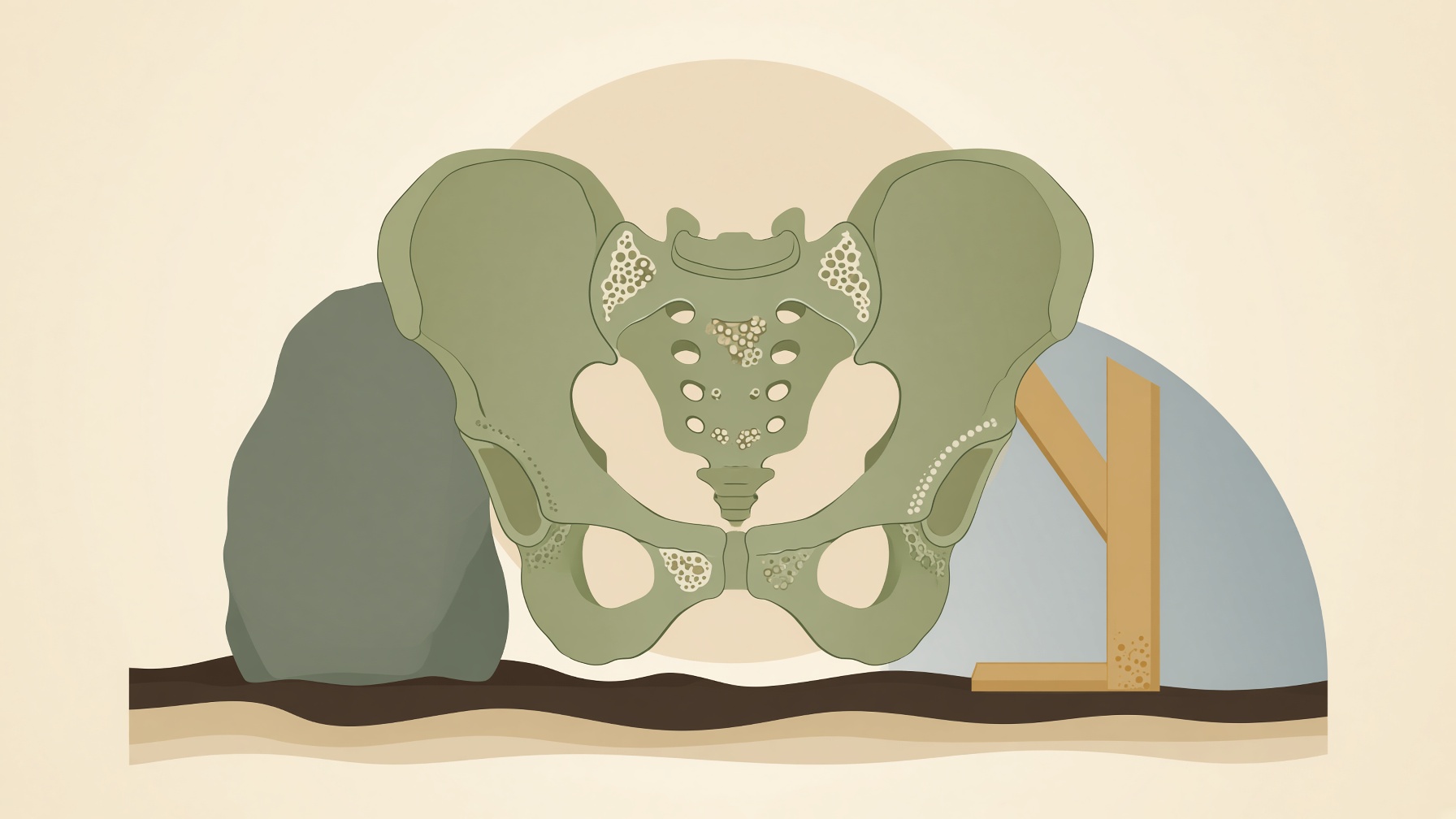
The pelvis limits movement through strong bony connections, providing a stable base that transfers upper-body weight toward the lower limbs.
Wikis
The coccyx, commonly called the tailbone, is the small, triangular bone at the lowest end of the vertebral column, immediately below the sacrum. It develops from coccygeal vertebral segments, with three to five segments commonly reported in adults and four being the most frequent number. The uppermost coccygeal segment articulates with the sacrum at the sacrococcygeal joint .1,2
The coccygeal segments become progressively smaller toward the lower tip of the bone and may be partly or completely fused with one another. The first coccygeal segment is generally the largest and may have projections called coccygeal cornua, which correspond to the sacral cornua above. The degree of fusion and the shape and curvature of the coccyx vary considerably among individuals .1,2
Despite its small size, the coccyx provides attachment for several muscles and ligaments. These include components of the pelvic floor, such as the levator ani and coccygeus muscles, as well as the gluteus maximus and several pelvic ligaments. It also contributes to support and force distribution during sitting, particularly when body weight shifts toward the posterior pelvis .1
The coccyx should not be confused with the sacrum. The sacrum is the much larger bone immediately above it and is formed from five fused sacral vertebrae. The coccyx forms the terminal portion of the vertebral column below the sacrum .1,2
From this collection
The pelvis limits movement through strong bony connections, providing a stable base that transfers upper-body weight toward the lower limbs.