
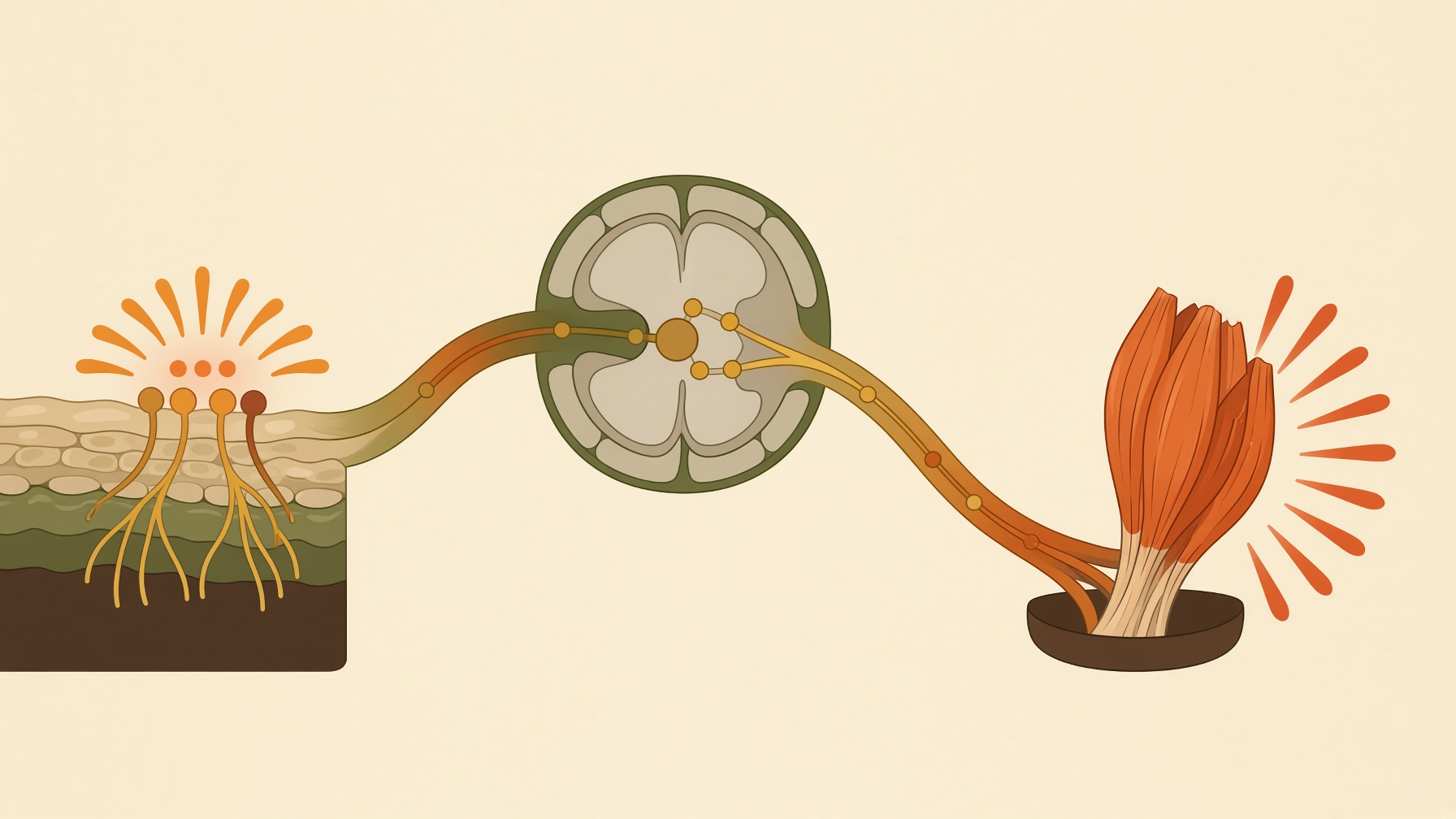
How Your Body Turns a Stimulus Into a Reflex
A reflex arc carries sensory information into the central nervous system and sends motor commands outward to produce an automatic response.
Wikis
An effector is a cell, tissue, or organ that produces a physiological response when it receives an appropriate signal. In the nervous system, effectors are the targets of motor, or efferent, pathways. Muscles and glands are major neural effectors because neural signals can cause them to contract, relax, secrete substances, or otherwise change their activity .1
In a reflex arc, the effector forms the response-producing end of the pathway. A sensory receptor first detects a stimulus, sensory neurons carry information toward the nervous system, and neural circuits generate an output that travels through an efferent pathway to the effector. For example, in a somatic reflex, a motor neuron can activate skeletal muscle fibers, causing them to contract .1
The type of effector depends on the part of the nervous system involved. Somatic motor pathways act on skeletal muscle. Autonomic pathways regulate smooth muscle, cardiac muscle, and glands, allowing neural activity to alter functions such as blood-vessel diameter, heart activity, digestive movement, and secretion .1
An effector should not be confused with an efferent neuron. An efferent neuron carries a signal away from a central neural circuit toward a target, whereas the effector is the cell, tissue, or organ that responds to that signal. Likewise, a sensory receptor detects a stimulus, while an effector produces the resulting physiological response .1
From this collection
A reflex arc carries sensory information into the central nervous system and sends motor commands outward to produce an automatic response.