
What’s Behind a Six-Pack?
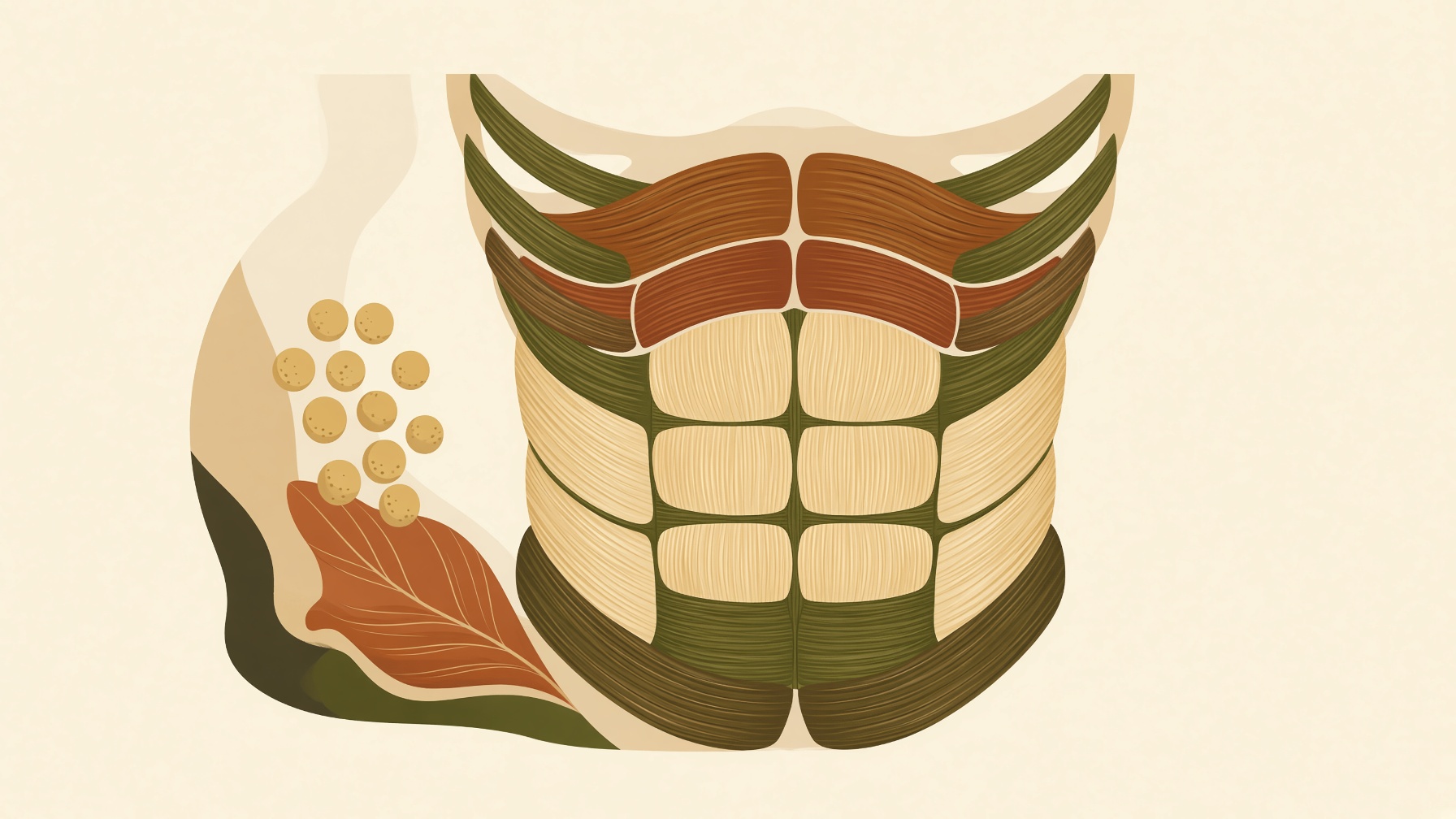
Abdominal muscles form layers with different fiber directions, making the visible six-pack only one part of the anatomy that supports the trunk.
Wikis
The external oblique is a paired skeletal muscle forming the most superficial of the three flat muscle layers of the anterolateral abdominal wall. It lies superficial to the internal oblique and transversus abdominis. The muscle originates from the lower eight ribs, and its fibers generally run downward and toward the body's midline, often described as a “hands-in-pockets” orientation .1
The external oblique attaches partly to the anterior portion of the iliac crest. Toward the front of the abdomen, its muscular fibers give way to a broad sheet of connective tissue called an aponeurosis, which extends toward the linea alba and contributes to the rectus sheath. Inferiorly, part of this aponeurosis folds to form the inguinal ligament .1
Contraction of the external oblique contributes to movement and stabilization of the trunk. Working with other abdominal muscles, it can participate in trunk flexion, lateral flexion, and rotation. It also helps compress the abdominal contents and can contribute to increased intra-abdominal pressure and forceful expiration .1
The external oblique is distinct from the internal oblique, which lies immediately beneath it and has a different predominant fiber direction. Both are oblique abdominal muscles and often act together or in coordinated combinations during movements of the trunk .1
From this collection
Abdominal muscles form layers with different fiber directions, making the visible six-pack only one part of the anatomy that supports the trunk.