
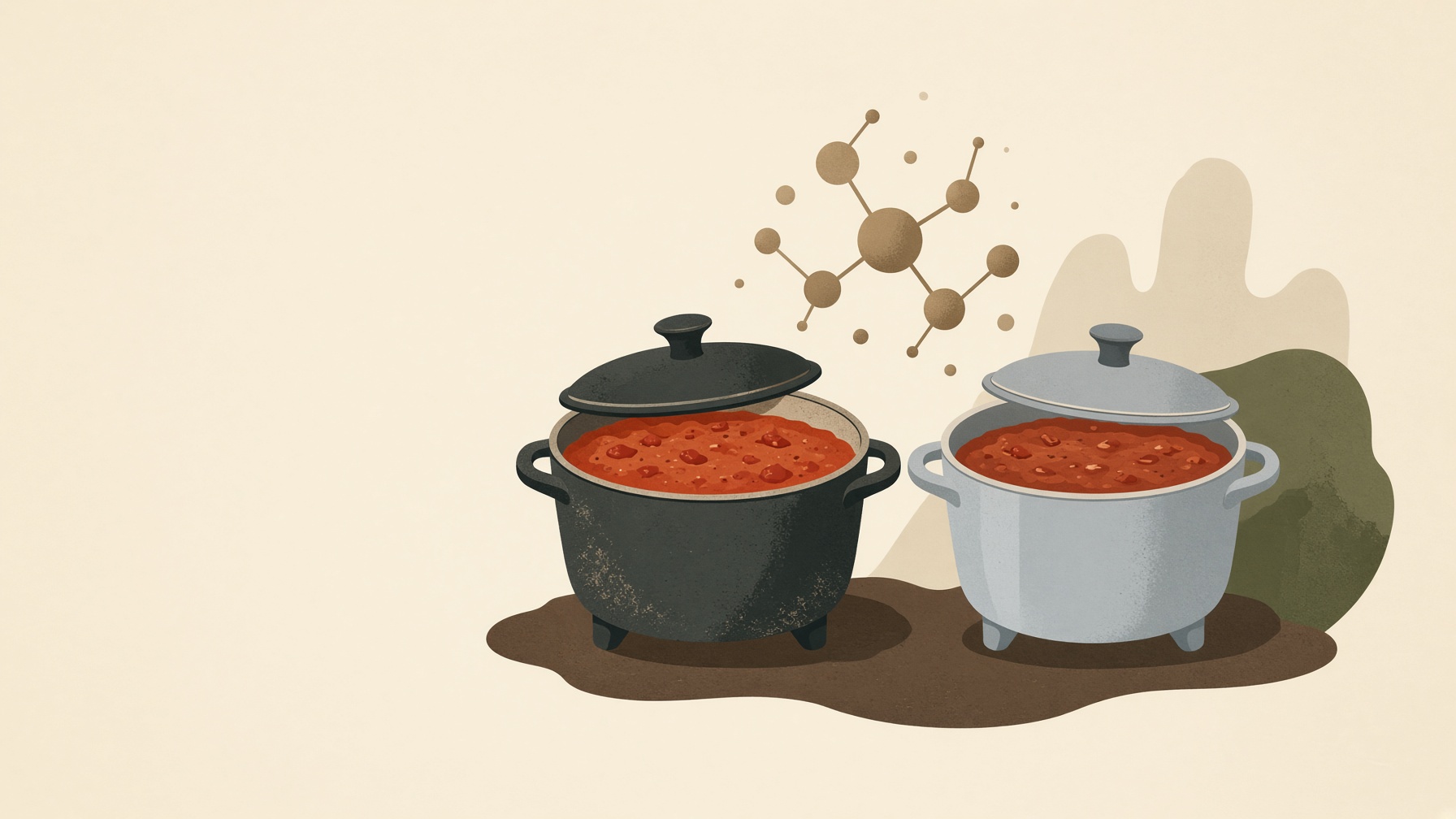
You Cook in Cast Iron. Does the Pot Change What Ends Up in Your Food?
Cast-iron pots yielded tomato sauce with a higher iron concentration than stainless steel in one lab comparison, without proving nutritional benefit.
Wikis
Food-contact material migration transfers chemicals from packaging or utensils into food, with the amount shaped by materials and contact conditions.
Food-contact material migration is the transfer of chemical substances from a material or object into the food or drink it contacts. Food-contact materials include packaging, containers, kitchen utensils and food-processing equipment. They may be made from plastic, paper, rubber, ceramic or metal .1
The amount transferred depends on the chemical substance, the material containing it, the composition of the food, and the temperature and duration of contact. Migration measurements therefore describe a particular combination of material and conditions. A result obtained for one food or use condition does not necessarily represent what would happen with another .2
Migration can be studied by measuring substances in food after contact with the material. When direct analysis in food is difficult, researchers can use food simulants: test liquids selected to reproduce relevant migration into different kinds of food. Testing also accounts for the temperatures and contact times expected during use. These measurements help estimate how much of a substance people may consume through food .2
Migration and health risk are related but distinct concepts. Migration describes chemical transfer; assessing its safety also requires information about the substance's toxic effects and the resulting exposure. Detecting transfer alone therefore does not establish that a material causes harm .1,2
From this collection
Cast-iron pots yielded tomato sauce with a higher iron concentration than stainless steel in one lab comparison, without proving nutritional benefit.