
How Are the Tiny Filaments Inside Your Muscles Arranged?
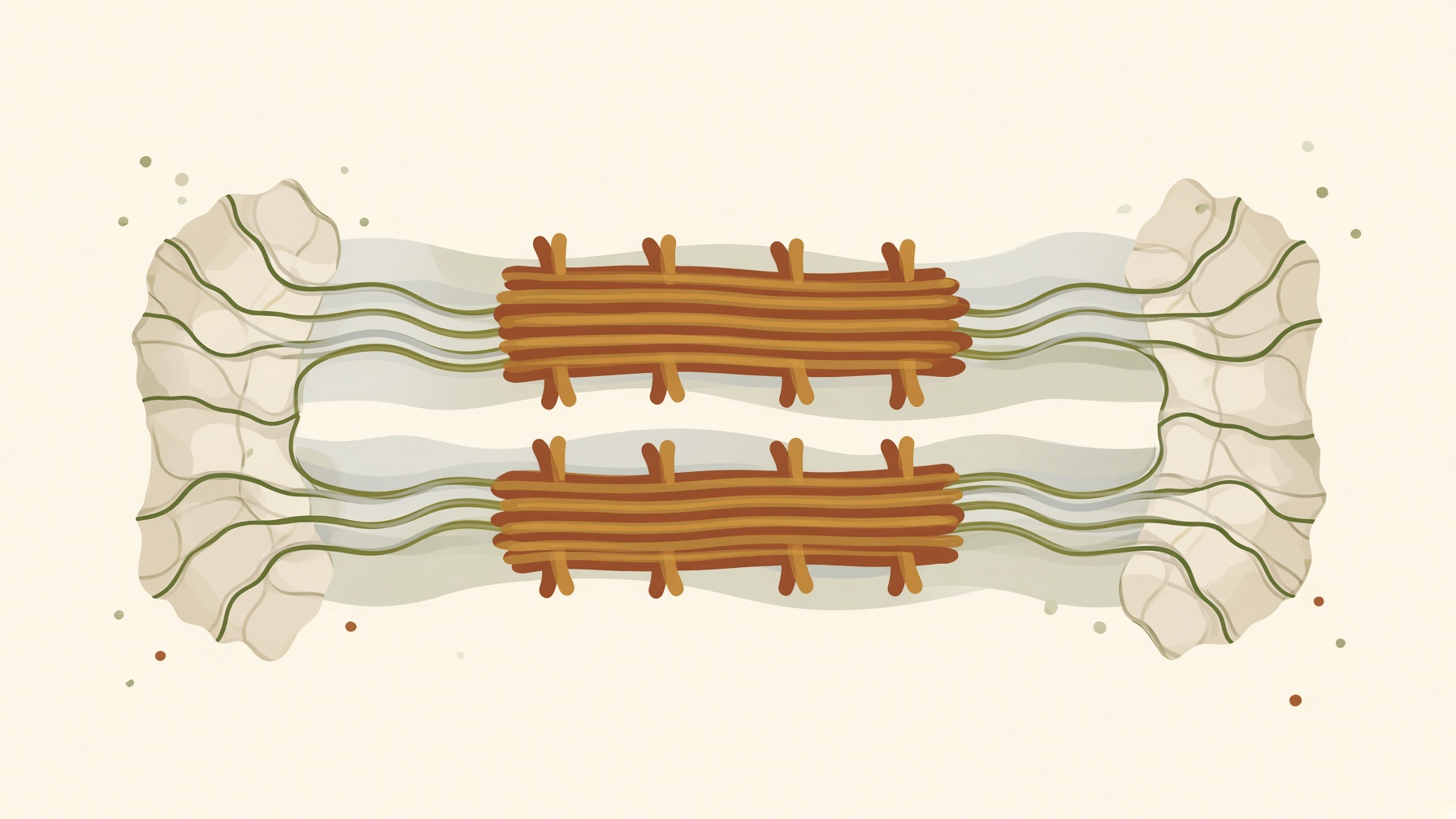
Sarcomeres shorten as thin filaments slide alongside thick filaments, increasing overlap without reducing the length of the filaments themselves.
Wikis
The I band is the lighter region of a sarcomere that contains thin, actin-containing filaments but no thick, myosin-containing filaments. It lies on either side of the darker A band in striated skeletal and cardiac muscle. A Z-disc runs through the middle of each I band, so a single I band spans the boundary between two neighboring sarcomeres .1,2
Thin filaments are anchored at the Z-disc and project from there toward the center of each sarcomere. The portions of these filaments that do not overlap the thick filaments make up the I band. This arrangement distinguishes the I band from the A band, which corresponds to the full length of the thick filaments and includes regions where thick and thin filaments overlap .1,2
During sarcomere shortening, thin and thick filaments slide past one another rather than appreciably shortening themselves. As the thin filaments move farther into the A band, their non-overlapping portions become smaller. The I band therefore narrows as the sarcomere shortens, while the width of the A band remains essentially constant .1,2
The alternating light I bands and darker A bands contribute to the characteristic striated appearance of skeletal and cardiac muscle. The term “I band” originated from its relatively isotropic optical properties compared with the anisotropic A band .1
From this collection
Sarcomeres shorten as thin filaments slide alongside thick filaments, increasing overlap without reducing the length of the filaments themselves.