
What’s Behind a Six-Pack?
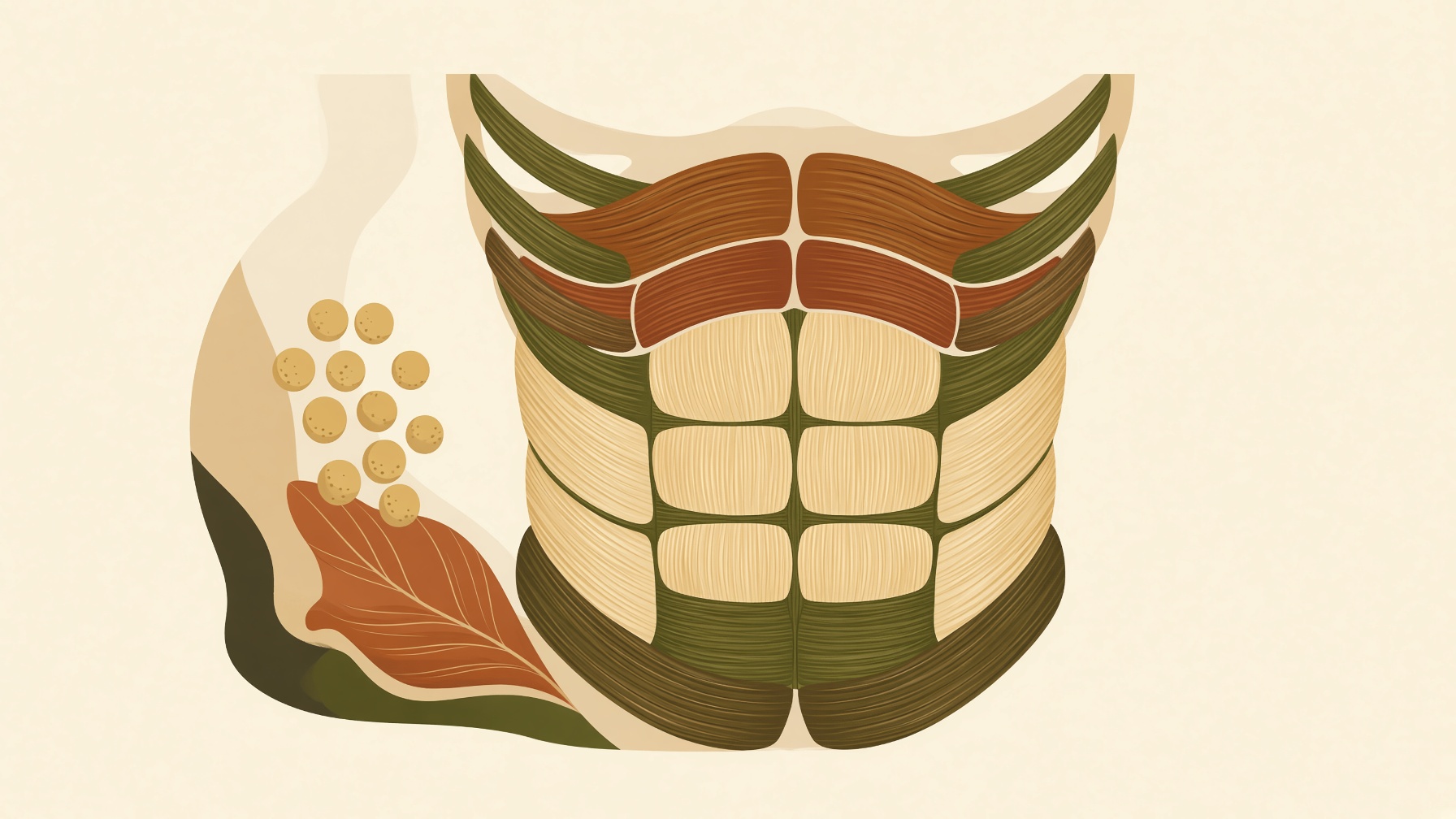
Abdominal muscles form layers with different fiber directions, making the visible six-pack only one part of the anatomy that supports the trunk.
Wikis
The internal oblique is a paired skeletal muscle forming the middle layer of the three flat muscles of the anterolateral abdominal wall. It lies deep to the external oblique and superficial to the transversus abdominis. In much of the muscle, its fibers run upward and toward the body's midline, generally differing from the predominant inferomedial fiber direction of the external oblique .1
The muscle arises from structures including the thoracolumbar fascia, iliac crest, and lateral part of the inguinal ligament. Its fibers and broad aponeurosis extend toward the lower ribs, linea alba, and pubic region. The internal oblique aponeurosis also contributes to the rectus sheath, the connective-tissue envelope surrounding the rectus abdominis .1
The internal oblique contributes to compression and support of the abdominal contents and to movements of the trunk. When both sides contract together, they can assist trunk flexion. Contraction on one side contributes to lateral flexion and rotation of the trunk toward the same side. Its activity can also help increase intra-abdominal pressure and participate in forced expiration .1
The internal oblique should not be confused with the external oblique. The internal oblique lies deeper and has a different predominant fiber orientation, whereas the external oblique lies superficially and generally runs inferomedially. The two muscles can nevertheless work together in coordinated trunk movements .1
From this collection
Abdominal muscles form layers with different fiber directions, making the visible six-pack only one part of the anatomy that supports the trunk.