
Why Your Pelvis Is Built for Stability
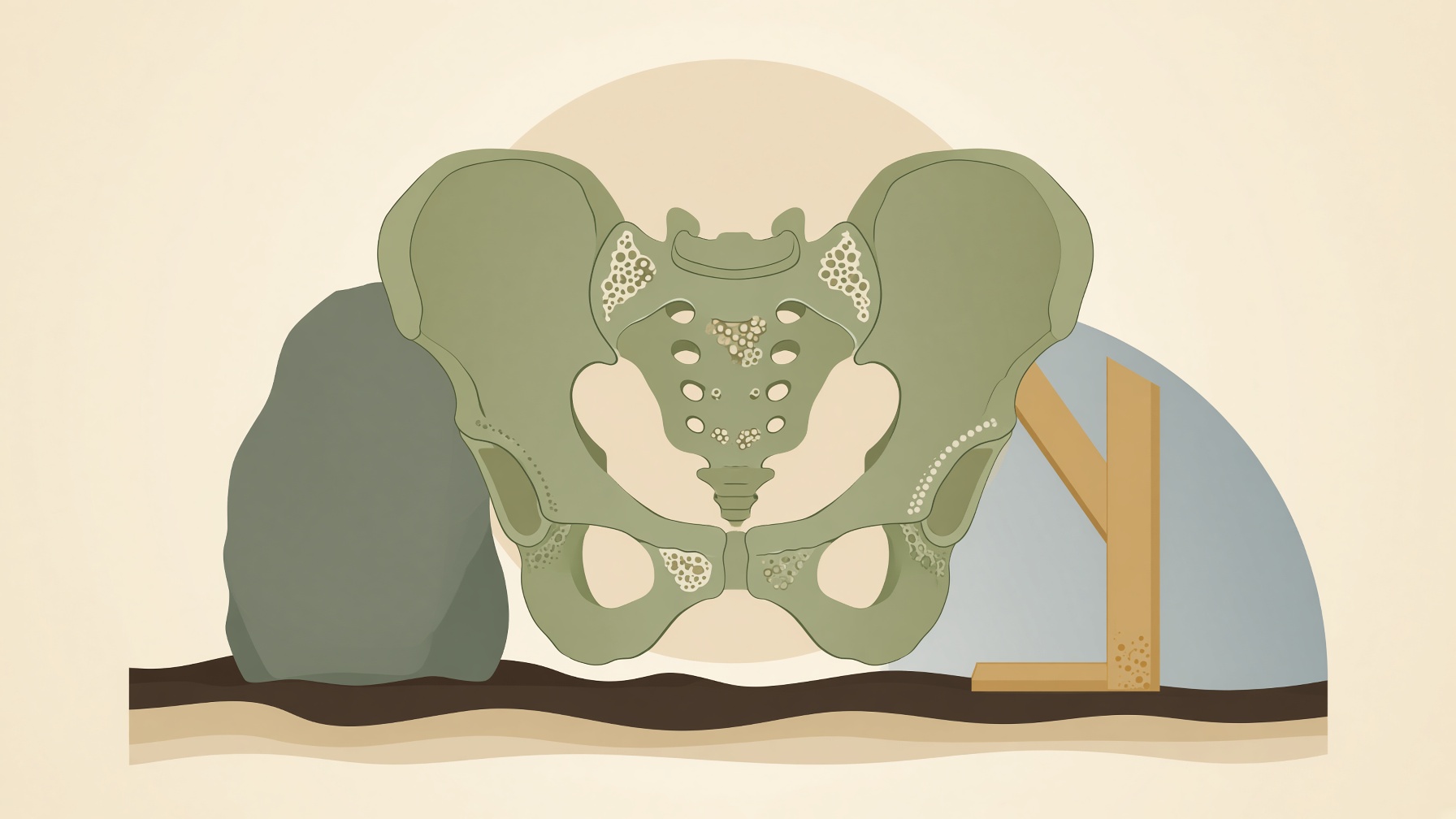
The pelvis limits movement through strong bony connections, providing a stable base that transfers upper-body weight toward the lower limbs.
Wikis
The pelvic girdle, also called the hip girdle, is the part of the appendicular skeleton that attaches the lower limbs to the axial skeleton. It is formed by the right and left hip bones, or coxal bones. Each adult hip bone is a single fused bone composed of three regions: the ilium, ischium, and pubis .1,2
Posteriorly, each hip bone articulates with the sacrum at a sacroiliac joint, creating a strong connection between the pelvic girdle and the axial skeleton. Anteriorly, the right and left pubic bones meet at the pubic symphysis. Compared with the highly mobile shoulder girdle, the pelvic girdle is strongly stabilized by its joints and ligaments, reflecting its major role in supporting and transmitting body weight .1,2
On the lateral side of each hip bone, the ilium, ischium, and pubis meet to form the acetabulum, the socket that articulates with the head of the femur. This arrangement allows forces from the trunk to pass through the pelvic girdle and hip joints into the lower limbs during standing and movement .1,2
The pelvic girdle should be distinguished from the bony pelvis. In standard anatomical usage, the pelvic girdle consists of the paired hip bones, whereas the complete bony pelvis includes both hip bones together with the sacrum and coccyx .1
From this collection
The pelvis limits movement through strong bony connections, providing a stable base that transfers upper-body weight toward the lower limbs.