
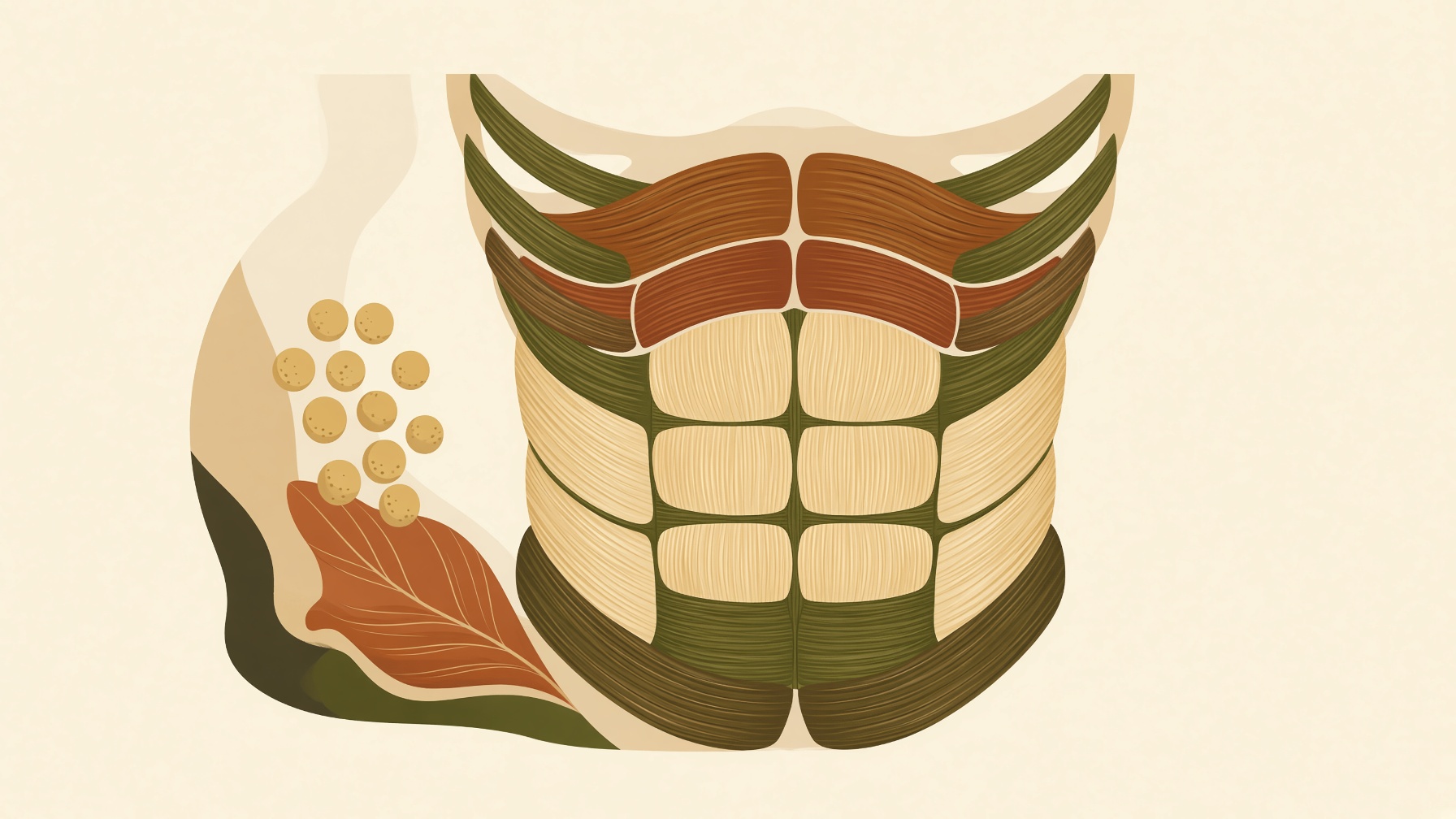
What’s Behind a Six-Pack?
Abdominal muscles form layers with different fiber directions, making the visible six-pack only one part of the anatomy that supports the trunk.
Wikis
The psoas major is a long, thick skeletal muscle that runs along each side of the lumbar spine and continues through the pelvis toward the upper femur. It has attachments to the bodies, intervertebral discs, and transverse processes of the lumbar vertebrae. Distally, its fibers converge into a tendon that passes alongside the iliacus and attaches to the lesser trochanter of the femur .1,2
Together, the psoas major and iliacus are commonly referred to as the iliopsoas, an important muscle group for hip flexion. When the trunk and pelvis are relatively fixed, contraction of the psoas major contributes to flexion of the thigh at the hip .1,2
Because the psoas major connects the lumbar vertebral column directly to the femur, its function is not limited to moving the hip. When the femur is relatively fixed, it can influence the position and movement of the lumbar spine. Evidence supports roles in lumbar stabilization and lateral flexion, although its precise mechanical contribution varies with posture, joint position, and the activity being performed .1,2
The psoas major should not be considered identical to the iliacus. The two muscles have different origins, architecture, and innervation even though they converge distally and commonly act together as the iliopsoas .1,2
From this collection
Abdominal muscles form layers with different fiber directions, making the visible six-pack only one part of the anatomy that supports the trunk.