
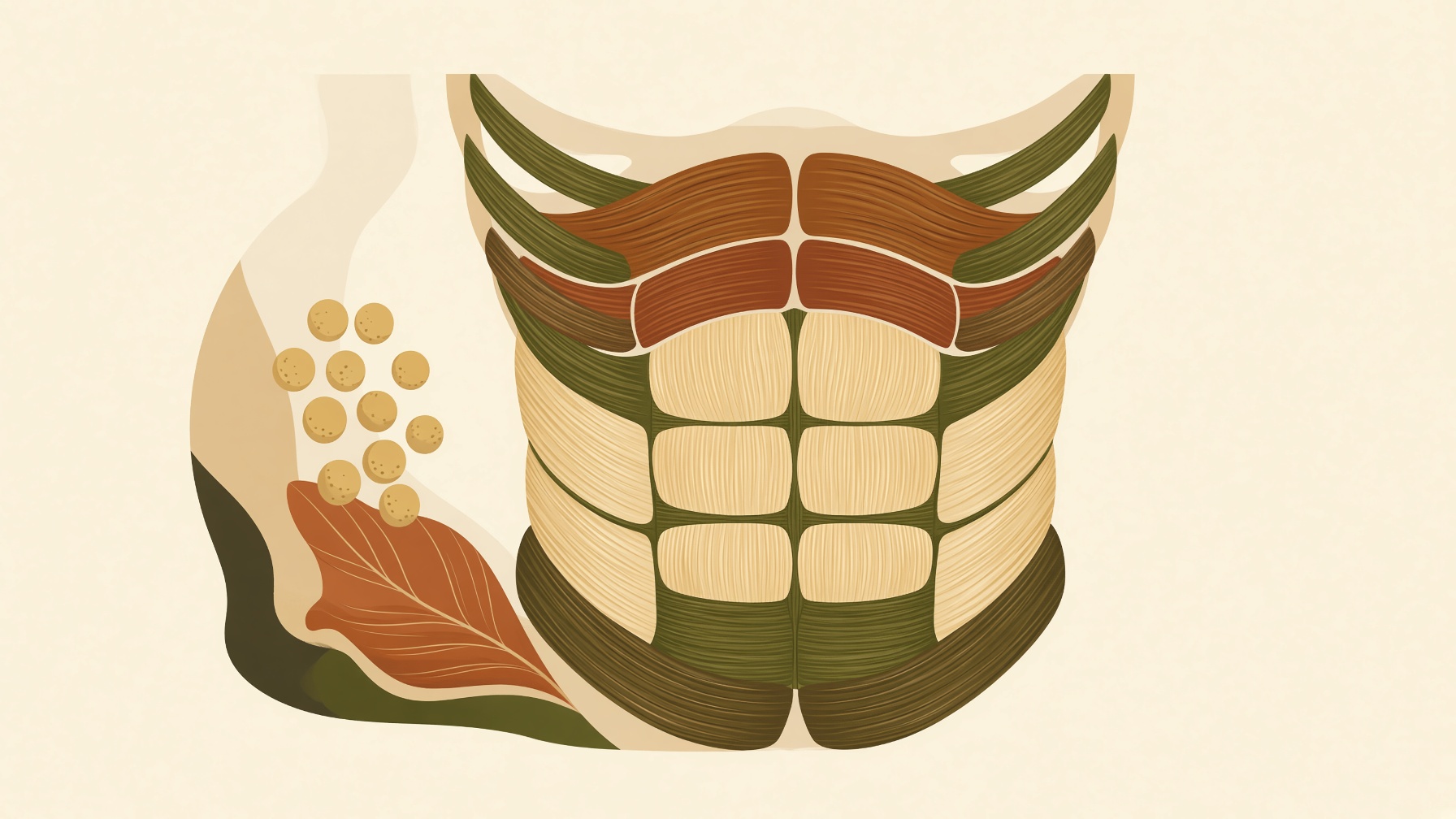
What’s Behind a Six-Pack?
Abdominal muscles form layers with different fiber directions, making the visible six-pack only one part of the anatomy that supports the trunk.
Wikis
The quadratus lumborum is a paired skeletal muscle of the posterior abdominal wall, positioned on either side of the lumbar spine. It extends between the iliac crest, the transverse processes of the lumbar vertebrae, and the twelfth rib. It lies posterior to the psoas major and is closely associated with the thoracolumbar fascia .1
The muscle has a complex arrangement of fiber bundles connecting the pelvis, lumbar vertebrae, and twelfth rib. Because these fibers have different orientations and attachment points, the quadratus lumborum can generate forces affecting both the lumbar spine and the lowest rib .1,2
Contraction on one side can contribute to lateral flexion of the trunk toward that side. Bilateral contraction can contribute to extension and stabilization of the lumbar region. Fibers attaching to the twelfth rib can also help stabilize the rib during respiration, providing a relatively fixed attachment for respiratory muscles .1,2
Although the quadratus lumborum contributes to lumbar stabilization, its mechanical role should not be considered in isolation. Biomechanical modeling suggests that its forces and moments on the lumbar spine can be relatively modest compared with those of larger posterior spinal muscles such as the erector spinae and multifidus. Its function therefore occurs as part of coordinated activity among surrounding trunk muscles and connective tissues .2
From this collection
Abdominal muscles form layers with different fiber directions, making the visible six-pack only one part of the anatomy that supports the trunk.