
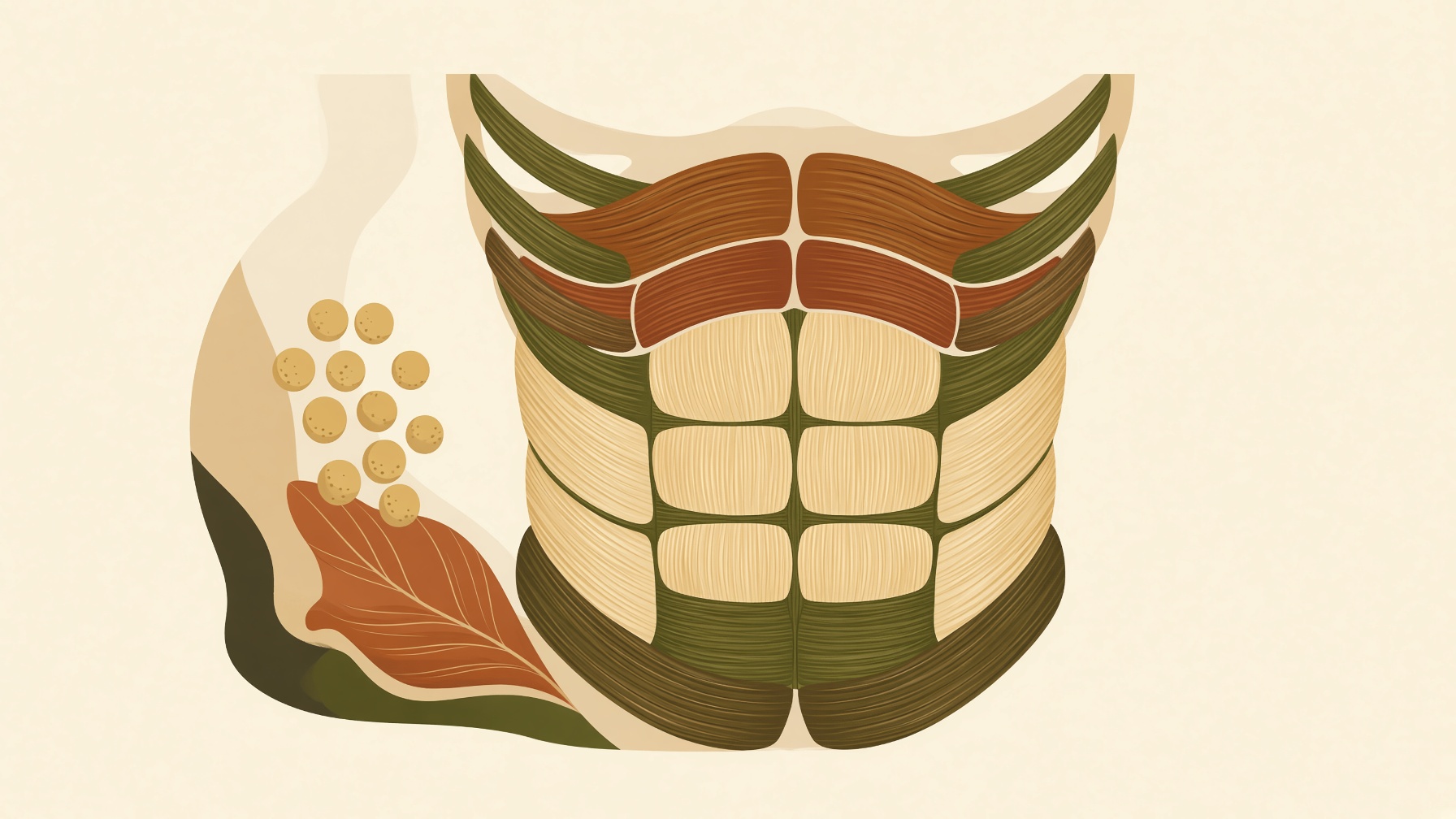
What’s Behind a Six-Pack?
Abdominal muscles form layers with different fiber directions, making the visible six-pack only one part of the anatomy that supports the trunk.
Wikis
The rectus sheath is a strong fibrous envelope in the anterior abdominal wall that surrounds the rectus abdominis muscles and, where present, the small pyramidalis muscles. It is formed mainly by the broad tendinous sheets, or aponeuroses, of the external oblique, internal oblique, and transversus abdominis muscles. The sheath also contains structures including the superior and inferior epigastric blood vessels and associated nerves .1
The arrangement of these aponeuroses changes along the abdomen. Between the costal margin and the arcuate line, the external oblique aponeurosis and anterior portion of the internal oblique aponeurosis pass in front of the rectus abdominis. The posterior portion of the internal oblique aponeurosis and the transversus abdominis aponeurosis pass behind it, forming the posterior layer of the sheath .1
Below the arcuate line, the arrangement changes substantially. The aponeuroses of all three flat abdominal muscles pass anterior to the rectus abdominis, so a true posterior rectus sheath is absent. Behind the muscle in this region lies the transversalis fascia, with deeper layers of the abdominal wall beyond it .1
The rectus sheath should not be confused with the linea alba. The rectus sheath surrounds each rectus abdominis muscle, whereas the linea alba is the fibrous midline structure where aponeurotic fibers from the two sides of the abdominal wall interweave .1
From this collection
Abdominal muscles form layers with different fiber directions, making the visible six-pack only one part of the anatomy that supports the trunk.