
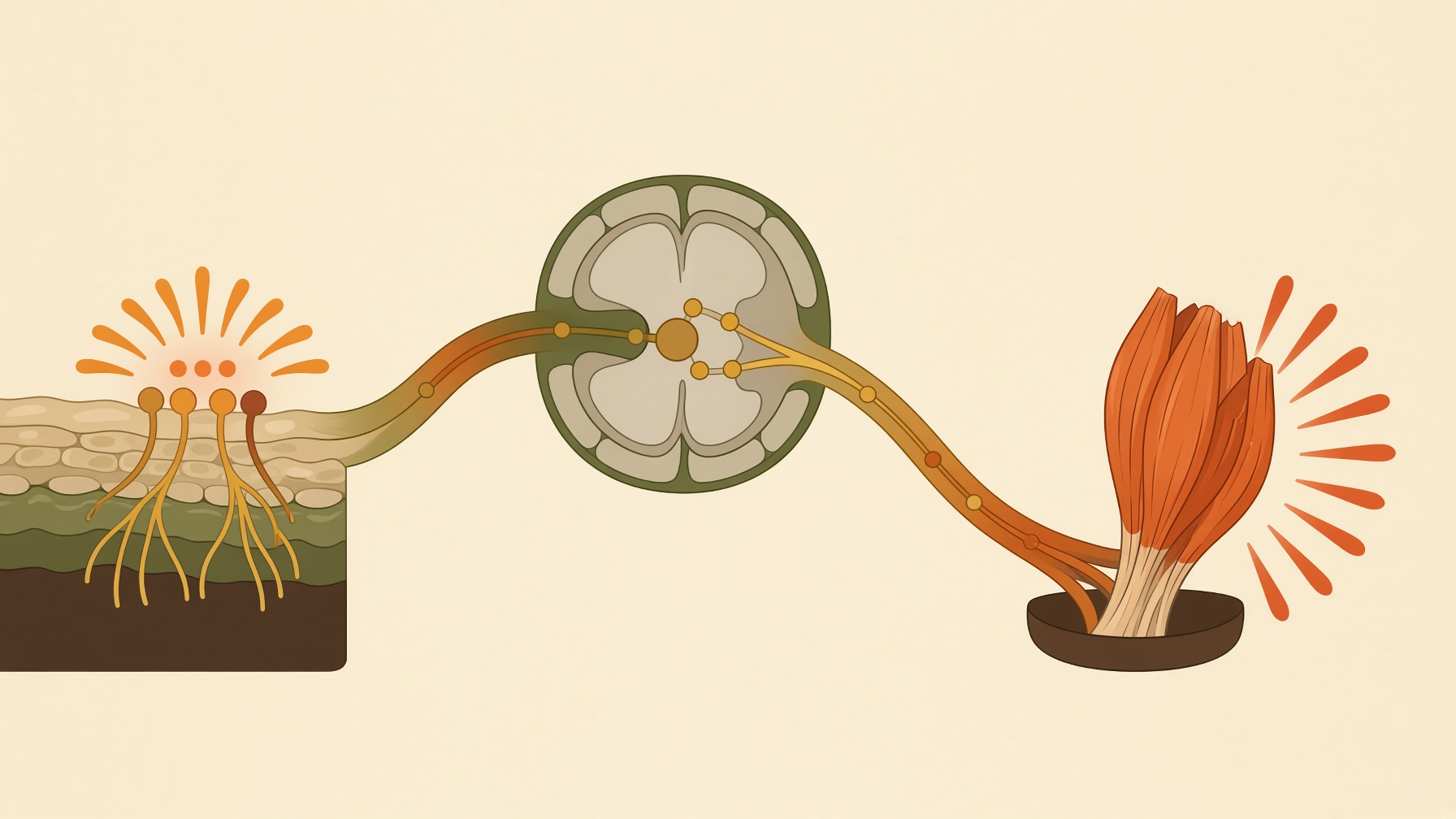
How Your Body Turns a Stimulus Into a Reflex
A reflex arc carries sensory information into the central nervous system and sends motor commands outward to produce an automatic response.
Wikis
A reflex arc is the neural pathway that mediates a reflex, an automatic response to a sensory stimulus. In its basic form, the pathway includes a sensory receptor that detects the stimulus, an afferent sensory neuron that carries information toward the central nervous system, neural integration within the spinal cord or brainstem, an efferent motor pathway, and an effector such as a muscle or gland that produces the response .1,2
The integrating portion of a reflex arc varies in complexity. In a monosynaptic reflex pathway, the sensory neuron makes a direct synaptic connection with a motor neuron. The stretch reflex provides a classic example: sensory input from a muscle spindle can directly excite an alpha motor neuron supplying the same muscle. Other reflex arcs are polysynaptic, meaning one or more interneurons are inserted between sensory and motor neurons .1,2
Polysynaptic circuits allow more complex responses. In the withdrawal reflex, for example, sensory input from a noxious stimulus activates spinal interneurons that coordinate motor neurons controlling several muscles, allowing a limb to withdraw from the stimulus. Reflex circuitry can also simultaneously excite some muscles and inhibit others .2
A reflex arc does not imply that the brain receives no information about the stimulus. Many reflex responses can be generated through spinal or brainstem circuitry without requiring conscious processing first, while sensory information can also travel to higher brain centers. Descending signals from the brain can in turn modify spinal reflex activity .1,2
From this collection
A reflex arc carries sensory information into the central nervous system and sends motor commands outward to produce an automatic response.