
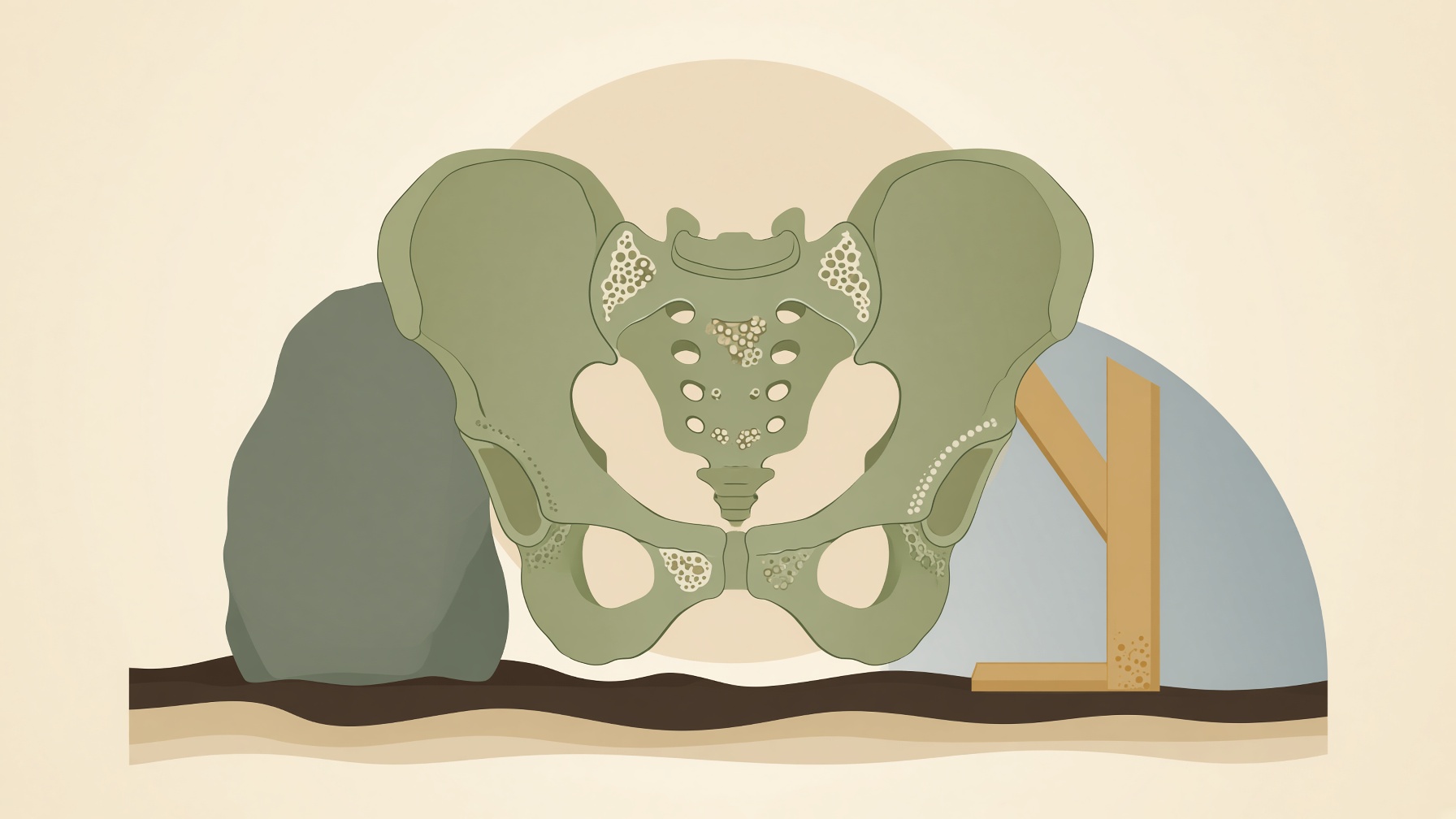
Why Your Pelvis Is Built for Stability
The pelvis limits movement through strong bony connections, providing a stable base that transfers upper-body weight toward the lower limbs.
Wikis
The sacrum is a large, triangular bone at the base of the vertebral column and the back of the pelvis. In most adults, it is formed by the fusion of five sacral vertebrae, designated S1 through S5. Its broad upper end, called the base, lies below the fifth lumbar vertebra, while its narrower lower end, or apex, articulates with the coccyx .1,2
On each side, the sacrum articulates with the ilium at the sacroiliac joint. Through these joints, the sacrum forms an important link between the vertebral column and the pelvic girdle and helps transmit weight and forces from the trunk into the pelvis and lower limbs .1,2
Several anatomical features reflect the sacrum’s origin from fused vertebrae. A central sacral canal continues from the vertebral canal above, while paired anterior and posterior sacral foramina provide passageways for the anterior and posterior rami of the sacral spinal nerves. Ridges on the posterior surface, including the median sacral crest, are formed from fused parts of the original vertebrae .1,2
The sacrum should not be confused with the coccyx, which is the smaller terminal bone directly below it. It is also distinct from an individual sacral vertebra because the adult sacrum is normally a single bone produced by fusion of the five sacral vertebrae .1
From this collection
The pelvis limits movement through strong bony connections, providing a stable base that transfers upper-body weight toward the lower limbs.