
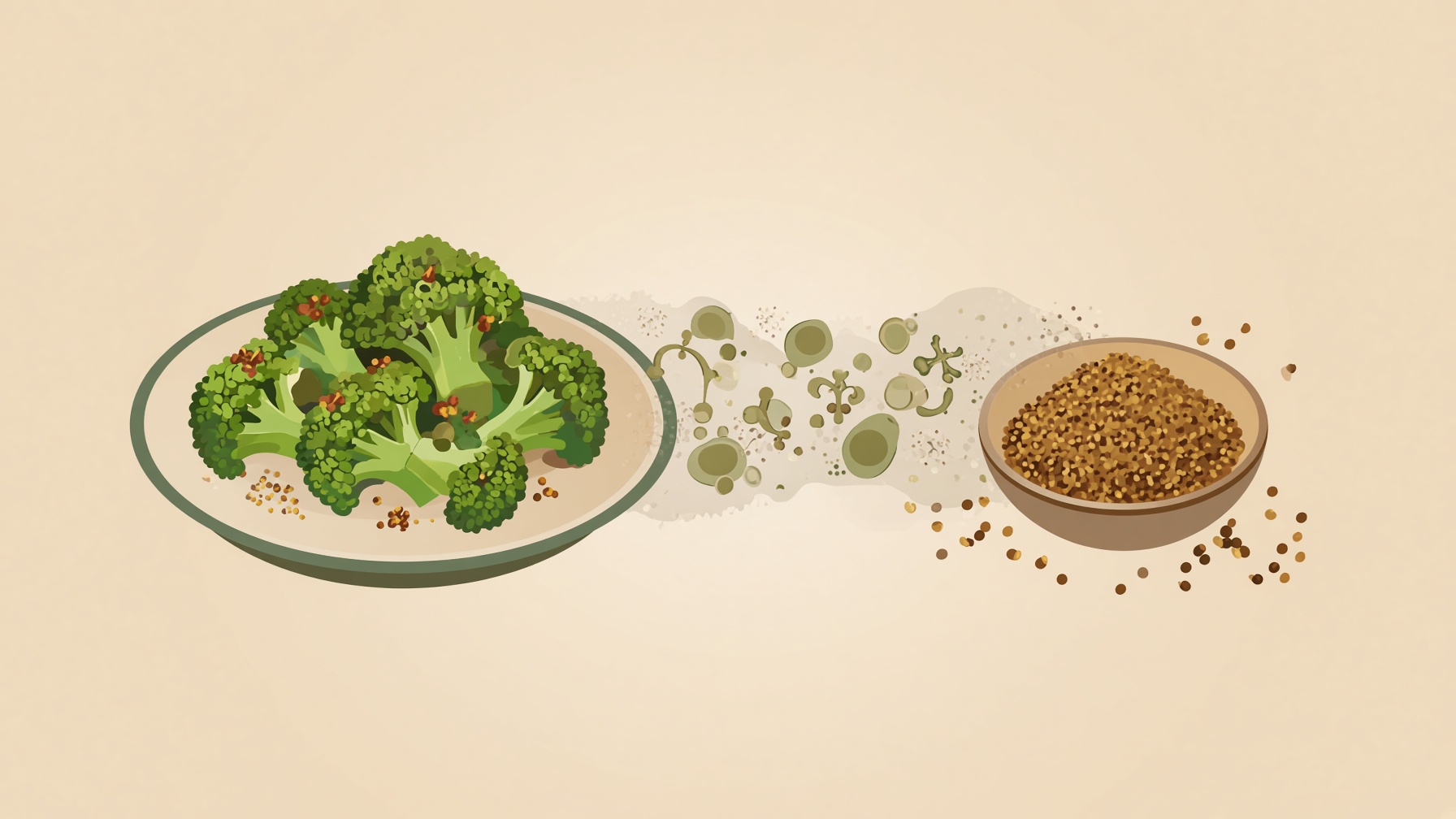
Is the Mustard-on-Broccoli Trick Actually Doing Anything for Your Health?
Ground brown mustard seed increased a sulforaphane-related urinary marker after cooked broccoli in a small trial, without proving a health benefit.
Wikis
Sulforaphane forms from glucoraphanin through a process started by myrosinase, so the precursor amount does not directly show the final yield.
Sulforaphane is a biologically active plant-derived compound in the isothiocyanate family. It forms from glucoraphanin through a breakdown process initiated by the enzyme myrosinase. Undamaged broccoli tissue contains glucoraphanin but little free sulforaphane .1
Tissue disruption allows the enzyme and precursor to meet. The reaction produces an unstable intermediate that can rearrange into sulforaphane. Thus, sulforaphane and glucoraphanin are distinct molecules, and measuring the precursor does not directly establish how much sulforaphane will be produced .1
Sulforaphane is chemically reactive and can influence cellular defense systems, including signaling associated with the regulatory protein Nrf2. This can change the production of enzymes involved in protective responses. Researchers study these effects in cells, animals, and humans, but a biochemical response alone does not establish that a particular preparation prevents or treats disease .1
From this collection
Ground brown mustard seed increased a sulforaphane-related urinary marker after cooked broccoli in a small trial, without proving a health benefit.