
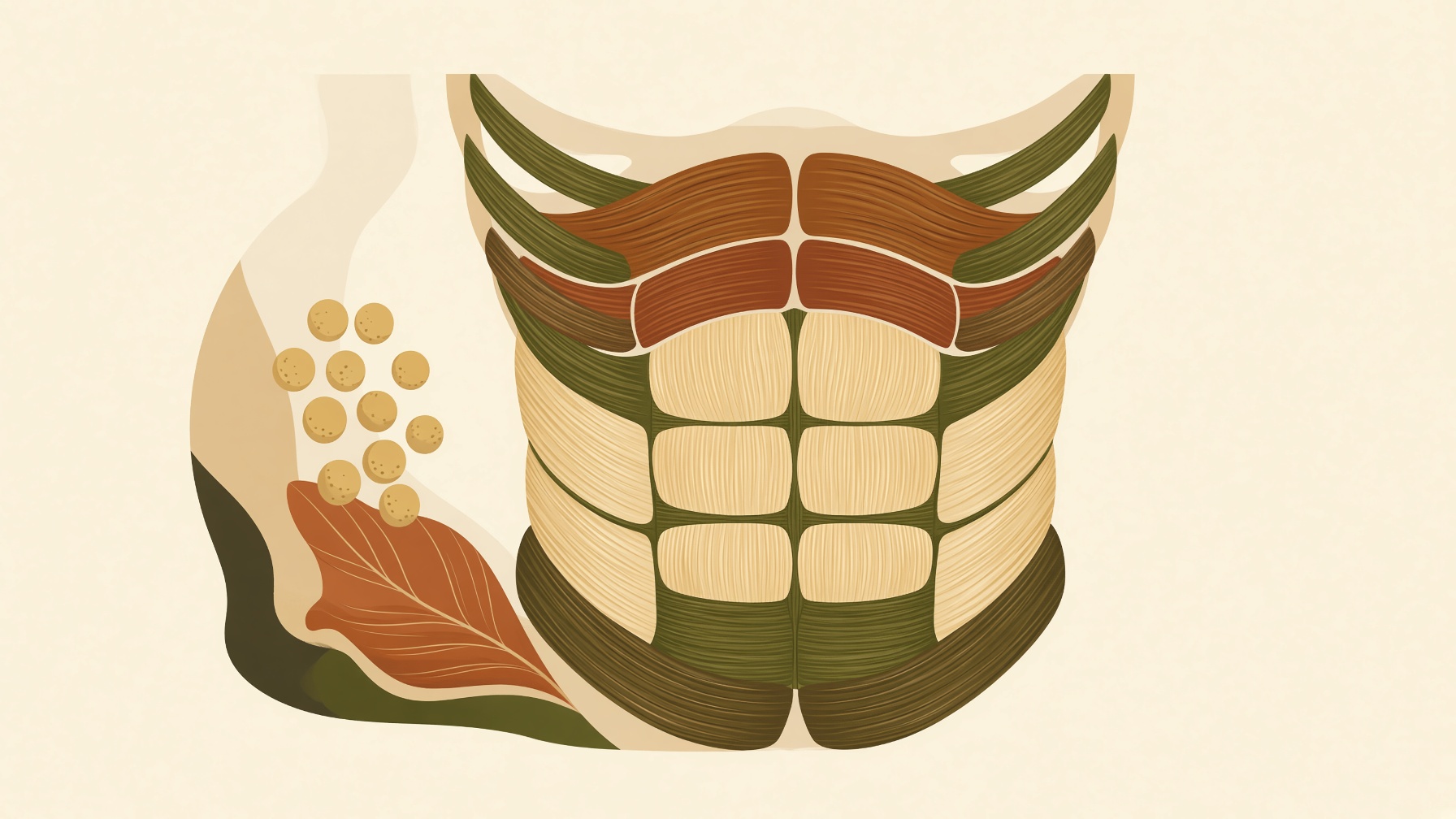
What’s Behind a Six-Pack?
Abdominal muscles form layers with different fiber directions, making the visible six-pack only one part of the anatomy that supports the trunk.
Wikis
The transversus abdominis is the deepest of the three flat muscles forming the anterolateral abdominal wall, lying beneath the internal oblique. Its fibers run predominantly horizontally around the abdomen rather than vertically or diagonally. The muscle arises from structures including the lower costal cartilages, thoracolumbar fascia, iliac crest, and inguinal ligament, and its broad aponeurosis extends toward the midline .1,2
The transversus abdominis primarily acts to compress the abdominal contents and increase tension within the abdominal wall. Its contraction can contribute to increases in intra-abdominal pressure during activities such as forced expiration and other actions requiring abdominal compression .1
Its aponeurosis also contributes to the rectus sheath, the connective-tissue envelope surrounding the rectus abdominis muscles. The course of this aponeurosis differs above and below the arcuate line as part of the layered organization of the abdominal wall .1
The transversus abdominis also participates with other trunk muscles in control of the abdominal wall and lumbopelvic region. It should not, however, be considered an isolated or uniquely responsible “core stabilizer,” because trunk stability depends on coordinated activity among multiple muscles and other structures. The transversus abdominis is distinguished from the external and internal oblique muscles particularly by its deeper position and predominantly transverse fiber orientation .1,2
From this collection
Abdominal muscles form layers with different fiber directions, making the visible six-pack only one part of the anatomy that supports the trunk.