
How Your Body Digests and Absorbs Protein
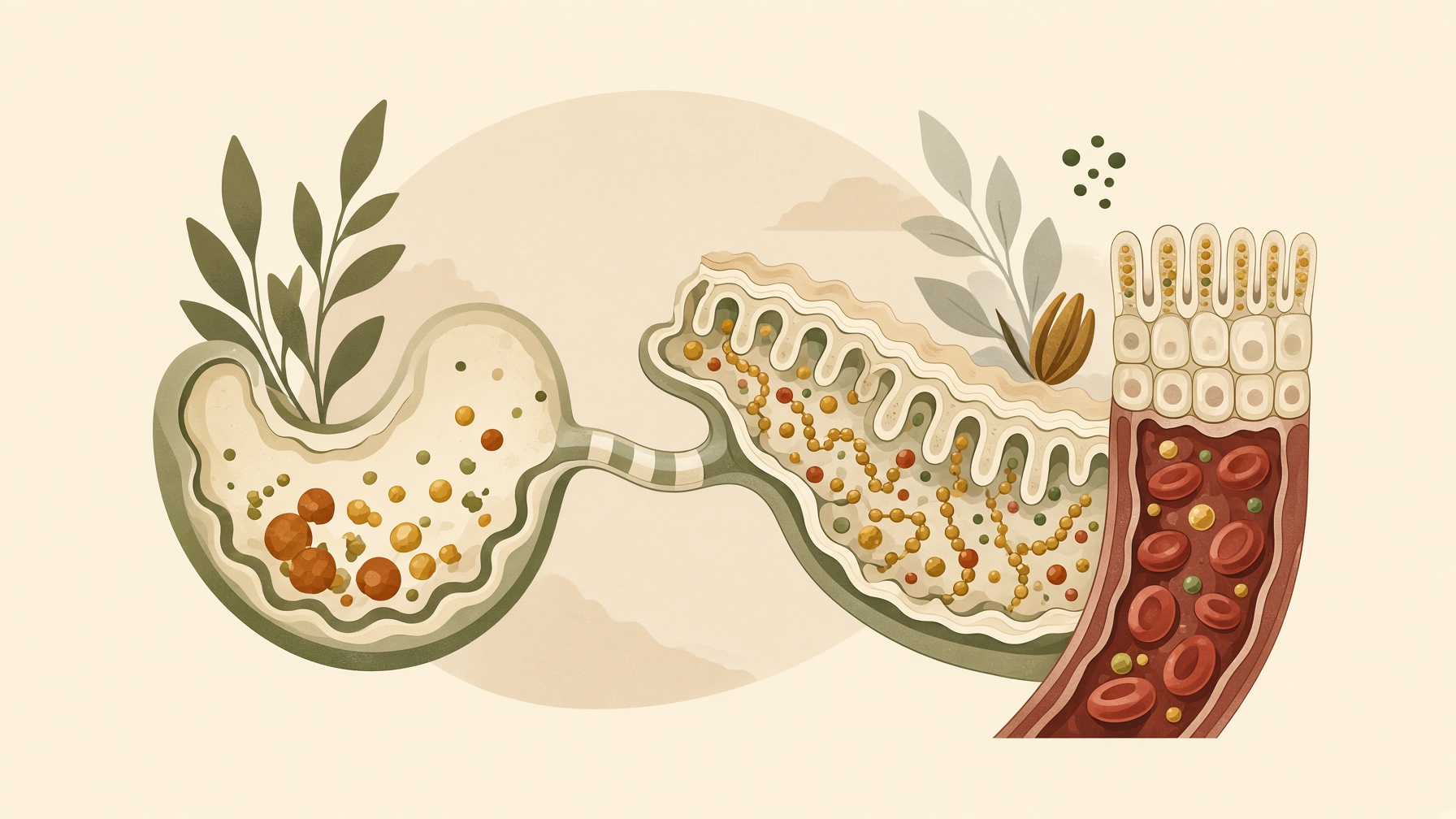
Protein digestion breaks food proteins into amino acids and small peptides that intestinal cells can absorb for the body’s ongoing protein turnover.
Wikis
Tripeptides are peptides composed of three amino-acid residues joined by peptide bonds. In a typical linear tripeptide, three amino acids are connected by two peptide bonds, producing a molecule with an amino end, called the N-terminus, and a carboxyl end, called the C-terminus. The order of the three amino acids is important because changing their sequence produces a chemically distinct peptide .1
Tripeptides can be produced during the digestion of dietary proteins. Proteases in the stomach and small intestine progressively break large proteins into smaller peptides and free amino acids. Dipeptides and tripeptides are among the small peptide products that can be taken up directly by intestinal epithelial cells rather than first being completely hydrolyzed into individual amino acids .2
In the small intestine, many tripeptides enter enterocytes through peptide transporter 1 (PEPT1), a proton-coupled transporter located in the brush-border membrane. PEPT1 uses a proton electrochemical gradient to transport a broad range of dipeptides and tripeptides but generally does not transport free amino acids or larger peptides. After uptake, most absorbed tripeptides are hydrolyzed by intracellular peptidases into their constituent amino acids, although small amounts of some peptides may remain intact .2,3
A tripeptide is therefore distinct from both a dipeptide and a free mixture of three amino acids. A dipeptide contains two amino-acid residues, whereas a tripeptide contains three residues chemically linked as a single molecule .1,2
From this collection
Protein digestion breaks food proteins into amino acids and small peptides that intestinal cells can absorb for the body’s ongoing protein turnover.