

A weight-loss timeline can look surprisingly certain when it is built from simple arithmetic. Divide a calorie deficit by a fixed number, extend the result across the calendar, and a target date appears. The question is whether the body follows that calculation for long enough to make the date reliable.
The familiar 3,500-calorie rule treats a cumulative energy deficit of about 3,500 kcal as equivalent to roughly one pound of body-weight loss. Used as a fixed conversion, it assumes that the same calorie deficit will keep producing weight loss at the same rate as time passes. That is the part the physiology does not support.1
Energy balance still matters: changes in stored body energy require a difference between usable energy intake and energy expenditure over time. But that difference is not necessarily fixed. As body weight and body composition change, energy expenditure changes as well, and behavior can change alongside them. The size of the effective energy deficit can therefore shift during weight loss even if the planned reduction in intake stays the same.2,3
Consider a static calculation built around a 500-kcal daily deficit. Over seven days, that adds up to 3,500 kcal, so the rule predicts roughly one pound of weight loss per week. Repeating the same calculation would produce a straight-line forecast for the following months. The arithmetic is straightforward; the assumption that the same net deficit persists indefinitely is not.1,2
Dynamic models account for that changing relationship. As body mass decreases, the energy required to maintain the smaller body generally changes, so a fixed change in intake does not continue to create the same net deficit forever. Weight loss therefore tends to slow relative to a simple linear projection rather than continuing indefinitely at its initial calculated rate.2
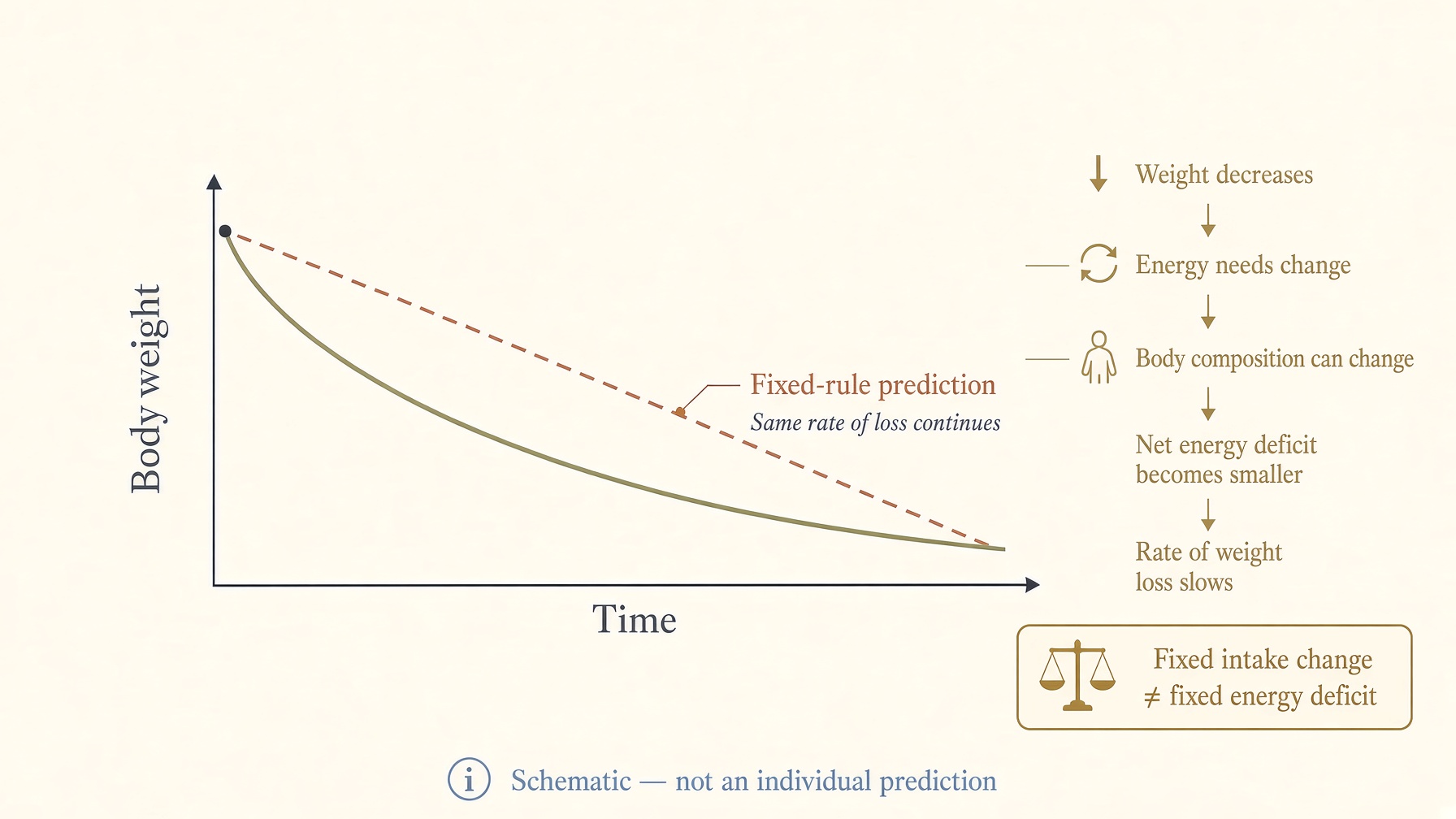
Body composition adds another layer. A pound of lost body weight is not always composed of the same proportions of fat and lean tissue, and those tissues differ in energy content. The energy deficit associated with a given amount of weight loss can therefore vary rather than remaining fixed at one calorie-per-pound value.1,2
The scale can also move for reasons that do not represent an equivalent change in body energy stores. Short-term shifts in glycogen and body water can change measured weight, sometimes noticeably, without indicating the same amount of fat loss. This is one reason a short stretch of scale data should not be read as a precise measure of accumulated energy deficit.3
Dynamic models represent these changing relationships more explicitly than a fixed 3,500-calorie conversion. They can incorporate changes in body weight, composition, and energy expenditure over time, but they are still models rather than guarantees. Their predictions depend on the assumptions and inputs used and on how closely real behavior follows those inputs.1,2,3
The 3,500-calorie rule can make the basic arithmetic of energy balance easier to picture. What it cannot do is turn that arithmetic into a dependable date on the calendar.
Join the discussion
No account or email is required. Your display name and comment will be public.