

Progress photographs are straightforward: the lighting, the pose, the comparison with last month. Questions about bones and the makeup of muscle are harder to fit into that format. If appearance is your usual record of exercise, it is worth asking what kind of progress a photograph was never intended to document.
Not every adaptation to exercise is visible from the outside. Two examples researchers can examine with imaging are bone mineral density and the amount of fat stored within and around muscle. These are different outcomes in different tissues, but they make the same broader point: some changes that matter to health are measured in ways a progress photo cannot capture.1,2
Bone responds to mechanical loading, and exercise studies can examine changes in bone mineral density, a measure of mineral content relative to bone area in commonly used scans. A meta-analysis of 80 controlled studies involving 5,581 postmenopausal women found favorable average effects of exercise on density at the lumbar spine, femoral neck and total hip. These were modest changes measured at specific skeletal sites, not a visible transformation.1
Those findings also need to be interpreted at the level actually studied. The exercise programs varied, and results in postmenopausal women cannot be assumed to describe every age group or every type of activity. A favorable change in bone density is not itself a direct measurement of how many fractures a program prevents. It supports an effect on one marker of bone health without settling every question about bone strength.1
Muscle has an internal composition too. Fat can accumulate within and around muscle tissue, often described as myosteatosis. This does not mean muscle literally turns into fat. Researchers use imaging to examine these deposits and other features of muscle composition, which can differ even when two muscles look similar from the outside.2
A meta-analysis of randomized trials involving 465 adults found that exercise reduced measures of muscle fat infiltration and improved imaging markers associated with muscle composition. Many participants belonged to groups at increased risk of obesity- or sarcopenia-related disability, and most were women. The result does not establish that everyone who exercises will experience the same change, or that an inactive person can be diagnosed with “fatty muscle” by appearance.2
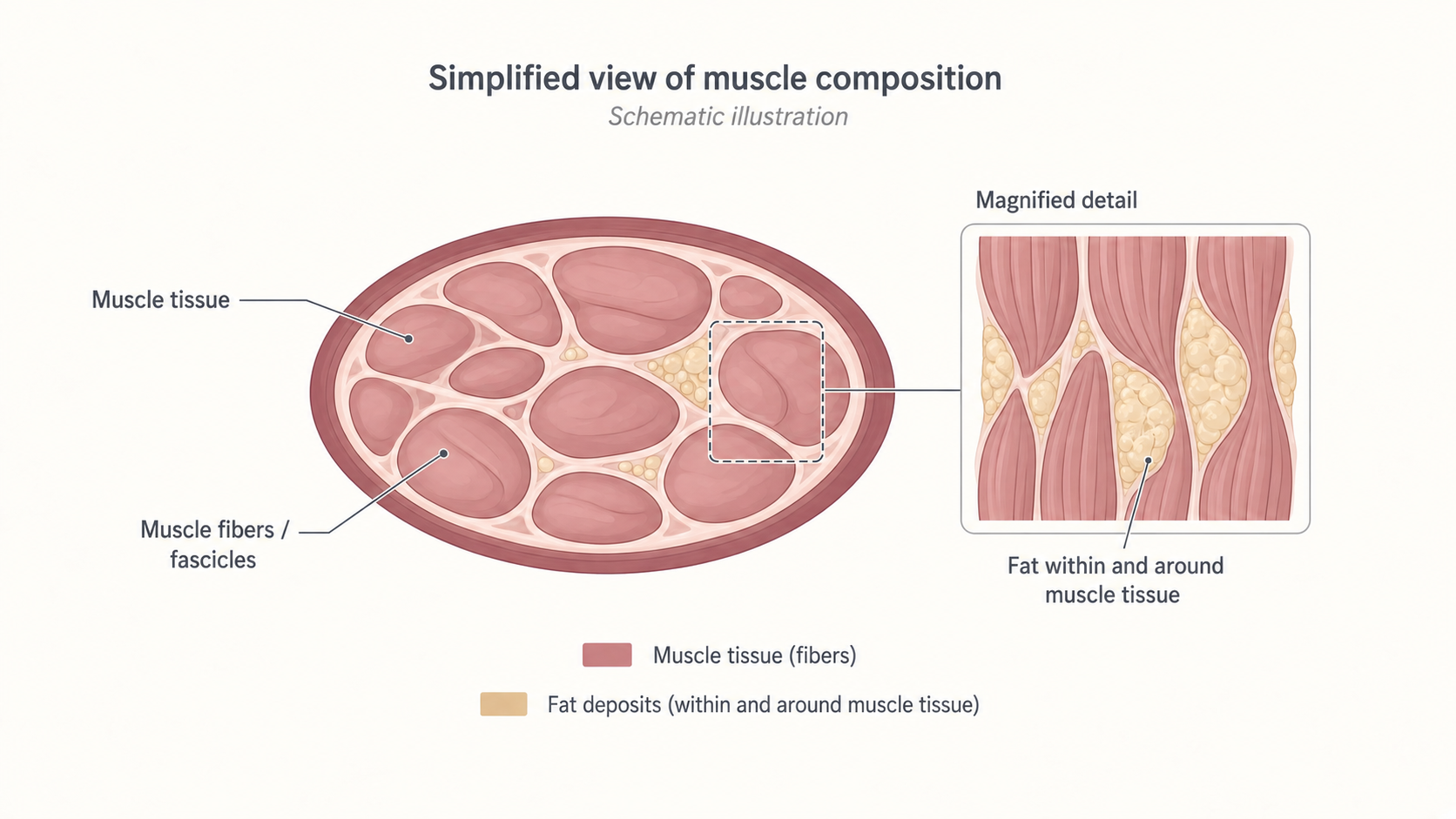
Bone density and muscle fat infiltration should not be treated as interchangeable measures of “fitness.” One describes mineral density at specific skeletal sites; the other describes aspects of muscle composition on imaging. Neither is the same as strength, walking ability, daily function, or a complete measure of tissue health. The available reviews also do not identify one exercise program proven to optimize both outcomes for everyone.1,2
It is perfectly reasonable to enjoy a photograph that marks your effort. You can also leave room for questions that do not have a photographable answer. The record of an exercise habit does not have to be limited to what you can place side by side on a screen.

Join the discussion
No account or email is required. Your display name and comment will be public.