
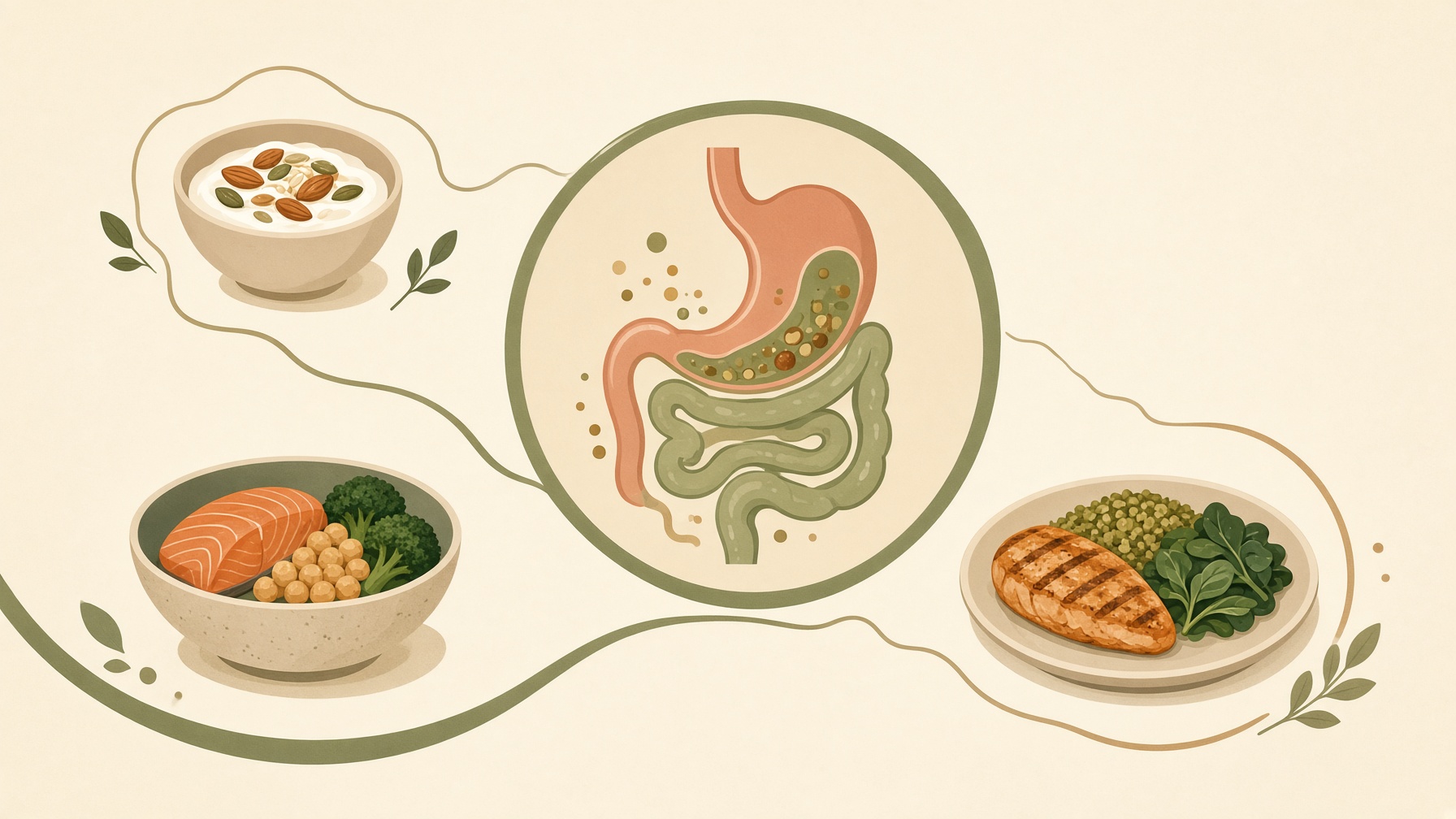
The target seemed simple when you wrote it down. By the end of the day, though, you are adding up breakfast, looking again at lunch and wondering what dinner is supposed to make up. Once a protein goal has been chosen, the everyday challenge is making room for it without turning every meal into a calculation.
Total intake and meal distribution are different questions. Research offers a physiological rationale for including protein at more than one eating occasion, but longer-term studies have not consistently shown that perfectly even distribution improves muscle outcomes when total intake is adequate. That leaves room for a practical meal pattern without treating every meal as an identical assignment. 1
Consider a purely illustrative daily total of 100 grams: meals contributing 25, 30 and 30 grams, plus a snack contributing 15, add up to that number. This is arithmetic, not a universal target or a claim about the ideal amount per meal. The same total can be arranged differently to suit a person's established target and usual eating schedule. The research does not require perfect equality between meals. 1
Food composition makes those slots less abstract. Protein density describes how much protein a food provides relative to its weight or energy content. Yogurt, eggs, fish, poultry, tofu and beans can all contribute, but their amounts are not interchangeable, and products and preparation methods differ. A food label or a matching food-composition entry gives a more useful starting point than assuming that one bowl, slice or scoop always contributes the same amount. 2
For example, a product labelled as containing 10 grams of protein per 100 grams would provide 20 grams in a 200-gram portion. If another product lists 5 grams per 100 grams, the same portion contributes 10. Those are hypothetical label values rather than claims about all yogurts or other foods. They illustrate why the portion actually eaten matters, particularly when appetite makes a much larger serving unattractive. 2
One practical approach is to check a few familiar meals once and keep their approximate contributions in mind. Someone who already knows the usual breakfast provides about 20 grams can plan around that meal instead of rebuilding the calculation every morning. This is a planning convenience, not a physiological strategy: recipes, brands and portions can change, and approximate meal values are only as reliable as the information used to create them.
Supplements can be another way to contribute protein, but the research question is usually whether increasing intake helps, rather than whether everyone needs a powder. A meta-analysis found small additional gains in lean body mass when protein intake increased alongside resistance exercise. That finding concerns protein and training; it does not turn a particular product into a requirement for an ordinary meal plan. 3
The aim is a day of eating you can recognize as your own. A few familiar meals, with room for changes in schedule and preference, may be easier to live with than an evening spent chasing the last gram. Precision can be useful without becoming the main event at dinner.
Join the discussion
No account or email is required. Your display name and comment will be public.