

A Nutrition Facts label contains plenty of numbers, but they become much easier to interpret when you read them in sequence. Start by establishing the serving basis that the numbers describe, then use Percent Daily Value to put individual nutrients in context. The same approach also helps avoid common mistakes, such as treating serving size as a recommendation or counting Added Sugars twice.
Begin with serving size. On a Nutrition Facts label, serving size is based on the amount people typically consume, not on a recommended portion that tells you how much you should eat. Most calorie and nutrient information is then presented for that serving. This matters especially when a package contains multiple servings, because the numbers need to be understood in relation to the amount represented on the label. Some dual-column labels also show information for the entire package or another required basis, so checking the serving information first establishes which quantity each set of values describes .1
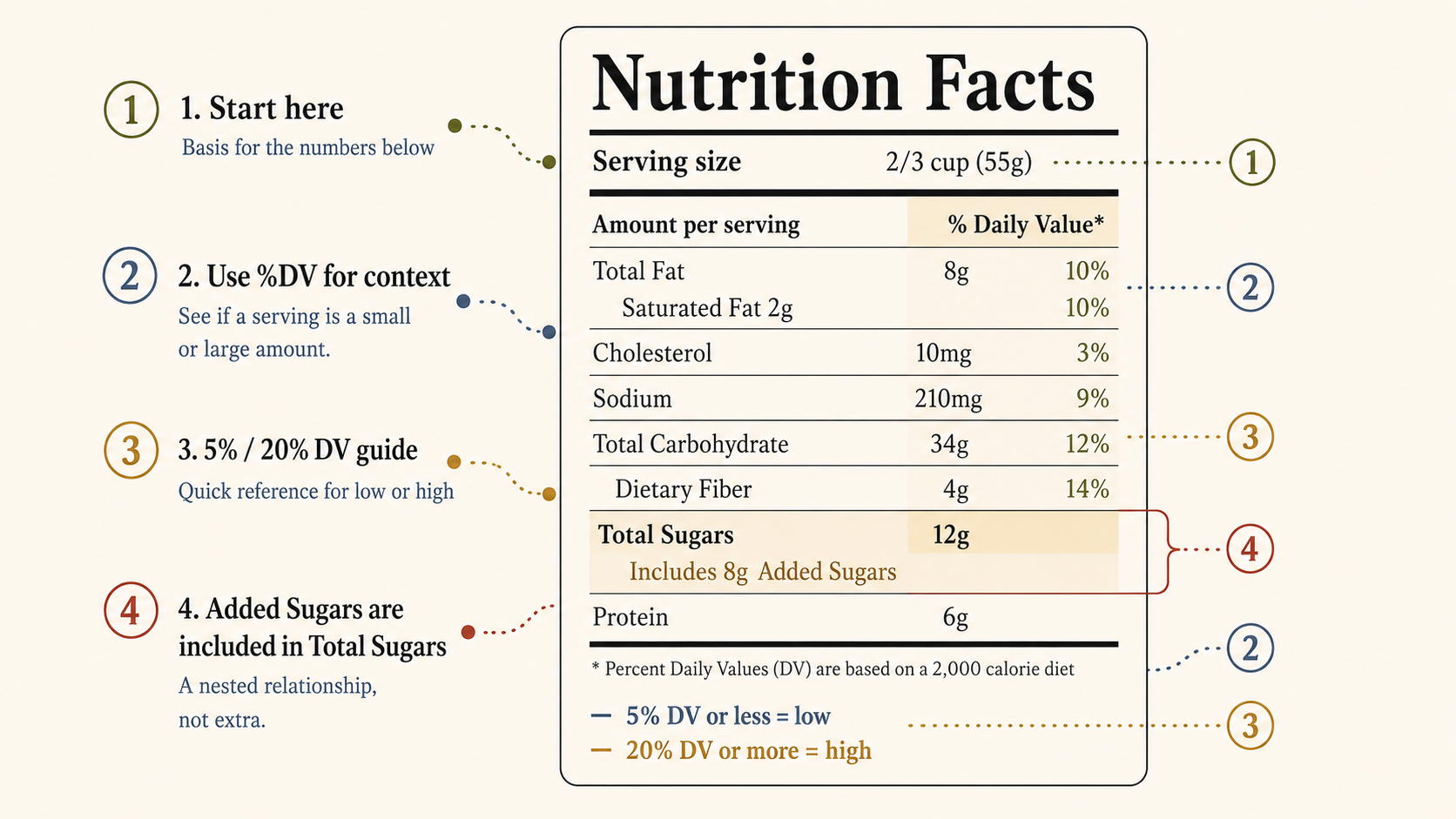
Percent Daily Value, or %DV, adds another layer of context. It tells you what percentage of a nutrient’s standardized Daily Value is supplied by one serving of the food. That makes %DV useful for judging whether a serving contributes relatively little or relatively much of a particular nutrient. The key distinction is that %DV refers to a standardized Daily Value rather than an individualized nutrient target .1
A simple guide can make those percentages easier to interpret. In general, 5% DV or less per serving is considered low, while 20% DV or more per serving is considered high. These benchmarks can be useful for comparing foods, even if your personal calorie needs differ from the 2,000-calorie reference value used for many labels. A high or low %DV is not automatically good or bad; its meaning depends on the nutrient being considered .1
The sugar section provides a useful example of why the relationship between label entries matters. On U.S. Nutrition Facts labels, Added Sugars are included within Total Sugars rather than being a separate amount to add on top. The word “Includes” helps signal this relationship visually: the Added Sugars line identifies the portion of Total Sugars that comes from added sugars. If a label shows both figures, adding them together would therefore count the added sugars twice .1
The most useful habit is to read the label as a sequence rather than as isolated numbers. Start with the serving basis, then use %DV to understand how much a serving contributes relative to standardized Daily Values. The 5%-low and 20%-high guide provides a comparison tool, while related entries such as Total Sugars and Added Sugars should be interpreted together rather than treated as separate totals.

Join the discussion
No account or email is required. Your display name and comment will be public.