
Suppose you are choosing between a bench and an exercise ball for a pressing exercise. Then you come across a headline about “force loss” on the ball, with a percentage that sounds large enough to make the choice for you. Before it does, take a moment to picture the test behind the number. Was someone trying to push as hard as possible without moving, or lifting a bar with a set weight? Which of those situations did you have in mind?
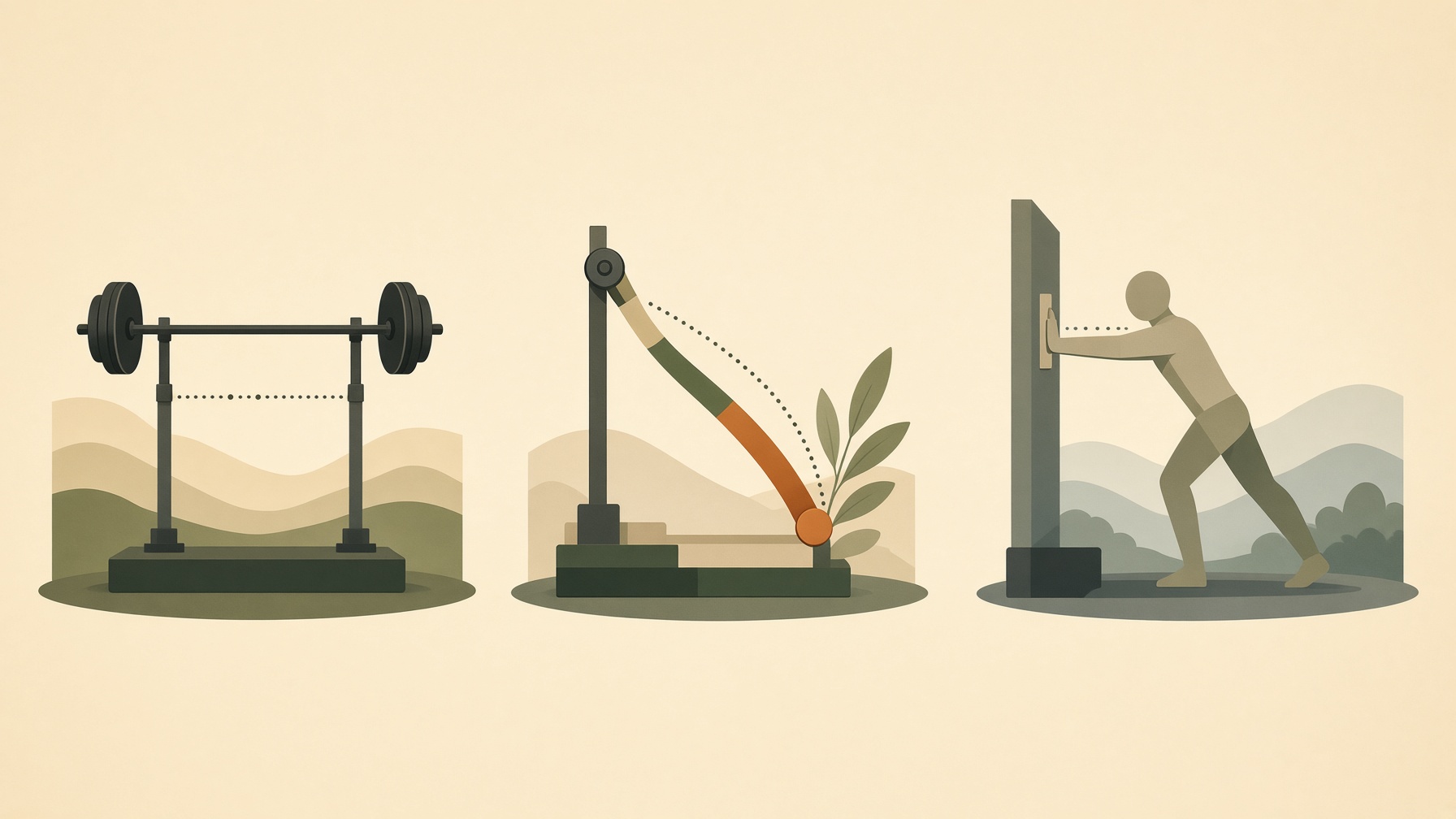
The two force-loss figures came from different pressing tasks. In one test, ten resistance-trained men pushed for five seconds against floor-fixed handgrips. Their maximum force was 59.6% lower with Swiss-ball support than with bench support. The bench supported the head, shoulders and buttocks; the ball supported only the shoulders, with feet grounded. In a separate moving-barbell test, twenty male collegiate judo athletes produced about 6% lower computed peak external force on the ball than on the bench. Both percentages describe a ball-versus-bench comparison, but only the first describes maximum stationary force.1,2
The moving press used the same absolute load on both supports: 50% of each athlete's flat-bench one-repetition maximum, the most they could lift once on that bench. Athletes attempted each repetition at maximal upward speed, and software calculated peak output from bar acceleration. This was neither a measurement of direct muscle force nor a test of the maximum weight they could lift on the ball. Keeping the load fixed also did not establish that it represented the same relative effort on each support.2
Muscle-electrical recordings provide a separate kind of information. Surface electromyography, or EMG, sampled five muscles on the right side in the experiment that measured maximum stationary force. No statistically significant support-surface differences were detected in those recordings. A nonsignificant difference does not establish equivalent electrical activity, equal effort or a measured amount of stabilizing work. The experiment also included moving dumbbell conditions for EMG, but those did not supply an equivalent maximum moving-force measurement.1
The gap between roughly 60% and 6% therefore cannot show that movement itself prevented most of the force loss. The experiments differed in participants, load, equipment, support and force measurement; neither isolated contraction type while holding those other differences constant. Each result establishes an acute output difference for its own task. Neither experiment measured perceived difficulty or established long-term training benefits, and the contrast between them cannot supply those missing conclusions.1,2
Before using either percentage to judge an exercise, decide which question you want it to answer. Are you comparing maximum force, performance with a particular load, or the value of a training method? Check the result against that question. You can assess a specific force measurement without making a broader decision about whether unstable pressing is a good or bad exercise.

Join the discussion
No account or email is required. Your display name and comment will be public.