
How Your Body Digests and Absorbs Dietary Fat
Dietary fat digestion combines physical dispersal by bile salts with enzyme breakdown, producing lipid components that intestinal cells can absorb.
Wikis
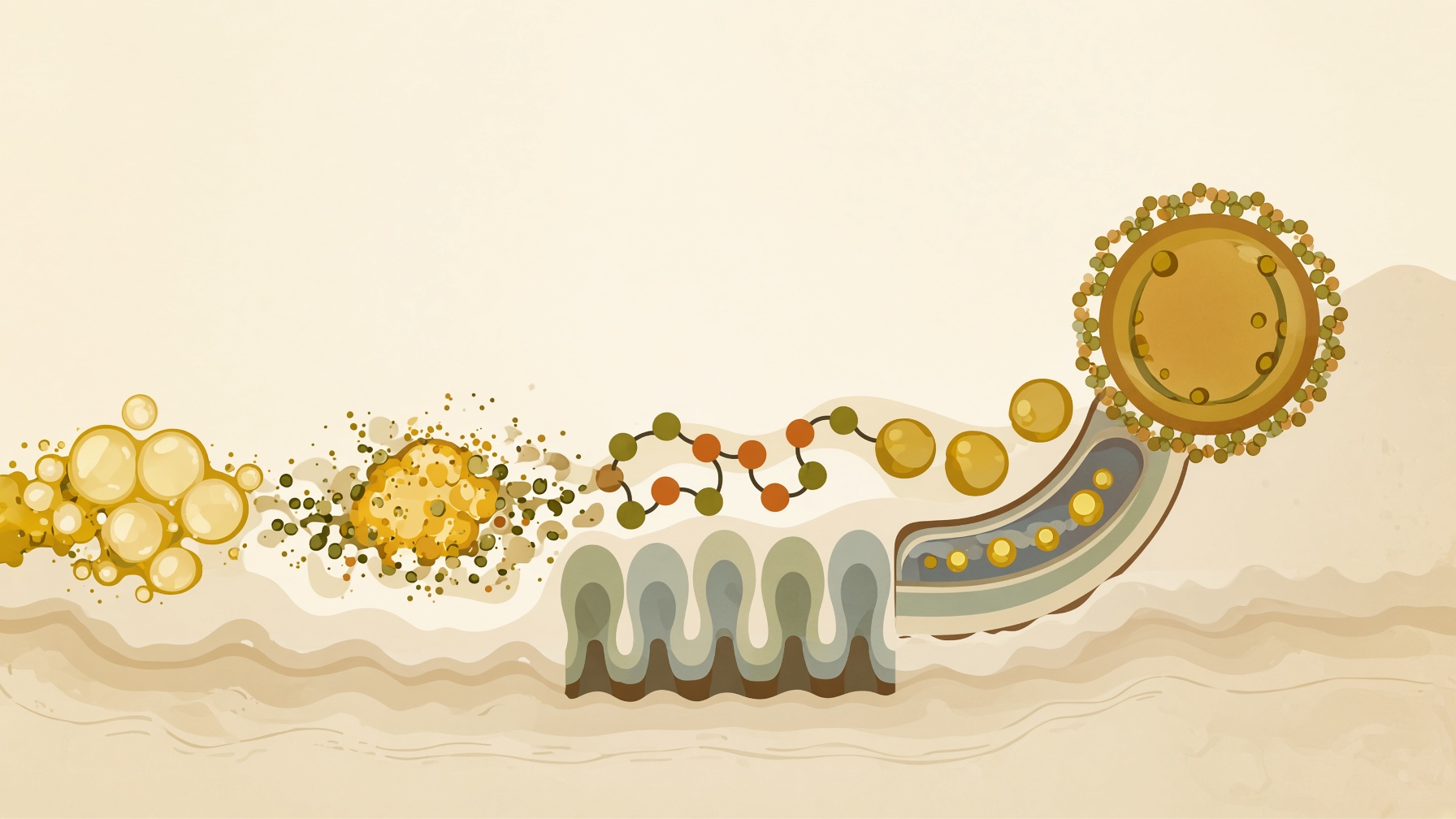
Emulsification is the process of dispersing one liquid into another liquid with which it does not normally mix. In digestion, the term usually refers to the dispersion of dietary fat into small lipid droplets within the water-based contents of the gastrointestinal tract. Breaking larger fat masses into smaller droplets increases the total surface area between lipid and water .1,2
Digestive emulsification begins through mechanical mixing in the stomach and continues in the small intestine. Bile salts are especially important because they are amphipathic molecules, with regions that interact with both water and lipids. By accumulating at lipid-water interfaces, bile salts and other surface-active components help keep lipid droplets dispersed and reduce their tendency to merge into larger droplets .1,2
Emulsification facilitates fat digestion by increasing the lipid-water interface at which digestive enzymes can act. Pancreatic lipase hydrolyzes triglycerides at this interface, producing mainly free fatty acids and monoacylglycerols. The droplet surface changes dynamically during digestion as bile salts, phospholipids, proteins, and digestive enzymes interact with it .1
Emulsification is distinct from both lipolysis and micelle formation. Emulsification physically disperses fat into droplets without itself breaking triglyceride molecules apart. Lipolysis is the enzymatic hydrolysis of triglycerides. As digestion proceeds, bile salts and lipid digestion products form mixed micelles that help keep poorly water-soluble lipids dispersed and transport them toward the intestinal absorptive surface .1,2
From this collection
Dietary fat digestion combines physical dispersal by bile salts with enzyme breakdown, producing lipid components that intestinal cells can absorb.