
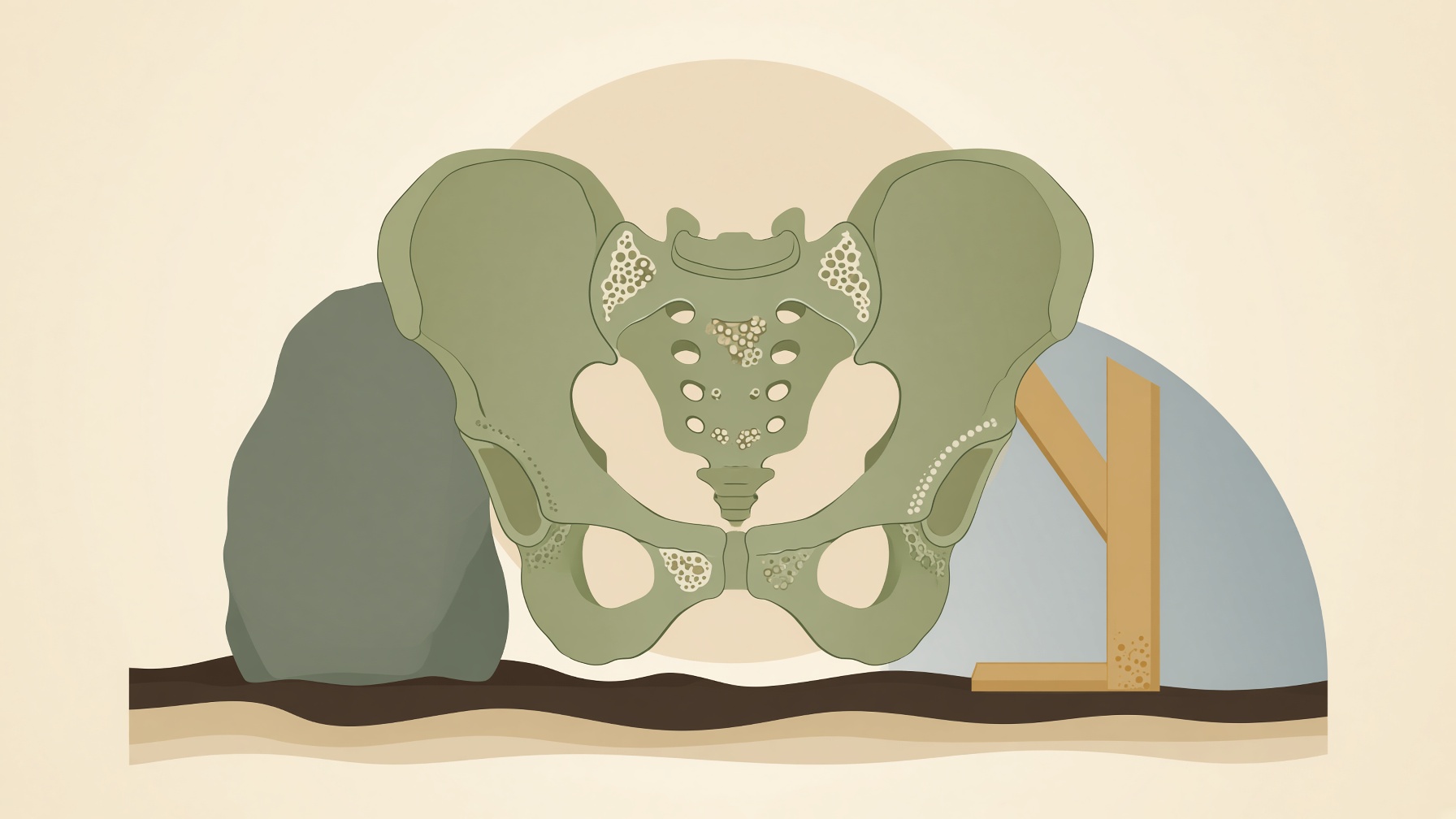
Why Your Pelvis Is Built for Stability
The pelvis limits movement through strong bony connections, providing a stable base that transfers upper-body weight toward the lower limbs.
Wikis
The pectoral girdle, also called the shoulder girdle, is the bony structure that connects each upper limb to the axial skeleton. In humans, each side of the pectoral girdle consists of two bones: the clavicle, or collarbone, and the scapula, or shoulder blade. Together, these bones provide a mobile foundation from which the arm can move .1,2
The clavicle lies across the front of the upper chest and connects medially to the sternum at the sternoclavicular joint, providing the direct bony connection between the pectoral girdle and the axial skeleton. Laterally, it joins the acromion of the scapula at the acromioclavicular joint. The scapula lies on the posterior thorax and contains the glenoid cavity, which articulates with the head of the humerus to form the glenohumeral, or shoulder, joint .1,2
The clavicle acts partly as a strut that holds the scapula and shoulder away from the trunk. It also helps transmit forces between the upper limb and axial skeleton. Because the pectoral girdle can move substantially, movements of the clavicle and scapula contribute to the large overall range of motion available to the upper limb .1,2
The pectoral girdle should not be confused with the shoulder joint itself. The pectoral girdle refers to the clavicle and scapula, whereas the glenohumeral joint is the articulation between the scapula and humerus .1,2
From this collection
The pelvis limits movement through strong bony connections, providing a stable base that transfers upper-body weight toward the lower limbs.