
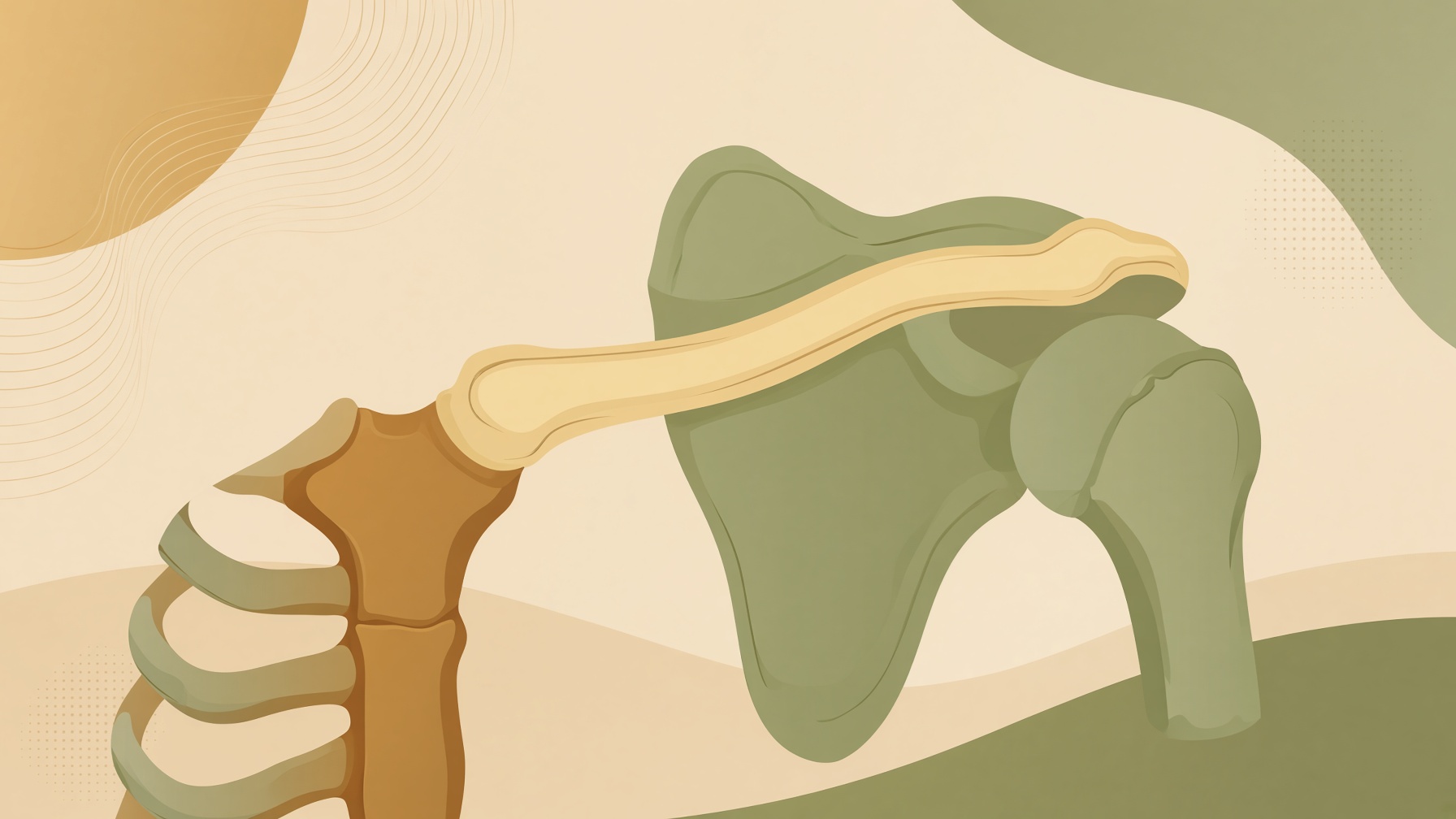
The shoulder can move through a strikingly broad range, but that freedom is not explained by one structure acting alone. Part of the answer lies in the pectoral girdle and, in particular, the clavicle (collarbone). The structure of the pectoral girdle, and the Collarbone’s place within it, helps explain that mobility.
Each pectoral girdle contains two bones: one collarbone and one scapula. The collarbone provides the girdle’s connection to the axial skeleton through a single, highly mobile joint, the sternoclavicular joint. This gives the pectoral girdle its attachment to the rest of the skeleton through a highly mobile connection .1
The collarbone is also unusual in its orientation. It is the only long bone in the body that lies horizontally, extending from the sternum toward the shoulder. At its lateral end, it joins the scapula just above the shoulder joint .1
Movement at this clavicular connection allows the pectoral girdle to shift with the shoulder, which in turn enhances movement of the upper limb. The right and left pectoral girdles can also operate independently, giving each side freedom to move on its own .1
The collarbone also has an important structural role. It acts as a laterally extending strut that supports the scapula and helps hold the shoulder away from the trunk. By maintaining that separation, the collarbone contributes to the large range of motion available to the upper limb .1
Its job is not limited to movement. The collarbone also transmits forces from the upper limb to the sternum and axial skeleton, while helping protect the nerves and blood vessels that pass between the trunk and the upper limb .1
Much of the shoulder’s freedom depends on giving it room to move and the collarbone provides this simple arrangement that makes the shoulder both stable and mobile.

Join the discussion
No account or email is required. Your display name and comment will be public.