
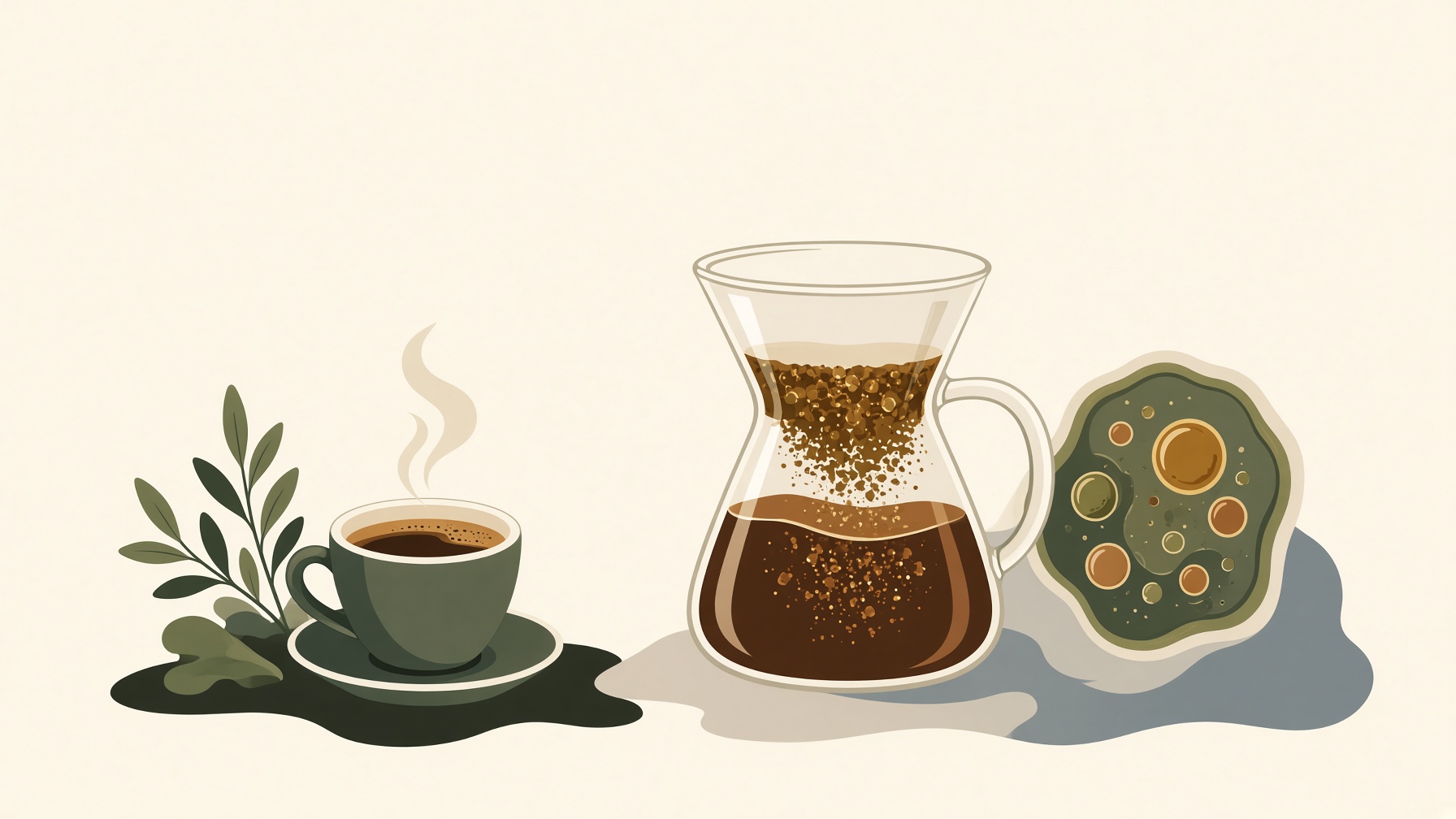
You are ordering coffee and ask for a stronger espresso. Before anyone changes the drink, what do you mean by 'stronger'? Perhaps you are thinking about the taste; perhaps you want to know how much caffeine you will drink. For this question, imagine keeping the same ground coffee in the machine and letting the extraction run longer. What would you want to compare between the shorter drink and the longer one?
Caffeine concentration and total caffeine answer different questions. In mass-based units, concentration is expressed as milligrams of caffeine per gram of beverage. The total is the number of milligrams in the complete serving. Multiplying the beverage’s average concentration by its mass gives that total. A concentration figure alone leaves out how much drink has been collected.1
The liquid arriving later in an extraction need not have the same concentration as the liquid arriving first. In a 2023 espresso experiment, separately collected portions, called fractions, had their highest caffeine concentrations early in extraction. Concentration declined as more beverage was extracted under the tested conditions. These measurements followed extraction from a fixed 20-gram dry coffee dose, using one Arabica source and a flow-controlled apparatus.1
Less concentrated liquid can still contain caffeine. As later fractions join the drink, they can lower its average concentration while adding caffeine to the amount already collected. The cumulative amount counts all the caffeine up to the stopping point, including what arrived in the early, more concentrated fractions.1
At the experiment’s central condition, the calculated cumulative amounts were approximately 129.0 milligrams of caffeine at 20 grams of beverage, 183.8 milligrams at 40 grams, and 207.1 milligrams at 60 grams. The totals combined the first-fraction measurement with integration of fitted extraction curves. They were not direct assays of three separately brewed, complete cups. The endpoints denote grams of beverage, not milliliters, and the values are not universal caffeine amounts for particular shot sizes.1
Continuing extraction also differs from adding plain water to a finished shot. Water added afterward increases beverage mass without supplying additional caffeine; continued extraction collects more liquid from the coffee, which can carry more caffeine into the cup. In this experiment, the calculated total rose at larger beverage-mass endpoints even as later fractions became less concentrated. These chemical measurements do not establish how the espresso tasted or what a particular serving would do to its drinker.1
For a caffeine comparison, state whether you want to compare concentration or the total amount in a serving. Specify the serving and the preparation being compared. Use those details to frame the question, and keep the discussion focused on caffeine. Questions about taste or personal effects can be considered separately, with evidence suited to those questions.
Join the discussion
No account or email is required. Your display name and comment will be public.