

Hard exercise can leave someone breathing quickly and deeply enough to look as though they are “hyperventilating”. In everyday language, that description may seem reasonable, but respiratory physiology uses the term more precisely. The visible effort of breathing does not by itself tell us whether ventilation is excessive or simply responding appropriately to what the exercising body requires.
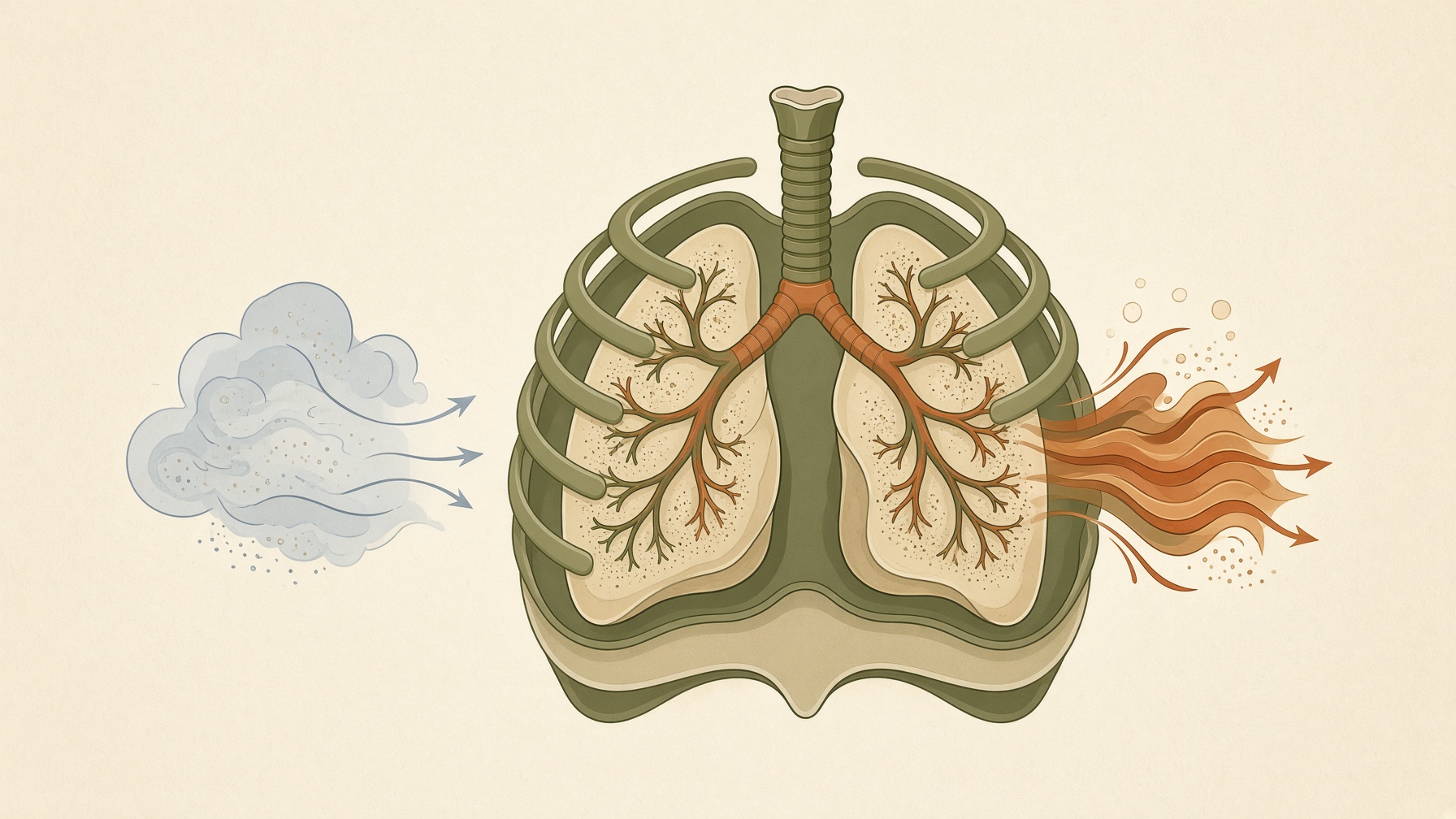
Exercise hyperpnea is an increase in ventilation that is appropriate to increased metabolic demand. It commonly involves changes in both breathing depth and rate, although the balance between those changes can vary. Hyperpnea occurs during exercise, and during typical mild-to-moderate exercise in healthy people, ventilation generally matches metabolic demand closely enough that arterial carbon dioxide stays near resting levels and changes in blood gases remain small. At higher exercise intensities, however, this relationship can change and arterial CO₂ may fall as ventilation rises disproportionately .1
Hyperventilation means something more specific: alveolar ventilation exceeds what is required for metabolic carbon dioxide production. Breathing rapidly by itself is therefore not enough to establish that hyperventilation is occurring. When ventilation becomes excessive relative to CO₂ production, arterial CO₂ falls and hypocapnia can develop .2
The control of exercise hyperpnea involves several interacting signals rather than one simple trigger. Proposed contributors include feedforward central command, feedback from exercising muscles, and chemical signals related to respiratory gas exchange. Timing provides an important clue: ventilation changes almost immediately at the onset and cessation of exercise, too quickly to be explained solely by slower metabolic feedback. This supports an important role for neural mechanisms. Those observations support neural involvement, but they do not identify one particular pathway as the sole controller of the response .1
This distinction matters because outward appearance can be misleading. Two people may both be breathing rapidly, yet the physiology behind that breathing can be quite different. During exercise, heavy breathing is often a normal part of meeting increased metabolic demand rather than evidence that breathing has become inappropriate. Understanding the terminology makes it easier to describe the ventilatory response by what it is doing physiologically, not simply by how intense it looks.

Join the discussion
No account or email is required. Your display name and comment will be public.