
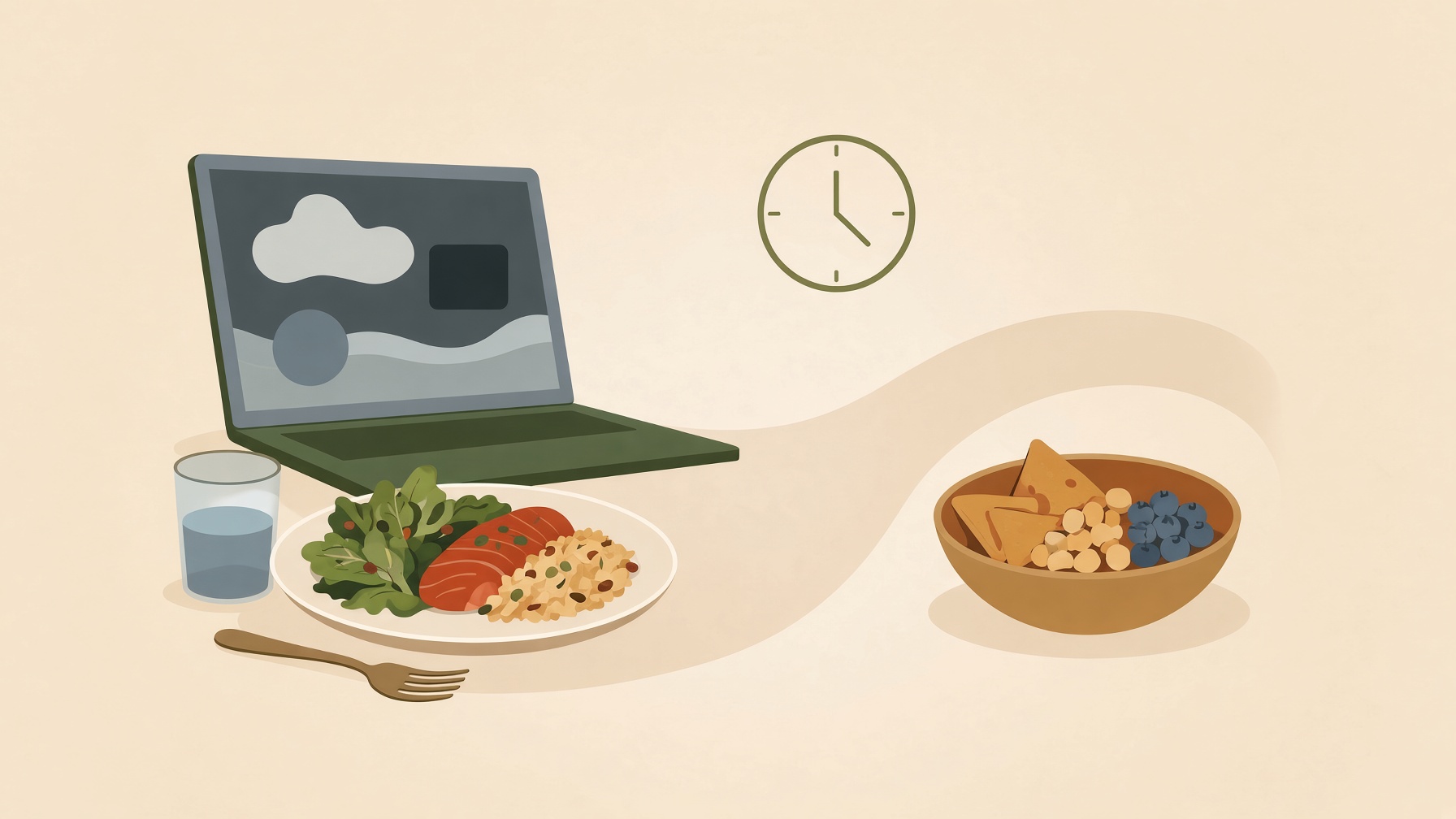
If you eat your usual lunch while watching a video, the unchanged portion might seem to show that distraction made no difference. Is the amount eaten at that meal enough to settle the question?
A review of controlled experiments in adults found that distraction during a meal could increase how much people ate at a later meal or snack. Participants ate a fixed portion during the initial meal, with more or less distraction, before taking part in a later eating test. There, they could decide for themselves how much of the available food to eat, rather than being required to finish a prescribed portion. The outcome was food actually consumed, measured by weight or by its energy content. The comparison was with the least distracting condition available in each experiment, which sometimes still involved another task.1
That first portion was set by the experiment, so it cannot show whether people would have chosen to eat more if given the option. A prescribed lunch and a freely chosen lunch that happens to be the same size are different things.1
When adults were free to choose how much they ate during distraction, the overall increase was uncertain. These were separate experiments from the later-intake tests. Results varied with the activity: relatively passive distractions, such as watching television, showed increases in the review. The overall estimate combined those with other kinds of tasks, so its uncertainty does not establish that watching a video leaves meal size unchanged.1
The immediate and later findings cannot be joined into a single account of the same people eating an unchanged lunch and then a larger meal afterward. The study groups and meal rules differed. A detectable increase at the later test, alongside an uncertain immediate result, does not establish that distraction acts only later or that its effect grows as time passes.1
The later tests took place between five minutes and three hours after the initial meal across the included experiments. How large and consistent the later increase is remains uncertain. The tasks, meals and delays between eating occasions differed, and the combined findings may overstate the size of the increase. These short laboratory tests also leave uncertainty about ordinary desk lunches. They measured food consumed at a later occasion, not a whole day's intake or the reason for one person's afternoon hunger.1
If you describe lunch as “the usual sandwich,” you’ve said what you ate, but not much about what the break was like. Watching a video is part of that experience too. It’s reasonable to be curious about both, without assuming that the screen explains every time you feel hungry later.
Join the discussion
No account or email is required. Your display name and comment will be public.