
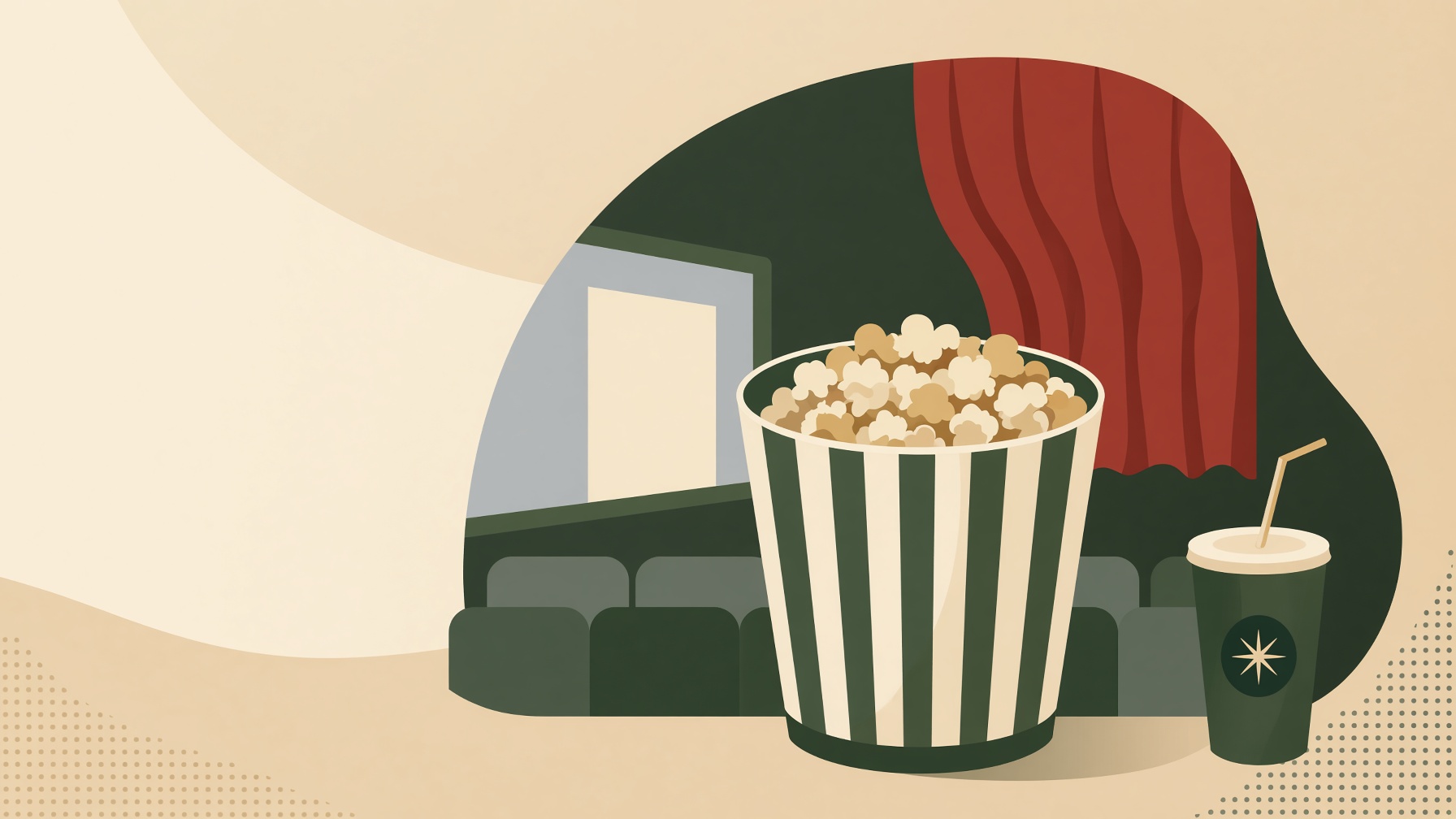
You're watching a movie with a box of popcorn beside you. A few handfuls in, you pause over a small question: am I still enjoying this, or am I simply carrying on? It is an ordinary moment, and a surprisingly tricky one to investigate. How could we tell whether the next handful has more to do with the popcorn itself or with the familiar way of eating it? That is the question behind a comparison of fresh and stale popcorn.
The relevant routine in two popcorn experiments was specific: how often people reported eating popcorn at cinemas. Participants received fresh or seven-day-stale popcorn, and intake was weighed and analyzed as the percentage of the box eaten over 15 minutes. Liking was rated separately after eating; stale popcorn was liked less. This comparison concerned lower current appeal, not a documented decline in someone's enjoyment of a once-favorite snack.1
People who reported eating popcorn more often at cinemas showed a smaller difference in fresh-versus-stale consumption in the cinema than in a comparison room. In the cinema, people watched movie trailers; the separately recruited room group watched music videos. The comparison therefore did not isolate place alone. Among the more habitual cinema eaters, the lack of a statistically clear freshness difference did not prove equal intake of fresh and stale popcorn.1
The way people performed the action also mattered to the pattern. In the second experiment, cinema sessions were assigned a hand for holding the popcorn box, constraining which hand remained free for eating. The relationship between reported habit strength and the fresh-versus-stale eating difference varied according to whether people ate with their dominant or nondominant hand. The overall result did not show a clear freshness difference in every subgroup or establish that using the other hand generally reduced intake.1
Together, the setting and action comparisons are consistent with context-linked habitual eating being less responsive to changed food appeal under some conditions. They do not establish eating independently of liking: direct tests of how liking and habit related to intake were inconclusive, and accounting for liking weakened the central patterns. Automatic performance was an interpretation, not a measured cause. These brief sessions also could not show that disrupting an action removed a habit for the long term.1
The question concerns the relationship between enjoyment and eating under particular conditions. It can be discussed without deciding that every repeated action is automatic or that changing the action removes the habit. Keeping the interpretation specific also avoids turning the example into advice about eating less. The focus remains on understanding the behavior being examined.
Join the discussion
No account or email is required. Your display name and comment will be public.