
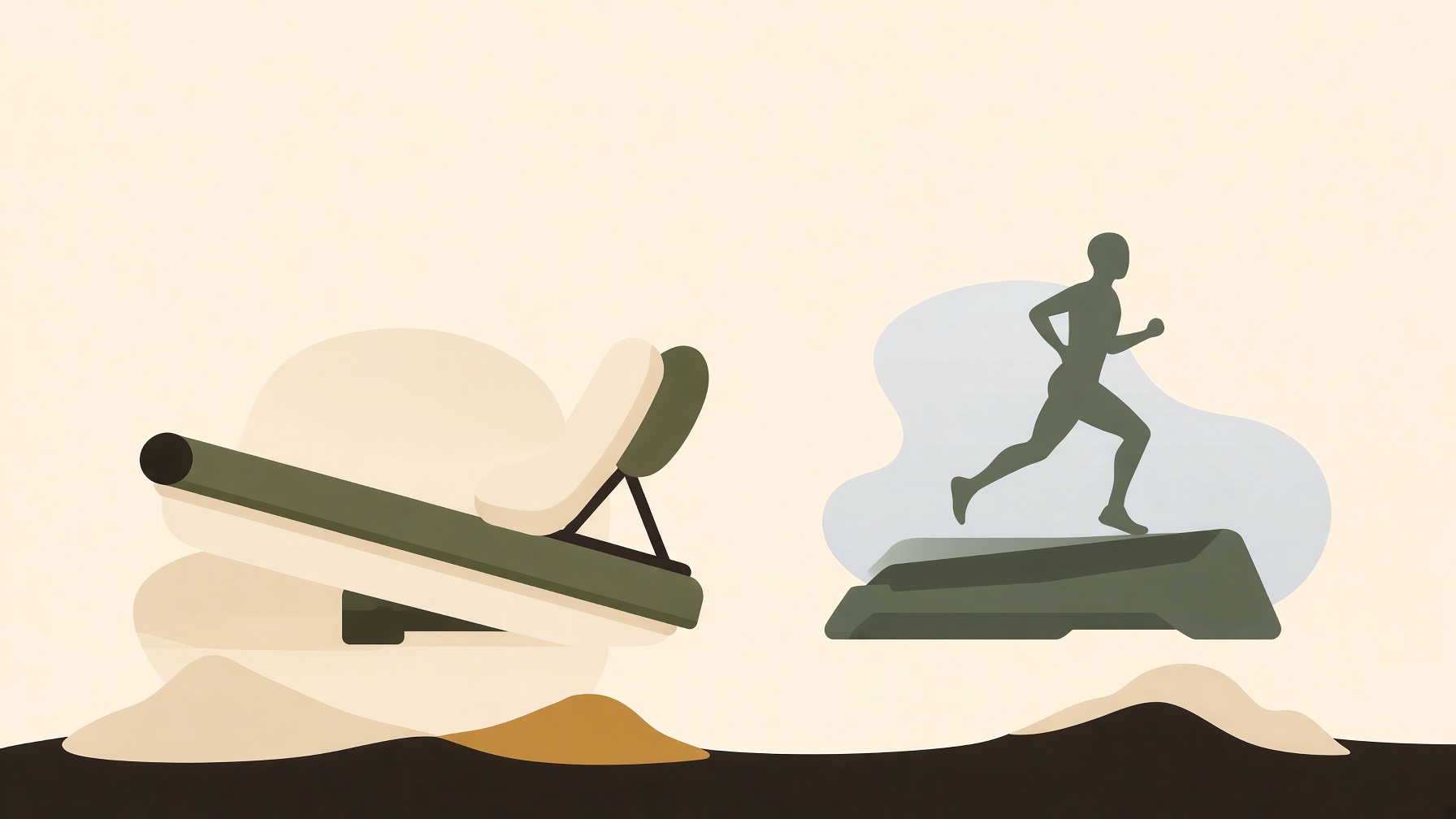
Imagine comparing treadmill workouts with a friend. You both walked at the same speed and incline, and you both held the handrails. Would you describe the walks as the same workout? Before answering, picture each person on the machine: standing upright with hands on the rails, or leaning back with arms straight. If you're trying to understand your own session, that detail deserves a closer look. What, exactly, are we comparing when we say both people were "holding on"?
Holding the rails upright and leaning back with straight arms were separate conditions in a small experiment involving 13 healthy adults familiar with treadmill walking. Participants completed five-minute bouts, including unsupported walking, with the order counterbalanced. At a 10% incline, speed stayed the same for each person across the conditions. The matched treadmill settings allowed a comparison of different instructions for using support and positioning the body. Posture was not isolated from support use.1
Leaning back produced lower short-term demand than either upright holding or unsupported walking. Measured oxygen use and heart rate were lower, as were participants' ratings of how hard the bout felt. Energy expenditure estimated from respiratory measurements was also lower. These findings do not establish what happens with every kind of handrail contact or during longer-term training.1
Upright holding left a less definite comparison. No statistically significant difference from unsupported walking was detected for the measured outcomes. That result does not prove the two conditions were equivalent: the experiment did not use an equivalence analysis to test whether any difference was small enough to count as practically alike. With only 13 participants and short bouts, the upright-versus-unsupported contrast remains uncertain. The lean-back result therefore cannot establish that all rail holding reduces demand. Light or resting contact was not the tested upright instruction.1
Support use and body orientation are plausible contributors to the lower demand during lean-back holding. Their separate contributions, however, were not quantified. Handrail forces and lower-limb mechanics were not measured, so the results cannot specify how much weight the arms supported or assign the response to one mechanical cause. These measurements describe the short bouts tested, not a personal calorie correction or a comparison of long-term training benefits.1
An account of a treadmill session is clearer when it states the speed, incline, body position, and how the rails were used. If you are comparing sessions, those are useful details to record together. They keep the discussion focused on what each walk involved. The comparison can then refer to a defined activity, with fewer assumptions about what "holding on" meant.

Join the discussion
No account or email is required. Your display name and comment will be public.