

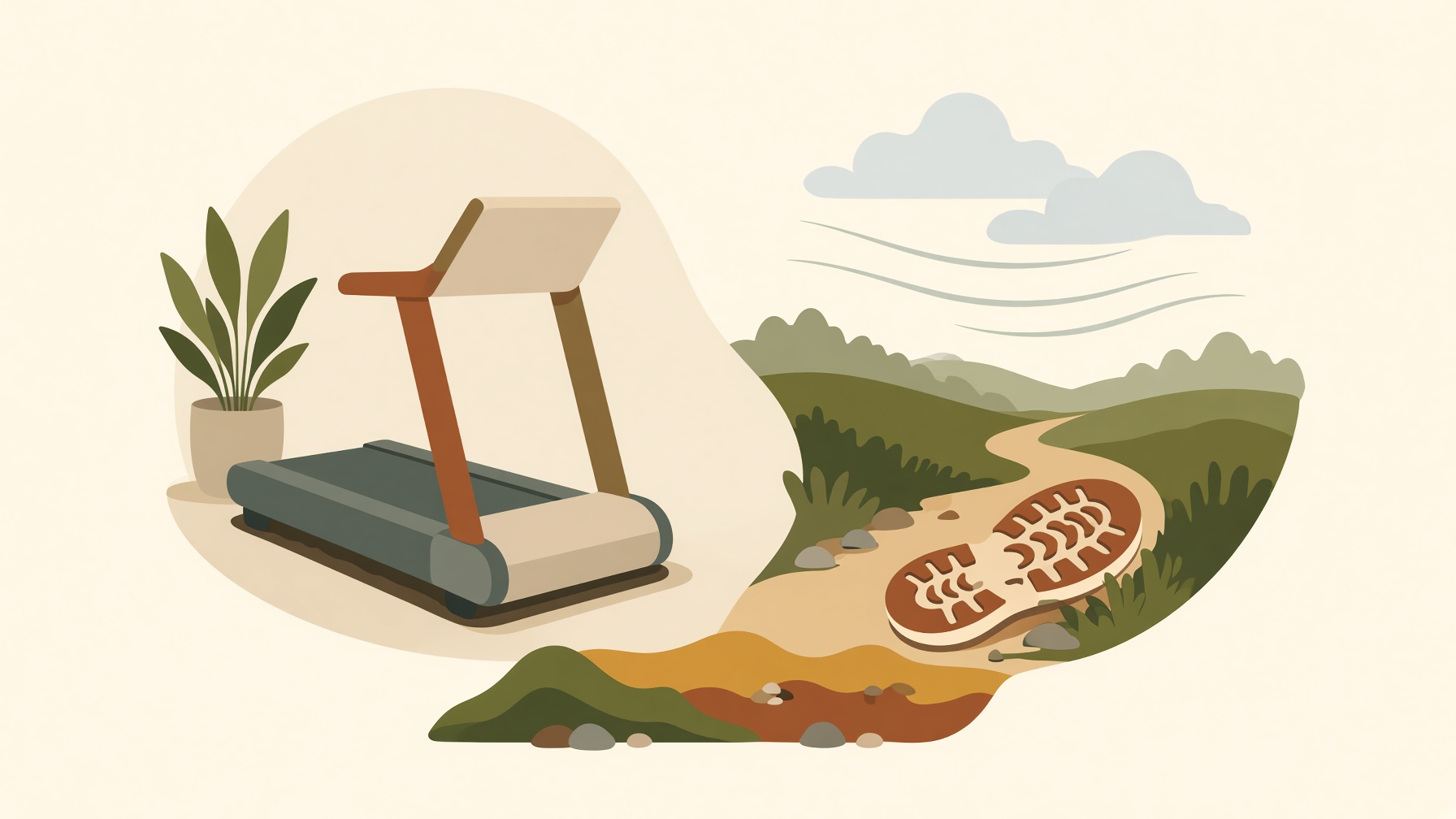
Two walks cover the same distance at the same pace: one on a smooth surface, the other over small bumps. Should those matching numbers mean the body is doing the same task?
In a laboratory comparison, ten healthy young adults walked on treadmill belts fitted with blocks that created repeating up-and-down profiles, without a sustained climb. The largest tested difference between high and low points was 4.5 centimeters. Each person tried a smooth surface and three uneven ones at four prescribed walking speeds, with conditions presented in randomized order. This allowed comparisons within the same walkers.1
Breathing measurements captured the rate of energy use during walking. Subtracting the energy used for standing gave net metabolic expenditure, which rose as the surfaces became more uneven. At a fixed walking speed, the walkers covered each meter in the same time, so that higher rate also meant more energy per meter.1
On the more uneven surfaces, each leg did more positive work on the body’s center of mass, a reference point used to describe its overall movement. Positive work adds mechanical energy to that movement. Researchers calculated it from the force the ground exerted on each leg and the estimated motion of the center of mass. Much of the extra work occurred early in the part of a step when one leg supported the body.1
Together with a mechanical model, those measurements support an explanation involving the redirection of the body between steps. Redirection means changing the body’s motion as one step leads into the next. The work measured on the center of mass is distinct from metabolic expenditure and does not capture all muscle and joint work. It therefore offers part of the explanation for the extra energy demand, without showing that it caused the entire increase.1
How much this changes an ordinary walk remains uncertain. The study involved a small group on artificial surfaces, so it provides no universal outdoor calorie increase or personal prediction. Greater immediate energy expenditure also does not establish that an uneven route offers better training or greater safety.1
Miles and minutes are handy when you keep track of your walks. You probably also remember where you went and what the path was like. Those details help describe the walk you actually took, even when two entries in the log happen to look the same.
Join the discussion
No account or email is required. Your display name and comment will be public.