
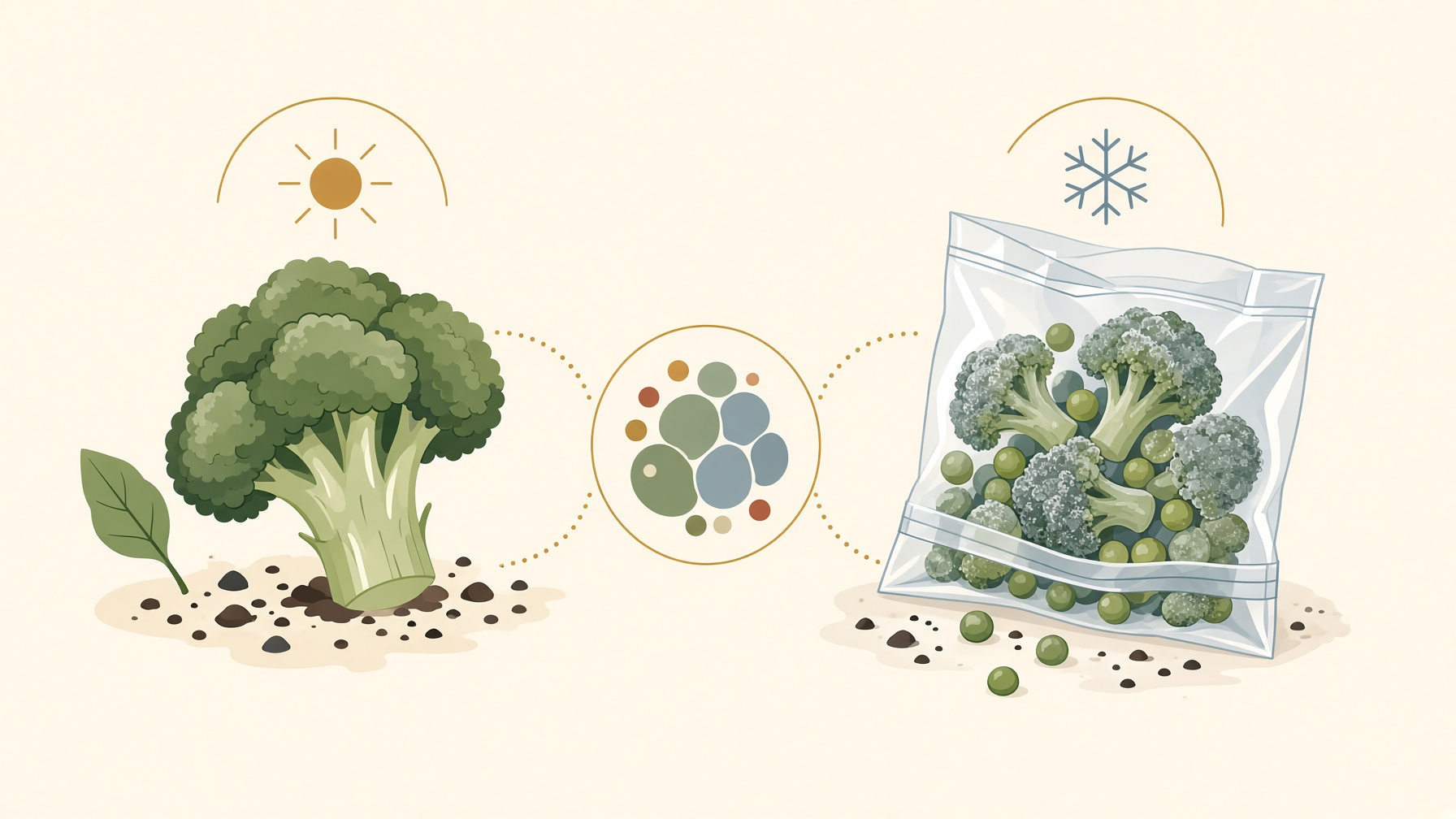
You are planning dinner, with fresh vegetables in one hand and a frozen bag in the other. If you want the more nutritious option, “fresh or frozen?” seems like a reasonable place to start. But imagine looking more closely at the comparison behind the advice. When were those foods tested: soon after harvest, after several days in a refrigerator, or after time in a freezer? Before picking a side, what would you want to know about that timeline?
Storage time was part of the question in an experiment that split produce after harvest into refrigerated and processed-frozen treatments. Day zero fell within 24 hours of harvest. Refrigerated samples were held at 2°C and measured on days zero, three and ten. Frozen samples were held at −27.5°C and measured on days zero, ten and ninety. The vegetables were blanched before freezing, so the frozen treatment included processing as well as freezing. These were study storage schedules, not histories beginning at supermarket purchase.1
For green beans, the measured vitamin C compound was ascorbic acid. Its concentration declined across the sampled days in the refrigerated series, while no decline was statistically detected in the processed-frozen series. For example, refrigerated ascorbic acid averaged 943±55 mg/kg on day zero and 595±77 mg/kg on day ten (means ± standard deviation). The measurements came from six field replicates per commodity and were expressed on a dry-weight basis: nutrient per mass after excluding water. They describe concentrations under the specified treatments, not the total nutrient amount in a household serving.1
The two timelines give that finding its meaning. The refrigerated result followed storage through day ten; the frozen result followed storage through day ninety. Comparing those endpoints does not compare foods of equal age, and neither endpoint is a date when frozen produce was shown to overtake fresh produce nutritionally. A statistically undetected decline in the frozen series also falls short of proof that every molecule was preserved.1
Frozen peas supplied a useful limit to that example. Their riboflavin concentration, also measured on a dry-weight basis, was lower at day ninety than at days zero and ten. Thus, the green-bean result cannot stand for every nutrient in every frozen vegetable. The pea contrast does not rank peas against green beans or score their overall nutritional quality. To interpret a claim about retention, check which crop and compound it names, along with the treatment history, time origin and sampling point.1
Before deciding what a fresh-versus-frozen claim means for you, check which food, nutrient and storage point it refers to. Then consider whether that is the comparison you wanted in the first place. Keep the judgment focused on that particular nutritional question, without turning a result from one set of samples into a buying rule for every kind of produce.
Join the discussion
No account or email is required. Your display name and comment will be public.