
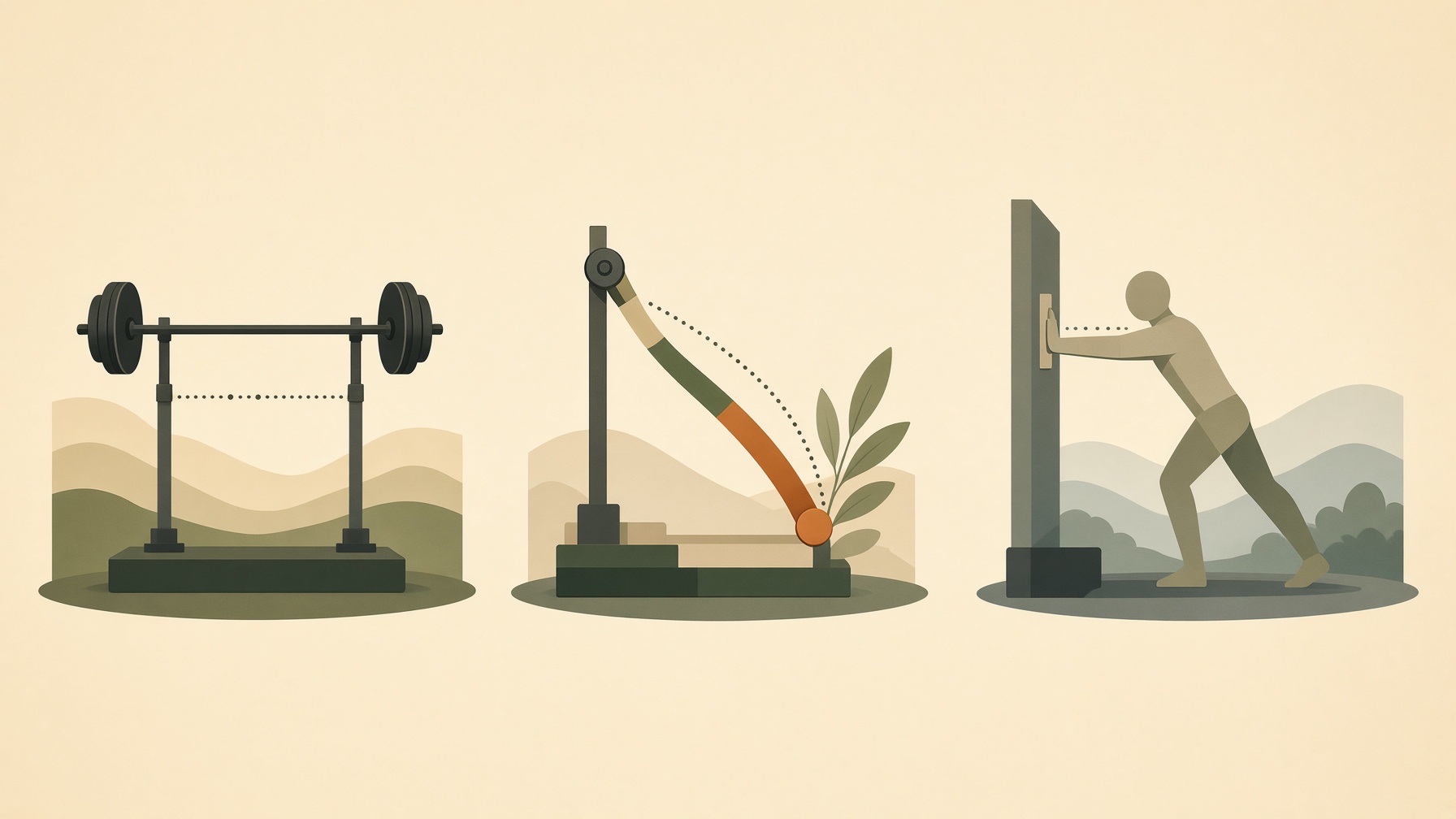
Two resistance exercises can look similar from the outside while placing very different mechanical demands on the body. The resistance may behave differently as the movement unfolds, or the exercise may involve force production without visible movement at all. Recognizing those differences helps make common resistance-training terminology much easier to interpret.
Resistance training can be performed using multiple forms of resistance and muscle action. These terms describe different mechanical features of resistance exercise: constant and variable resistance refer to how loading changes, whereas isometric exercise refers to producing force without appreciable joint movement. The important distinction is what happens mechanically during the exercise .1,2
In constant-resistance training, the external mass or added resistance does not intentionally change across the repetition. Free weights are a common example. The word “constant” refers specifically to the external resistance, not to everything the muscles and joints experience. Muscle force, joint torque, and the difficulty of different portions of the movement can still change even when the weight being lifted stays the same. A fixed load therefore does not imply a fixed muscular demand from start to finish .1
Variable resistance changes the resistance presented to the lifter across the range of motion. That changing resistance can be designed to better approximate differences in a person’s ability to produce force at different points in a movement. The match is not perfect, however. How closely the resistance profile follows an individual’s force-producing capacity depends on the mechanics of the exercise, the design of the equipment, and the person’s own strength curve. Variable resistance therefore changes the loading profile without guaranteeing that resistance exactly matches strength at every position .1
Isometric exercise differs from these dynamic formats because force is produced without appreciable movement at the joint. Although the external position remains essentially fixed, muscle and tendon tissues can still undergo internal changes during the contraction. Isometric resistance training can increase muscular strength, but those gains tend to be greatest at or near the joint angle used during training. They are not confined exclusively to that position, since some strength can transfer to other joint angles. The amount of transfer varies with factors such as muscle length, training angle, intensity, and program design .2,3
These terms are most useful when they describe the mechanical problem an exercise creates rather than when they are treated as competing labels. Changing the loading profile or removing visible joint movement alters what the body must respond to, and those differences can influence how strength is expressed and developed. Understanding the mechanics behind the terminology is therefore more useful than assuming that one format represents a universally better way to train.


Join the discussion
No account or email is required. Your display name and comment will be public.