
Exercise already creates a thermoregulatory challenge because contracting muscles produce substantial heat. When body-water losses accumulate, maintaining thermal balance can become more difficult, particularly under environmental conditions that already limit heat loss. Understanding why requires looking at how fluid status interacts with the body’s responses to rising heat strain.
Body water supports both cardiovascular function and sweat production during exercise. Evaporation of sweat is a major avenue of heat loss, particularly in warm environments, but sweating also removes water from the body. If those losses exceed fluid replacement, a body-water deficit develops, producing a state of hypohydration. Exercise-induced dehydration refers to the process through which that deficit develops .1
As hypohydration becomes more substantial, plasma volume can decline and cardiovascular strain can increase. Hypohydration can also reduce the skin blood-flow response during exercise in the heat, limiting heat transfer toward the skin. Sweating responses can also be altered or reduced as the body-water deficit increases. Together, these cardiovascular and thermoregulatory changes can increase heat storage and physiological strain during exercise .2
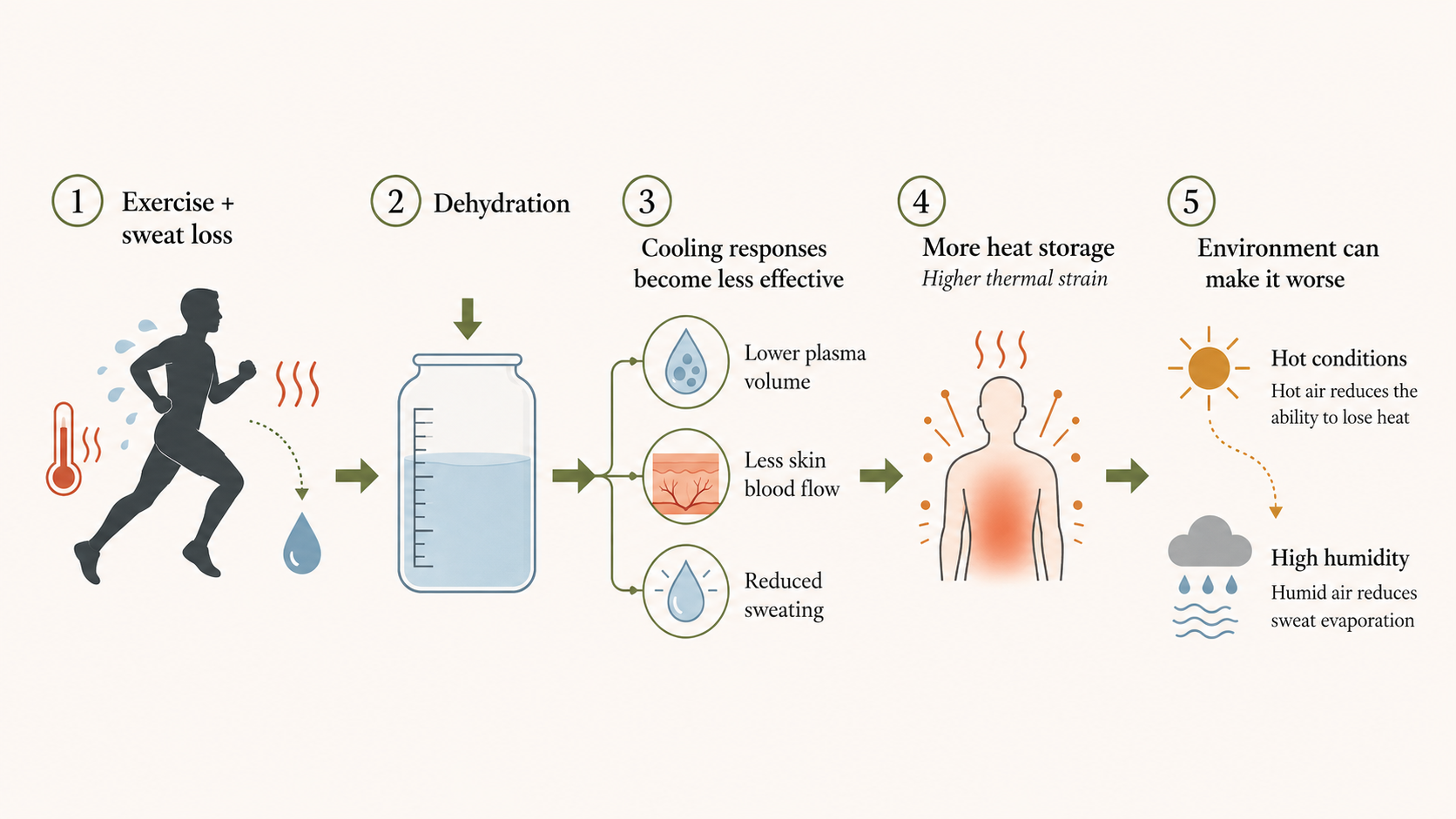
Dehydration can increase susceptibility to exertional heat illness, but it is not required for heat illness to occur. Environmental conditions add their own strain. Higher ambient temperatures can reduce the gradient available for dry heat loss and, when sufficiently high, can promote heat gain from the environment. High humidity reduces the vapor-pressure gradient for sweat evaporation, limiting evaporative cooling. Exercise intensity, acclimatization, clothing, illness, solar radiation, wind, and other factors can also influence risk. Hydration status is one part of a broader thermal challenge rather than the sole determinant .3,4
The broader point is that hydration status changes the conditions under which thermoregulation has to operate. A body-water deficit does not switch cooling off, nor does good hydration make exercise in the heat automatically safe. Instead, fluid status can either add to or reduce an already complex physiological challenge whose outcome depends on the combined demands placed on the body.


Join the discussion
No account or email is required. Your display name and comment will be public.