
A familiar pace can feel very different after months of aerobic training. The same run, ride, or swim may require less effort, while harder workloads become easier to sustain than they were before. Those changes in performance reflect physiological adaptations that develop with repeated training, even though they are not always visible from the outside. Looking beneath the performance change helps explain what improved aerobic fitness actually represents.
Aerobic training can improve maximal oxygen uptake through adaptations at multiple points involved in oxygen transport and use. The relative contribution of those changes can vary with the training program and the individual, so improved aerobic capacity should not automatically be attributed to a single organ or mechanism .1,2,3
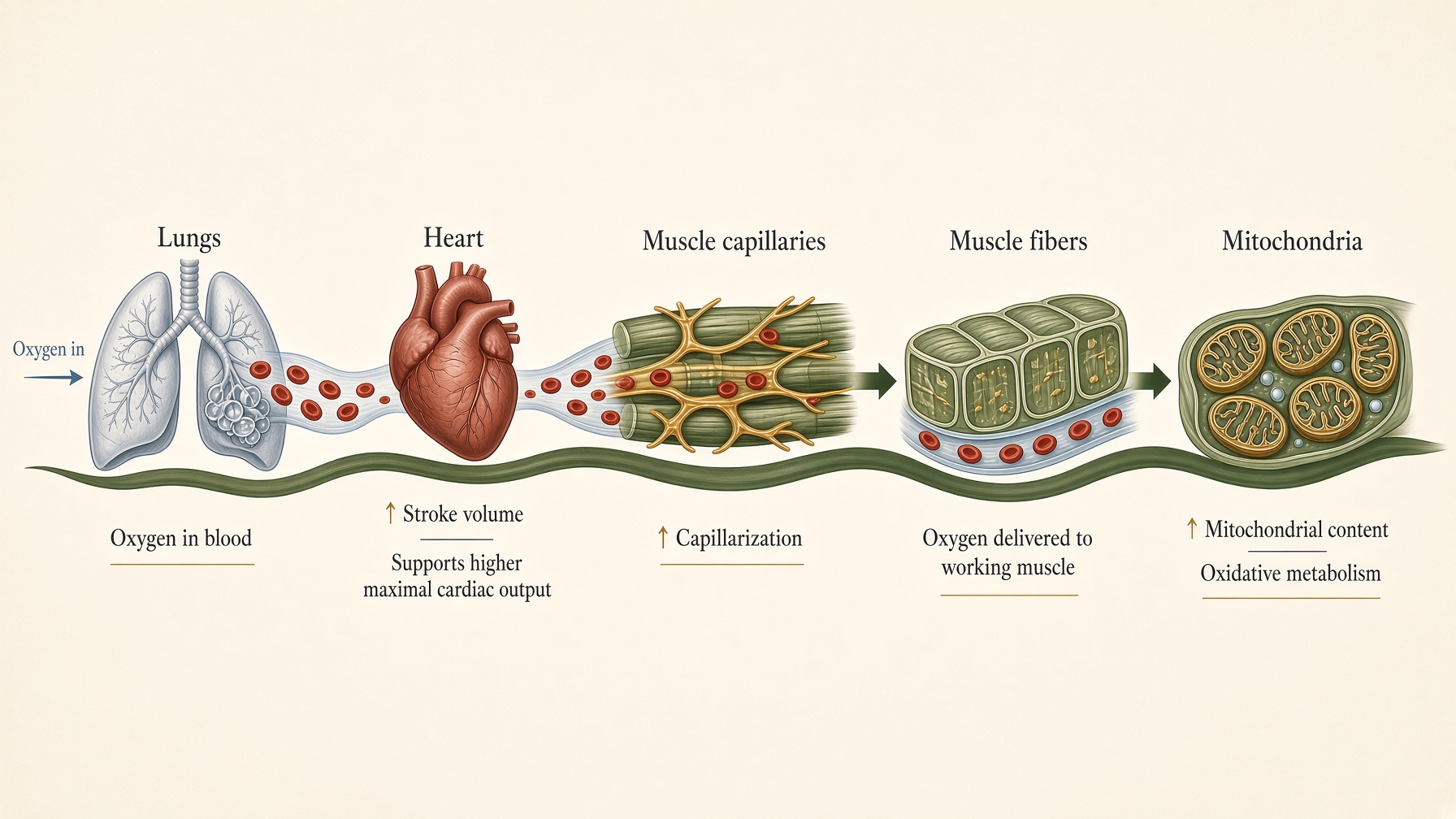
The cardiovascular system can show several adaptations to endurance training. Resting heart rate often decreases, and sustained endurance training can produce physiological cardiac remodeling, including changes in chamber dimensions and cardiac mass. These changes are not limited to the left ventricle. Another distinct change is an increase in stroke volume, the amount of blood pumped with each heartbeat .1,4,5
A greater stroke volume can support a higher maximal cardiac output, although cardiac output also depends on heart rate. Together with arterial oxygen content, cardiac output helps determine how much oxygen can be transported to the tissues . Skeletal muscle adapts as well. Endurance training can increase muscle capillarization and mitochondrial content, changes that support oxygen exchange, extraction, and oxidative metabolism during exercise .1,2,3
Periods of insufficient training can reverse some of these adaptations. VO₂max, stroke volume, blood volume, and aspects of skeletal-muscle oxidative capacity can decline with detraining, although the timing and magnitude of those losses vary .6
A change in aerobic fitness therefore tells us about the performance of an integrated system, but it does not reveal one single adaptation responsible for the result. Two people can improve their aerobic capacity through somewhat different combinations of physiological changes, depending on their starting point and the training they perform. This is why measures such as VO₂max are useful descriptions of overall aerobic function without serving as a direct measure of what changed in any one part of the body.
Join the discussion
No account or email is required. Your display name and comment will be public.