
A body-fat percentage can look like a precise description of the body, yet the number depends heavily on how it was obtained. Different assessment methods begin with different physical measurements and then use those measurements to infer body composition. That is why two legitimate methods can produce values that are not exactly the same for the same person.
None of these methods simply counts all of the fat in the body directly. Each begins with a measurable physical property and uses that information, together with equations, models, or algorithms, to estimate body composition .1
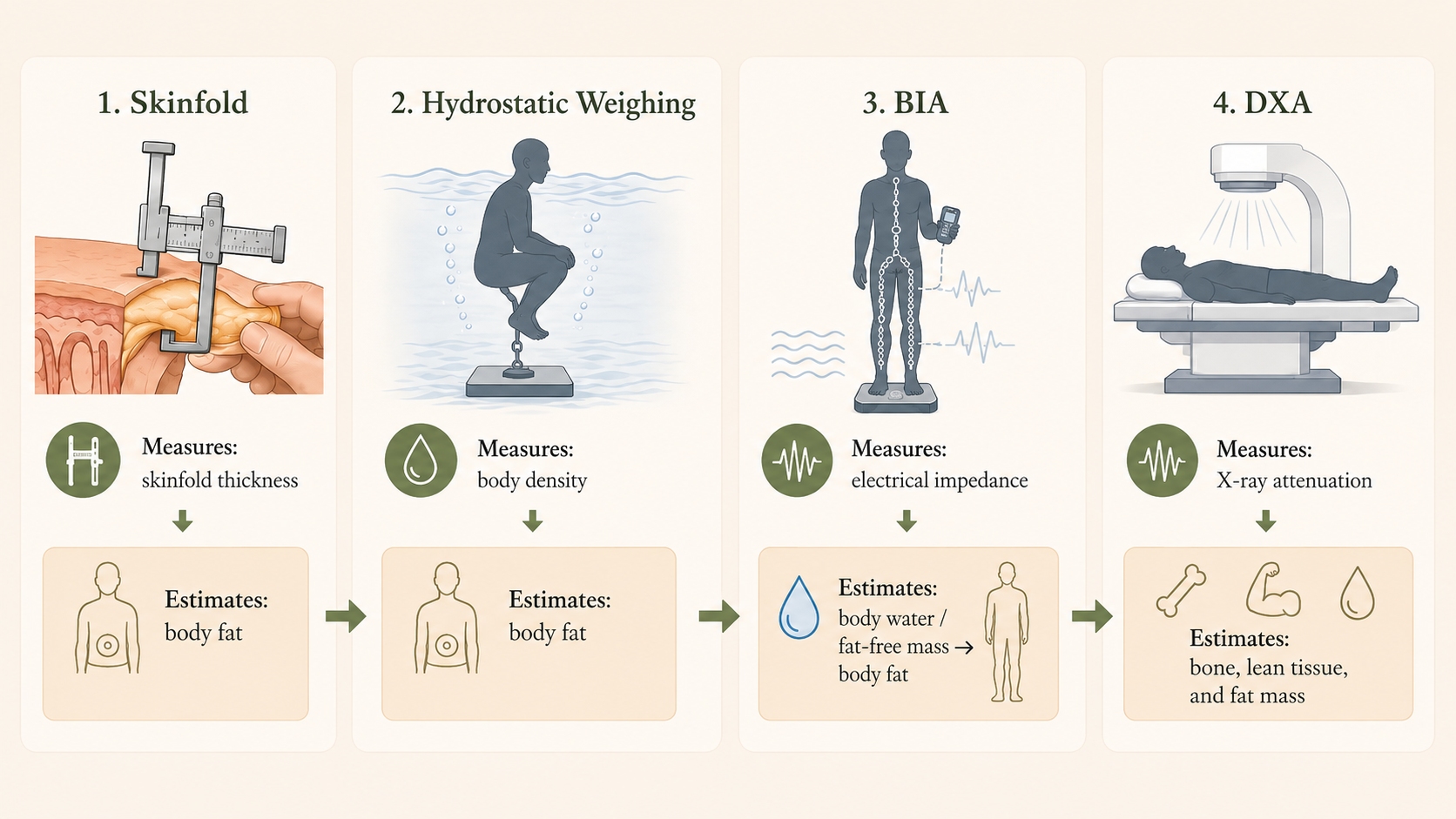
Skinfold testing is one relatively inexpensive and portable way to estimate body fat. A trained assessor uses calipers at standardized body sites to measure folds that include both skin and subcutaneous fat. Those measurements are then entered into validated prediction equations to estimate body fatness. Skinfold testing can provide reasonably accurate estimates when it is performed by a skilled assessor using an appropriate equation, but its accuracy depends on the assessor, the equation chosen, and the population for which that equation is suitable .1
Hydrostatic weighing takes a different approach by estimating whole-body density. A person’s body mass on land is compared with their apparent weight while submerged, allowing body volume to be estimated from water displacement. The calculation also accounts for air remaining in the lungs because trapped air affects apparent underwater volume. Body density is then converted into an estimate of body fat using a model that assumes characteristic densities for fat mass and fat-free mass. Those assumptions are useful, but they are not perfectly constant across every individual or population .1
Bioelectrical impedance analysis, or BIA, uses the electrical properties of body tissues to estimate body composition. A small electrical current is applied and the body’s impedance to that current is measured. Because water and electrolytes strongly influence electrical conduction, the measurement can be used with prediction equations to estimate quantities such as total body water and fat-free mass, from which body-fat estimates can be derived. The result depends on the device, prediction model, and assumptions about body hydration, so factors such as recent food intake, exercise, and hydration status can influence the estimate .1
DXA uses two X-ray energy levels and examines how differently those X-rays are attenuated as they pass through body tissues. From those attenuation differences, DXA estimates bone mineral content, lean soft tissue, and fat mass. DXA can provide highly reproducible body-composition estimates under standardized conditions, but the values are not assumption-free or perfectly interchangeable across devices and protocols. Scanner model, software, positioning, and testing conditions can influence the result. Like the other methods, it uses a particular measurement principle and an analytical process to estimate body composition rather than providing a perfectly direct reading of body fat .1,2
A body-fat percentage is not completely separate from the method that produced it. Two methods can give somewhat different answers without either result necessarily being meaningless, because each is translating a different physical measurement into an estimate of body composition. For that reason, the number is most useful when the method, testing conditions, and expected measurement error are kept in view, especially when changes are being compared over time.
Join the discussion
No account or email is required. Your display name and comment will be public.