
Body mass index (BMI) is often treated as a compact summary of body size and health risk. It can provide useful information, but the number has clear limits. Understanding what goes into BMI, and what does not, helps explain why it can be informative without providing a complete assessment of an individual’s health or body composition.
BMI is calculated as weight in kilograms divided by height in meters squared. For adults, it provides a simple and inexpensive screening measure of weight relative to height and is commonly used to assign BMI categories .1
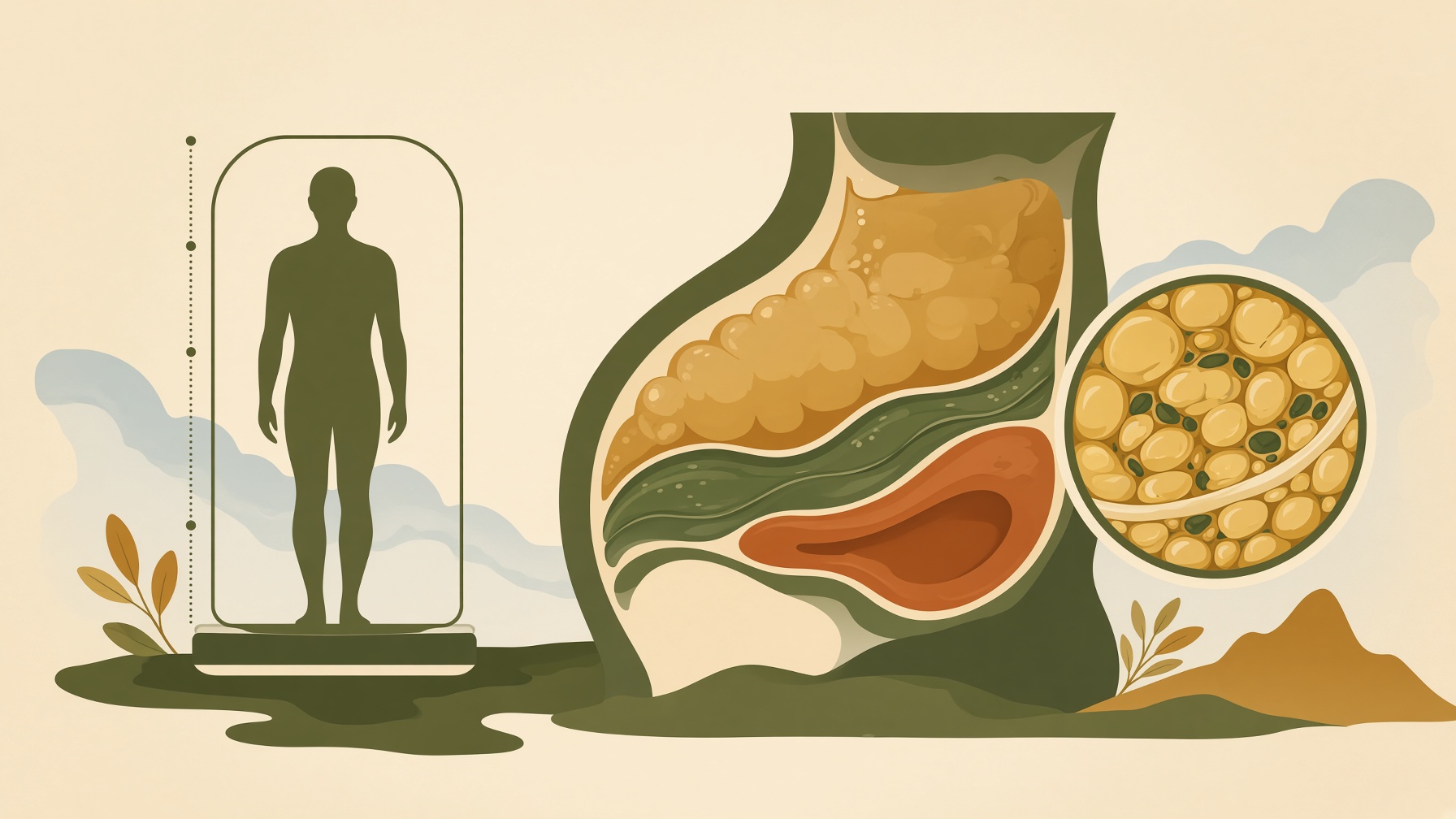
BMI also has health relevance because BMI categories are associated with the risk of several health conditions across populations. At the individual level, however, BMI is better treated as one screening indicator rather than a precise prediction of disease risk. BMI does not directly measure body fat and cannot distinguish fat mass from muscle, bone, or other components of body weight. It also provides no information about where body fat is distributed .1
Muscularity provides a clear example of this limitation. A person with substantial muscle mass can sometimes have a BMI in the overweight or obesity category despite having relatively low body fat. The reverse can also occur: a person can have a BMI within a lower category while having relatively low muscle mass or a body-fat distribution that BMI does not capture. These examples show why BMI can provide an incomplete picture when applied to an individual. Other information, such as waist measurements, body-composition data, blood pressure, laboratory findings, and health history, can provide context that BMI alone cannot .1,2
BMI is most useful when it is treated as one piece of information rather than as a verdict about a person’s body or health. Its simplicity is exactly what makes it practical, but that same simplicity means important differences in body composition and fat distribution remain invisible. The number becomes more informative when its limits are kept in view.

Join the discussion
No account or email is required. Your display name and comment will be public.