
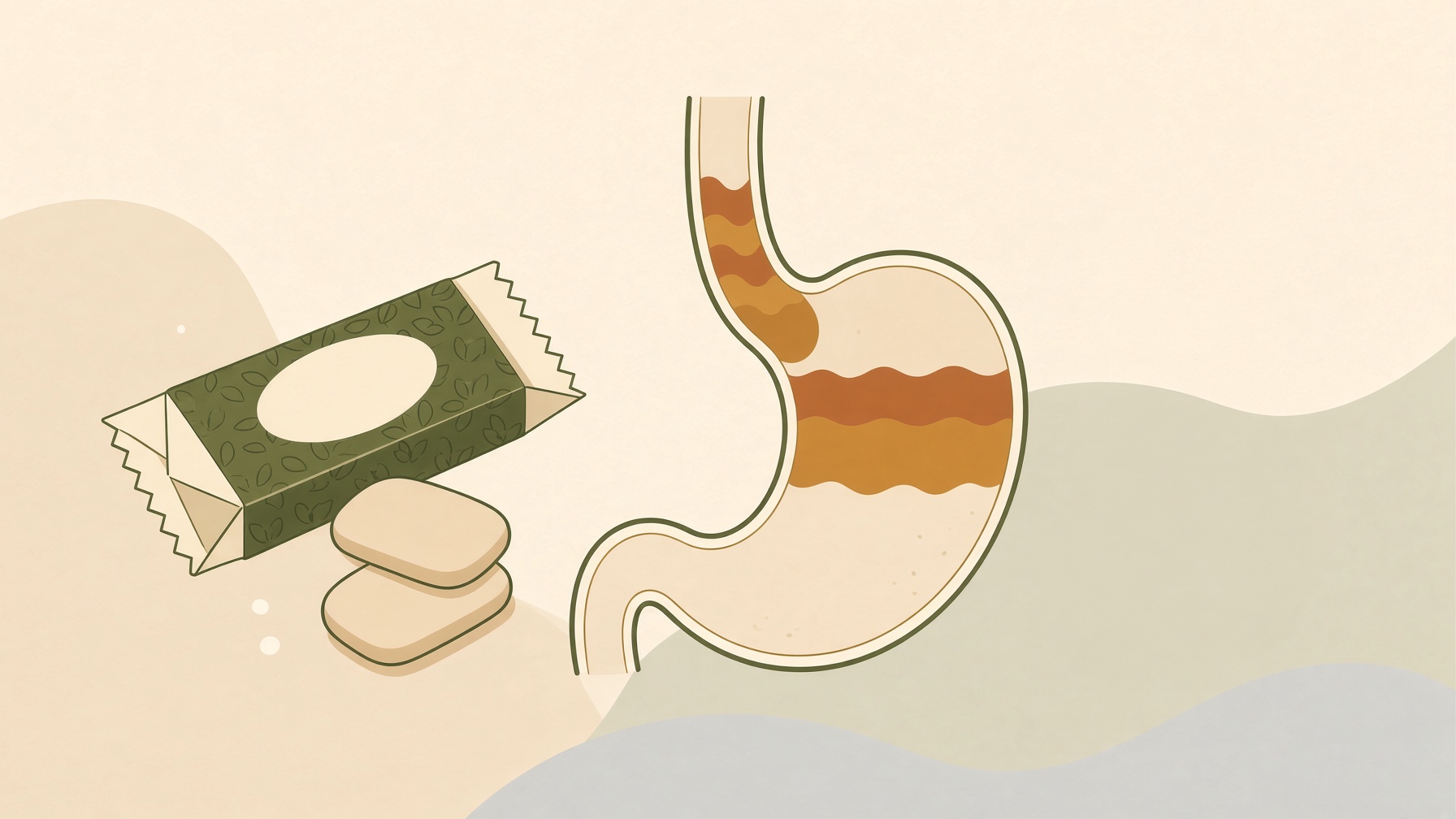
“Less reflux” can sound like a straightforward benefit of chewing gum after a meal. But what would count as less: fewer entries of stomach contents, less time exposed to acid, or less discomfort? The phrase leaves the question open.
The clearest change was in time spent acidic. Thirty-one adults with reflux symptoms ate the same standardized high-fat meal on two occasions, chewing sugar-free gum for 30 minutes afterward on one occasion and resting without gum on the other. The order was randomized, and participants acted as their own controls. Acidity was tracked in the lower esophagus, the food pipe connecting the mouth and stomach. The main measure was the percentage of the next two hours during which its pH was below 4. The group median was 5.7% without gum and 3.6% with gum. Those figures describe the two conditions, not the improvement experienced by every participant or a personal prediction.1
The number of acid episodes also fell, and the longest episode was shorter with gum. The median count was two without gum and one with gum; the median longest episode lasted eight minutes without gum and six with gum. These were separately measured outcomes, rather than conclusions inferred from the exposure-time result. Yet the episodes were identified by pH: they counted occasions meeting an acidity criterion, not every backward entry of stomach contents. Neutralizing acid can affect whether an entry is detected by that criterion. The trial used no impedance monitoring to detect reflux beyond the acidity signal, so fewer acid-defined episodes cannot establish that gum blocked entry.1
Once contents have entered, clearing them involves two distinct processes. Muscular waves move the bulk material onward, while swallowed saliva helps neutralize acid that remains. Physical removal and chemical neutralization offer ways to shorten an acidic period without blocking entry. Observations in 251 healthy people linked swallow-induced muscular waves after reflux to shorter chemical clearance, meaning a shorter time for pH to recover. Those recordings support the plausibility of a saliva-and-swallowing explanation, but came from a separate group who were not assigned gum or a saliva intervention. The association did not establish a causal pathway.2
The gum comparison did not measure saliva flow or swallowing frequency, so it cannot show that either explained the reduction in acid exposure. The relative contributions of entry, physical clearance and neutralization remain unresolved. Only nine participants reported heartburn during the test periods. The symptom index, the proportion of reported symptoms coinciding with pH below 4, did not differ significantly between conditions. It was not a direct measure of symptom severity, and neither that result nor two hours of acidity monitoring establishes lasting relief. The selected symptomatic sample and test meal limit generalization to healthy people eating everyday meals.1,2
Return to the promise that made chewing gum sound appealing: what did you hope “less reflux” would mean? Keep that question in view when reading the results. A useful answer should speak to the concern that brought you to the article.

Join the discussion
No account or email is required. Your display name and comment will be public.